Understanding Entity AI Pathfinding Limitations
Did you know that even the simplest Minecraft mob, from a lumbering zombie to a bustling villager, relies on a sophisticated A\* graph search algorithm to navigate its blocky world? While this underlying system is remarkably effective for generating dynamic gameplay, it’s far from perfect. Understanding the inherent limitations and unique quirks of Minecraft’s entity AI pathfinding is not just an academic exercise; it’s a critical skill for any player looking to design efficient farms, secure bases, or clever traps. Ignoring these nuances can lead to frustrating inefficiencies, wasted resources, and unexpected mob behavior that undermines your carefully laid plans.
Core Mechanics of Minecraft AI Navigation
At its heart, Minecraft’s entity AI employs a modified version of the A\* graph search algorithm to determine paths. This algorithm is a cornerstone of intelligent navigation in many digital environments, allowing entities to find the most efficient route from one point to another while considering various factors. For mobs in Minecraft, this process is dynamically engaged when they are within a certain proximity to a player, typically around 32 blocks. Beyond this range, the initial burst of active pathfinding often gives way to more random movement patterns after a brief period, especially following their initial spawn.
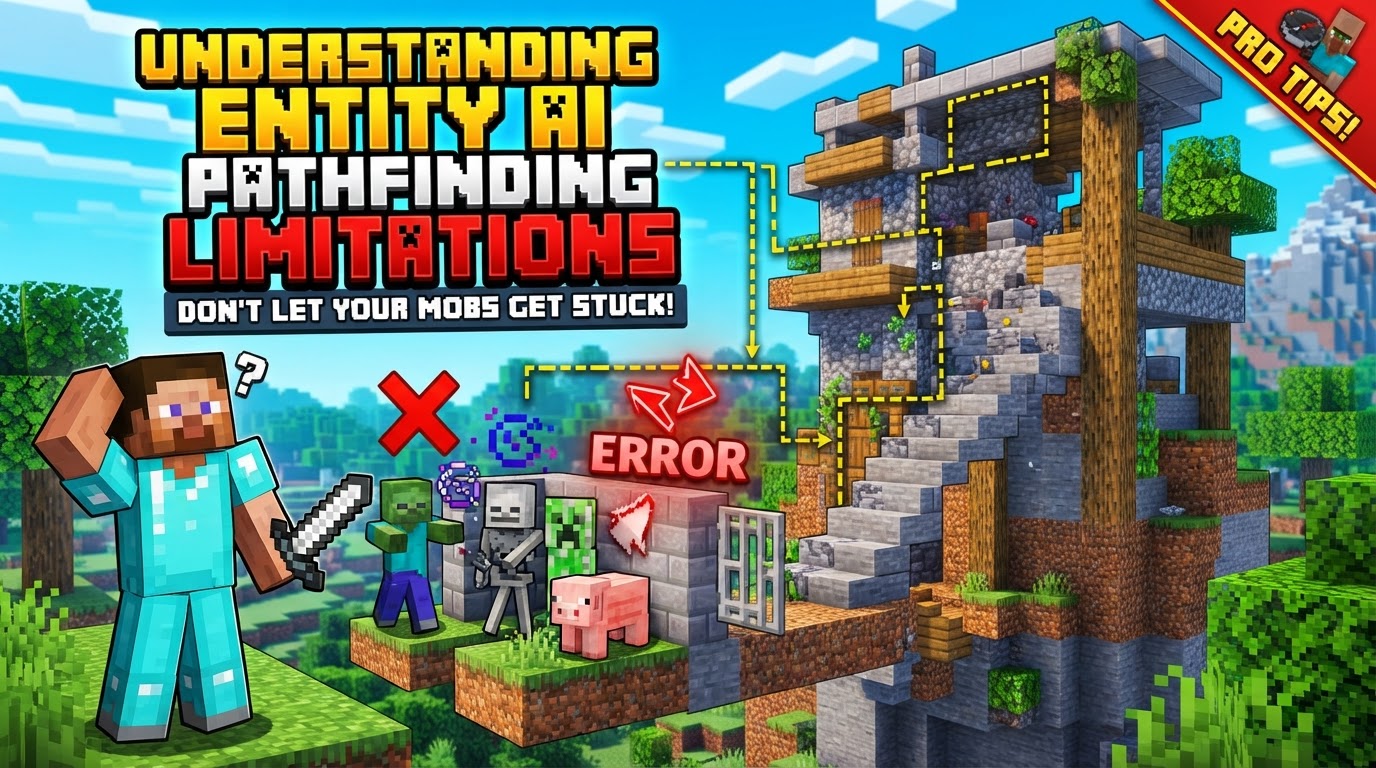
The pathfinding algorithm doesn’t just look for the shortest route; it also evaluates “path costs” and block “malus,” which are essentially penalties associated with different actions or specific block types. For instance, jumping up a block generally incurs a higher cost than simply walking across a flat surface, influencing the chosen route. Entities also possess defined movement speeds, types (such as walking, swimming, or flying), and specific navigation abilities, all governed by various internal components, including `minecraft:preferred_path` settings that dictate their preferred movement styles.
Intriguingly, mob AI can sometimes perceive certain blocks differently than a player would. A prime example is an open trapdoor; the AI often registers it as a solid, walkable surface, even though it provides no actual support. This specific misperception is a widely exploited mechanic in many farm designs. Another peculiar behavior involves villagers and iron golems: if a village is completely destroyed, perhaps by the removal of all beds, these entities may initiate long-range pathfinding towards the world’s origin point (0,0,0) from significant distances.
The Algorithmic Journey: How Mobs Find Their Way
The process of an entity navigating its environment can be conceptualized as a three-step sequence:
- An entity first identifies a target it needs to reach. This target could be a player it’s aggressive towards, a workstation it needs to interact with, or a specific location it’s programmed to move towards.
- Once a target is established, the pathfinding system springs into action. Utilizing the A\* algorithm, it generates a sequence of walkable blocks that form a path from the entity’s current position to its desired destination. This generation involves a continuous evaluation of the “cost” associated with moving through or over various blocks in the environment.
- Finally, the entity attempts to execute this calculated path. Its movement is then adjusted in real-time based on its inherent physical abilities (can it fly? can it climb? how fast can it move?) and any immediate environmental factors it encounters.
General Obstacles and Environmental Confusions
Despite the sophistication of the A\* algorithm, entities frequently encounter situations where their pathfinding fails or becomes inefficient. One common issue is when entities become stuck due to unrecognized obstructions. Blocks like bamboo, for example, can sometimes be overlooked by the pathfinding system, leading mobs to attempt to walk through them repeatedly and get trapped.
Furthermore, pathfinding is inherently restricted by an entity’s physical capabilities. A non-flying mob, such as a zombie or a cow, simply cannot pathfind to an airborne location, regardless of how clear the direct line of sight might be. Similarly, complex or poorly designed environments are major culprits for mob confusion. Structures with missing support blocks, confusingly branched paths, or intricate layouts without clear, accessible routes can easily overwhelm the pathfinding AI, leading to mobs getting stuck, wandering aimlessly, or failing to reach their intended destinations.
Bedrock Edition’s Unique Pathfinding Quirk
While some pathfinding limitations are universal across Minecraft editions, Bedrock Edition notoriously suffers from a specific set of bugs and quirks that significantly impact mob behavior, particularly for villagers:
- Villager Frustration: Villagers in Bedrock Edition frequently struggle to reach their assigned workstations and beds. Even when paths appear clear and unobstructed in vanilla structures, they often fail to navigate correctly, leading to disruptions in trading cycles and job assignments.
- Structural Misinterpretations: Mobs may ignore obvious entrances to buildings or persistently pathfind to incorrect sides of structures, even when a direct, unobstructed path is available.
- Block Navigation Failures: Entities can surprisingly fail to pathfind over specific block types. This includes lower slabs that lack a full block directly underneath them, creating an invisible barrier, and waterlogged blocks which the AI sometimes misinterprets as impassable.
- Turtle Egg Immunity: A significant difference from Java Edition is that undead mobs (like zombies and skeletons) in Bedrock Edition currently do not pathfind towards or break turtle eggs. This breaks many common farm designs that rely on this behavior to attract and collect undead mobs.
- Immune but Stuck: Wither skeletons and Zombie Pigmen, despite being immune to fire and magma block damage, can get stuck on these blocks. They continuously spin in place as if taking damage, creating visual glitches and pathfinding dead ends.
- Bedlock: Villagers frequently become stuck on top of beds, preventing them from properly unlinking from their current bed and workstation or restocking their trades, severely hindering automated trading halls.
- Trapdoor Traps: Mobs can also get temporarily stuck on trapdoors, especially when these blocks are used in complex pathing systems.
Leveraging AI Behavior for Your Advantage
Understanding these limitations and mechanics isn’t just about avoiding pitfalls; it’s also about exploiting them to your benefit:
- Trapdoor Tricks: Exploit the mob AI’s perception of open trapdoors as solid surfaces. By placing open trapdoors strategically, you can create invisible barriers or guiding paths that mobs will attempt to walk across, leading them into specific collection areas for farms.
- Manipulating Path Costs: By understanding the concept of block “malus” or path costs, you can subtly influence mob paths. For example, placing blocks that incur a higher movement cost in undesirable routes can compel mobs to prefer a lower-cost, desired route.
- Aggressive Markers: For long-range pathing, especially for hostile mobs, compelling an entity to be aggressive towards a “marker” entity (like a villager or another mob) placed at your desired destination can effectively guide it over significant distances. The hostile mob will continuously try to pathfind towards its perceived target.
- Block Experimentation: Don’t be afraid to experiment with different block types in critical pathing areas. Sometimes, simply replacing a block like a grass path with a solid block such as stone can resolve pathfinding failures for villagers or other mobs that are struggling to navigate a particular section.
Mastering the Digital Maze
Minecraft’s entity AI pathfinding, while a marvel of procedural generation, is a system with distinct rules and noticeable vulnerabilities. By internalizing how the A\* algorithm functions, recognizing the impact of path costs and block perceptions, and being aware of the specific bugs that plague editions like Bedrock, players gain an invaluable advantage. Whether you’re constructing an intricate mob grinder, designing an efficient villager trading hall, or simply trying to keep your animals from wandering off, a deep understanding of these pathfinding limitations is the key to building successful and resilient structures in your blocky world.
Tags:
YOU MAY ALSO LIKE...