

Understanding Mob Pathfinding Around Obstacles Precisely
Many Minecraft players assume mobs will always avoid visually non-solid blocks like open trapdoors. However, this common misconception can lead to inefficient mob farms and flawed defenses, as mobs frequently perceive these blocks as solid walking surfaces. Understanding the intricate logic behind mob movement is not just a curiosity; it’s a fundamental skill for any serious builder or survivalist. Beneath the seemingly random wanderings lies a sophisticated, albeit sometimes quirky, pathfinding system that can be manipulated to great effect.
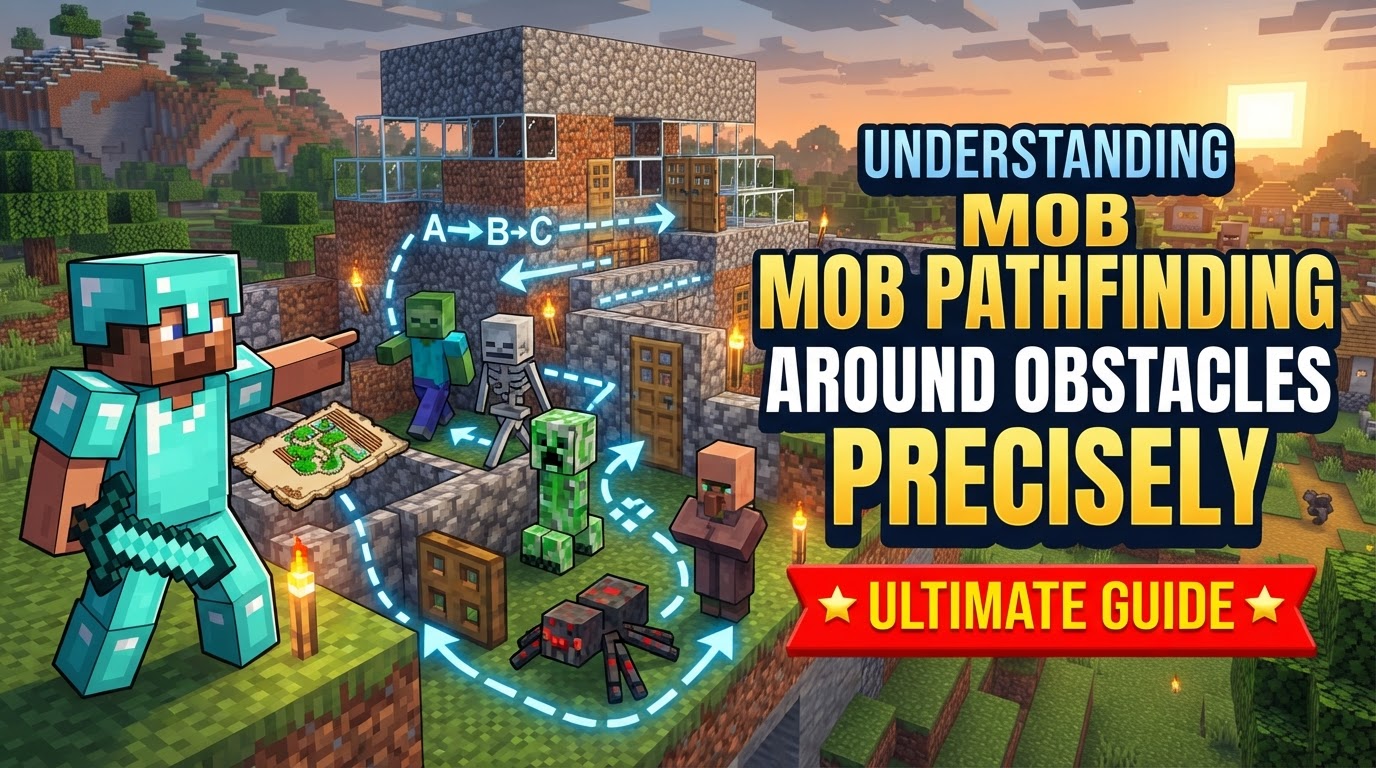
The Core Mechanics of Mob Pathfinding
At its heart, Minecraft’s mob pathfinding operates on a modified A* graph search algorithm. This powerful system doesn’t just look for a direct line to a target; instead, it meticulously calculates “path costs” for various routes, seeking the most efficient one. Every block a mob considers stepping on has an associated cost, and certain blocks can even impose a “malus” or penalty, making that path less desirable.
- Directional Biases: Mobs aren’t entirely neutral in their choices. They exhibit a subtle yet significant bias towards traveling in the negative X and Z coordinates when making pathfinding decisions. This means if given two equally viable paths, one leading slightly more towards negative X/Z and the other towards positive X/Z, they are more likely to choose the former.
- Altitude Preference: Another critical bias is their inclination towards higher altitudes or areas with more solid blocks directly beneath them. This often results in mobs pathfinding uphill or crowding onto elevated platforms. This “weight” of blocks in a particular direction plays a role; a slope with many solid blocks offers a more appealing path than an empty void.
- Perceived Solidity: This is where many players get tripped up. Mobs don’t always see the world as you do. Blocks that appear non-solid, such as open trapdoors, slabs, or stairs, are often perceived by mobs as solid walking surfaces. They will confidently attempt to walk across them. On Bedrock Edition, this extends even to seemingly fragile items like coral fans, which mobs can perceive as solid.
- Random Wanderings: While seeking a specific target, mobs also engage in random pathfinding when within a certain proximity to a player, typically around 32 blocks. This adds an element of unpredictability but still adheres to the underlying pathfinding rules when obstacles are encountered.
The Step-by-Step Pathfinding Process
To truly master mob manipulation, it’s essential to grasp the sequence of events that dictates a mob’s movement:
- Target Selection: Every journey begins with a destination. A mob first identifies its target. This could be a player (for hostile mobs), a specific block (like a workstation for a villager), another mob (e.g., a zombie targeting a villager), or simply a random point in the world if it’s wandering aimlessly.
- Path Evaluation: Once a target is set, the mob’s internal pathfinding algorithm springs into action. It evaluates potential paths to this target. This evaluation considers numerous factors: the solidity of blocks, the height changes required, and other “costs” associated with different block types or movements. For instance, jumping might incur a higher cost than walking on level ground.
- Path Choice: After evaluating multiple routes, the mob selects the path with the lowest calculated “cost.” Alternatively, it might choose a path with the highest “weight,” such as a route offering more solid blocks or perceived fewer obstacles, leveraging its inherent biases.
- Navigation: With a chosen path in mind, the mob then attempts to move along it. This involves interacting with perceived obstacles, utilizing movement abilities like jumping over small gaps or climbing single blocks, and adjusting its trajectory as needed.
Strategic Manipulation: Guiding Mobs Precisely
Understanding these mechanics empowers you to design highly efficient mob farms, intricate defenses, and custom mob-transport systems. Here’s how to put that knowledge into practice:
- Trapdoor Exploitation: This is perhaps the most versatile trick. By placing open trapdoors, slabs, or stairs, you can create invisible barriers or perceived solid paths. Mobs will walk onto an open trapdoor as if it were a full block, allowing you to funnel them into specific drops, pits, or water streams. Similarly, a half-slab positioned correctly can create a perceived solid surface that mobs will walk on, while a player can fall through.
- Guiding with Solid Blocks: Mobs are drawn to solid ground. By constructing large volumes of solid blocks in the direction you want mobs to travel, you significantly increase the likelihood of them pathfinding towards those areas. This is especially effective in mob farms where you want to encourage movement towards a central collection point.
- Attraction Entities: Leverage the natural behaviors of certain mobs. For example, creepers are afraid of cats and will pathfind away from them, while zombies are attracted to villagers. In Bedrock Edition, you can also utilize “marker entities” to subtly influence mob pathfinding, though this is a more advanced technique.
- Exploiting Biases for Funneling: Design your structures to capitalize on the mob’s inherent biases. Build collection points slightly in the negative X and Z directions from where mobs spawn to encourage movement towards them. Similarly, utilize ramps and elevated platforms to guide mobs uphill, funneling them into specific areas due to their preference for higher altitudes.
Common Pitfalls and Misconceptions
Even with a solid understanding, mistakes are common. Being aware of these pitfalls can save you countless hours of troubleshooting:
- Ignoring Perceived Solidity: As mentioned, this is a major one. Assuming mobs will avoid visually non-solid blocks like open trapdoors or transparent blocks can lead to mobs getting stuck or taking unexpected detours, rendering your designs ineffective. Always test how mobs interact with such blocks.
- Overly Complex Paths: While the A* algorithm is powerful, it has limits. If the path to a mob’s target is too long, too intricate, or has too many confusing turns and obstacles, mobs can get stuck, wander aimlessly, or simply fail to find the intended route. Keep paths as simple and direct as possible for optimal efficiency in farms and defenses.
- Bedrock Edition Bugs: Bedrock Edition frequently experiences unique pathfinding quirks. Villagers and golems, in particular, are known to exhibit unexpected behaviors around obstacles, sometimes failing to navigate efficiently or getting stuck in seemingly open spaces. Always account for these platform-specific inconsistencies.
- Large Mob Pathfinding Issues: Larger mobs, such as ravagers or even larger variants of zombies, often struggle more with the vanilla pathfinding system. They can be particularly erratic when moving in negative X and Z directions, sometimes getting stuck on corners or failing to navigate tight spaces that smaller mobs would clear easily.
- Altitude Crowding: The bias towards higher altitudes can lead to mobs crowding and pushing on top of the same elevated spot. While sometimes useful for specific traps, this can also disrupt farm designs by preventing mobs from spreading out or falling into collection points as intended. Careful spacing and additional funneling mechanisms may be required.
Mastering mob pathfinding is an ongoing process of observation, experimentation, and design. By internalizing these core mechanics, biases, and common pitfalls, you equip yourself with the knowledge to build truly intelligent and efficient structures in your Minecraft world.
Tags:
YOU MAY ALSO LIKE...


