

Understanding Sculk Catalyst Experience Conversion
Did you know that the Deep Dark holds a secret not just of ominous danger, but also of unparalleled resource generation and experience storage? While the Ancient Cities are infamous for the fearsome Warden, they also house a block that can fundamentally change how you gather experience and materials: the Sculk Catalyst. Understanding its unique mechanics is key to harnessing its power, transforming mob farms from mere grinders into sophisticated experience banks and automated resource generators.
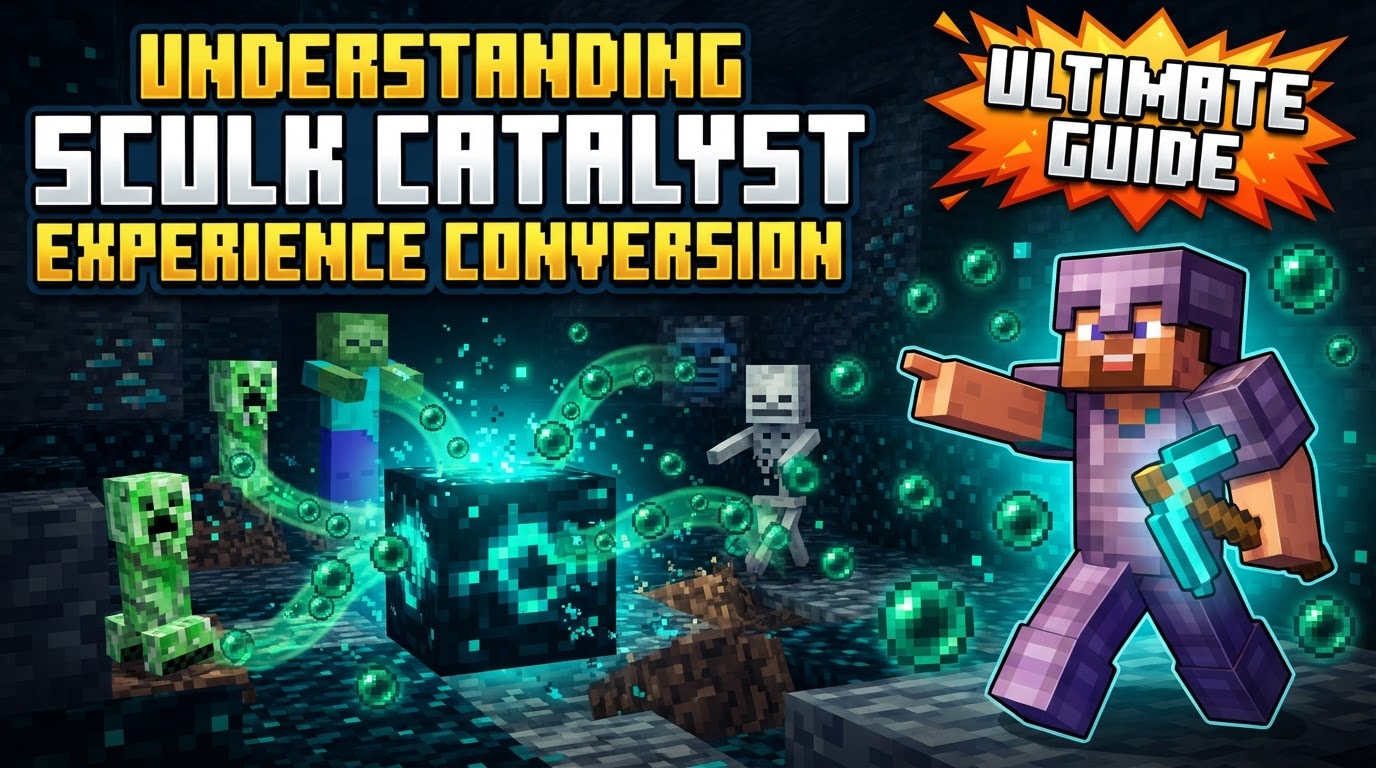
The Sculk Catalyst: A Block of Transformation
At its core, the Sculk Catalyst is an active block found deep within the unsettling biomes of the Deep Dark and Ancient Cities, typically around Y: -52. It functions as an alchemist, converting dead mobs’ experience points into tangible Sculk blocks. However, obtaining this powerful block requires precision: it must be harvested with a Silk Touch enchanted tool. Attempting to mine a Sculk Catalyst without Silk Touch will cause it to break, yielding only 20 experience points instead of the block itself, a common and frustrating mistake for many adventurers.
The Alchemy of Experience: How it Works
The true magic of the Sculk Catalyst unfolds when a mob that drops experience dies within its effective range. This range is a generous 8-block spherical radius around the catalyst. Upon a mob’s demise, the catalyst consumes the experience points that the mob would normally drop, including those from a fallen player. In exchange, it initiates a profound transformation of nearby blocks.
The conversion process is dynamic: the catalyst transforms surrounding blocks into various Sculk variants. The most common outcome is basic Sculk, but there’s also a 9% chance for a Sculk Shrieker and a 1% chance for a Sculk Sensor to generate. It’s crucial to note that Sculk Shriekers generated by a Sculk Catalyst are distinct from their naturally occurring counterparts; they cannot summon a Warden, regardless of how many times they are activated, making them safe for automation setups. If a block cannot be converted into a Sculk variant (such as obsidian or ores), it will instead be covered with aesthetic Sculk Veins.
The extent of this Sculk spread is directly proportional to the experience points the dying mob would normally drop. A mob yielding more XP will result in a larger area of Sculk conversion. Furthermore, the method of a mob’s death-whether by player, fall damage, or even lava-does not affect the catalyst’s activation. Once converted, these Sculk blocks become a valuable resource themselves; when mined, they drop experience, effectively turning the Sculk Catalyst into a highly efficient method for bulk experience storage.
Constructing Your Sculk Farm: A Step-by-Step Approach
Integrating a Sculk Catalyst into your operations can revolutionize your resource gathering. Here’s a basic guide to setting up your own Sculk farm:
- Obtain Your Sculk Catalyst: As mentioned, travel to the Deep Dark or Ancient Cities. Locate a catalyst and carefully mine it with a Silk Touch pickaxe. Without this crucial enchantment, you’ll only get 20 XP.
- Set Up a Mob Farm: You’ll need a reliable source of experience-dropping mobs. This can be any standard mob farm design, such as a dark room mob spawner, a zombie/skeleton spawner farm, or even a guardian farm. The key is to funnel mobs to a designated kill zone.
- Place the Catalyst Strategically: Position the Sculk Catalyst within the mob farm’s killing area. Remember, its influence extends in an 8-block spherical radius. Ensure mobs will consistently die within this zone for the catalyst to activate.
- Implement a Killing Mechanism: Mobs must die within the catalyst’s range. Common methods include fall damage traps (calibrated to leave mobs at 1 health for player kills, or full damage for automated systems), lava blades, or even manual killing by the player.
- Provide Replaceable Blocks: The catalyst needs material to convert. Surround the catalyst and its activation zone with easily convertible blocks like dirt, stone, or cobblestone. Avoid hard blocks like obsidian or any ore blocks, as these cannot be converted and will only receive Sculk Veins.
- Harvest Your Yield: Once Sculk blocks have generated, you can mine them. If you break them without Silk Touch, they will drop experience points, allowing you to retrieve your stored XP. If you wish to collect the Sculk blocks themselves for building or other purposes, use a Silk Touch tool.
Beyond Basic Sculk: Advanced Strategies and Benefits
The utility of the Sculk Catalyst extends far beyond simple experience conversion. Its unique properties open up numerous possibilities for efficient gameplay:
- Unrivaled XP Storage: Sculk farming is arguably the most efficient way to store vast amounts of experience. Instead of keeping it on your player, where it’s lost upon death, you can convert it into Sculk blocks and retrieve it at your leisure by mining them. This provides a robust safety net for your hard-earned XP.
- Sustainable Resource Generation: Beyond basic Sculk, the catalyst allows for sustainable farming of Sculk Sensors and Sculk Shriekers. This eliminates the need to constantly venture into dangerous Deep Dark biomes for these specific blocks, providing a steady supply for your redstone projects or decorative needs.
- Controlled Growth: The direct proportionality between a mob’s XP drop and the Sculk spread allows for a degree of control. By selecting mobs with specific XP values, you can influence the size and density of the Sculk growth, tailoring it to your needs.
- Automation Potential: The Sculk Catalyst is a prime candidate for full automation. Combine it with an automated mob farm and a cobblestone generator (to constantly provide replaceable blocks), and you can create a fully autonomous system for both Sculk block production and bulk experience storage.
- Redstone Integration: The Sculk Sensors generated by the catalyst are invaluable for Redstone contraptions. Their ability to detect vibrations makes them central to advanced automated systems, from automatic doors to complex sorting machines, adding another layer of utility to your Sculk farm.
Navigating the Deep Dark’s Nuances: Common Errors to Avoid
While the Sculk Catalyst is powerful, several common pitfalls can hinder its effectiveness or lead to frustration. Being aware of these can save you time and resources:
- Ignoring Silk Touch for Catalyst: This is perhaps the most frequent mistake. Always, always use a Silk Touch enchantment when mining the Sculk Catalyst itself. Without it, you’ll destroy the block and only gain 20 XP.
- Mobs Dying Out of Range: The catalyst’s 8-block spherical radius is strict. If mobs die even one block outside this zone, the catalyst will not activate, and no Sculk will spread. Precision in your farm design is key.
- Lack of Replaceable Blocks: The catalyst needs suitable blocks to convert. If there are no blocks like dirt, stone, or cobblestone within its range, it simply cannot spread. Hard blocks like obsidian, bedrock, or ore blocks are immune to conversion and will only be covered in Sculk Veins.
- Expecting Warden Spawns: A common misconception is that catalyst-generated Sculk Shriekers will summon a Warden. They will not. These Shriekers are purely for aesthetic or Redstone purposes and pose no threat of summoning the terrifying guardian of the Deep Dark.
- Using Mobs That Don’t Drop XP: The catalyst specifically consumes experience. Mobs that do not naturally drop experience points, such as baby mobs or certain entities, will not activate the catalyst upon death.
- Mobs Dying on Non-Full Blocks: For optimal spread, ensure mobs die on solid, full blocks. If a mob dies on a non-solid block like pointed dripstone or a pressure plate, the Sculk Catalyst may fail to spread effectively, or at all.
Mastering the Sculk Catalyst transforms your approach to resource management in Minecraft. By understanding its mechanics, building efficient farms, and avoiding common errors, you can unlock an unparalleled system for experience storage and the sustainable generation of valuable Deep Dark resources. This often-overlooked block truly is a game-changer for any serious Minecraft player.
Tags:
YOU MAY ALSO LIKE...


