

Understanding Sculk Sensor Frequency Accuracy
A single footstep in Minecraft generates a distinct vibration frequency of 1, while a powerful explosion resonates at frequency 15. Understanding these precise numerical values and how Sculk Sensors interpret them is the cornerstone of advanced redstone automation. The accuracy of Sculk Sensor frequency detection is not just a technical detail; it’s the key to building intricate, reliable systems that respond exactly as intended, filtering out the chaotic noise of the Minecraft world.
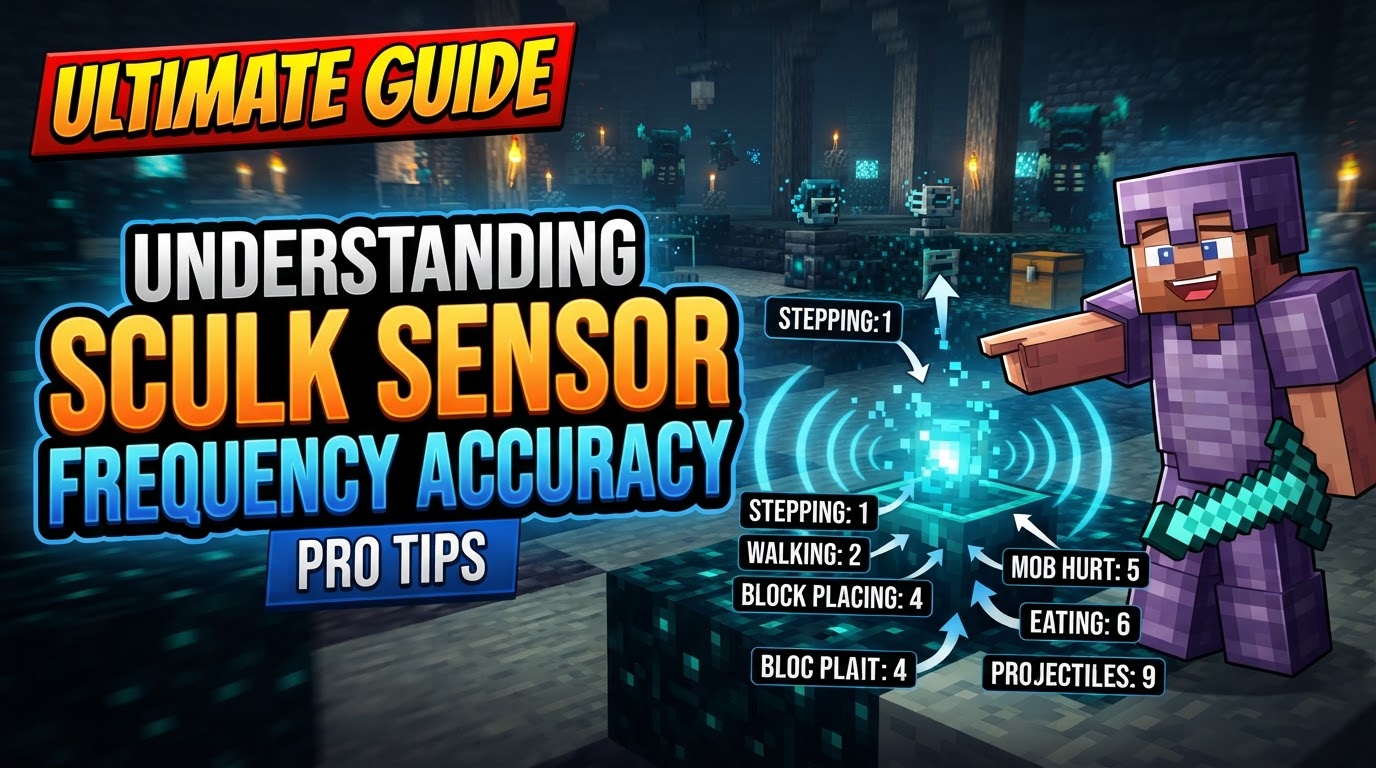
Sculk Sensors, introduced in the Wild Update, revolutionized redstone by offering a new method of detection based on vibrations. These enigmatic blocks, originating from the Deep Dark biome, perceive a wide array of in-game events, from the most subtle movements to the most destructive forces. While initially seeming like simple on/off switches, their true power lies in their ability to differentiate between these events by assigning them unique frequency values, which directly correspond to a redstone signal strength from 1 to 15. Mastering this frequency-to-signal relationship transforms random detection into intelligent, event-specific automation.
The Core Principle: Vibration Frequencies and Redstone Signals
At its heart, a Sculk Sensor operates as a vibration detector. When an event occurs within its range, it generates a vibration. This vibration isn’t just a generic pulse; it carries a specific frequency value. For instance, a player walking or placing a block emits a low frequency, typically 1 or 2, while more impactful events like a mob dying or a TNT explosion register at the highest frequency, 15. A regular Sculk Sensor, upon detecting any vibration, will emit a redstone pulse matching that specific frequency’s signal strength. This means if a footstep (frequency 1) is detected, it outputs a redstone signal of strength 1. If an explosion (frequency 15) occurs, it outputs a signal of strength 15. While this provides basic information, it also means a regular sensor will activate for any detected event, potentially leading to unintended triggers and an inconvenient cooldown period.
Unlocking Precision: The Calibrated Sculk Sensor
For true accuracy and sophisticated automation, the regular Sculk Sensor’s broad detection capabilities often fall short. This is where the Calibrated Sculk Sensor becomes indispensable. This advanced variant is designed for selective detection, allowing builders to filter out unwanted vibrations and respond only to specific events. Crafting one is straightforward: combine one Sculk Sensor with three Amethyst Shards in a crafting grid. The result is a block that retains the vibration-sensing capabilities but introduces a crucial tuning mechanism.
The advantages of the Calibrated Sculk Sensor extend beyond mere filtering. It boasts an impressive detection range of 16 blocks, double that of a regular Sculk Sensor’s 8 blocks, allowing for monitoring larger areas. Furthermore, its cooldown period is significantly shorter, at just 1 second compared to the regular sensor’s 2 seconds. This reduced cooldown means the calibrated version can detect and react to subsequent events much more rapidly, making it ideal for systems requiring quick, successive activations without missing critical triggers.
Mastering the Tuning Process: Filtering for Specific Events
The defining feature of the Calibrated Sculk Sensor is its ability to be tuned to a single, specific vibration frequency. This process requires a precise redstone input into its “crystalized side” – the side of the block that displays an amethyst texture. The strength of the redstone signal fed into this side dictates the exact frequency the sensor will listen for, ignoring all other vibrations within its range.
To achieve this precise tuning, several methods are commonly employed:
- Lecterns with Books: A lectern with a book placed upon it can output a redstone signal strength from 1 (first page) to 15 (last page). By placing a book on a specific page, you can generate the exact signal strength required to tune your sensor. For example, to tune a sensor to detect only footsteps (frequency 1), you would place a book on page 1 of a lectern and route its comparator output into the calibrated sensor.
- Chests and Containers: The number of items inside a chest, barrel, or shulker box can also be used to generate specific redstone signal strengths when read by a comparator. A full chest outputs a signal of 15, while varying quantities of items can be meticulously arranged to achieve any signal from 1 to 14. This method requires careful calculation but offers a compact solution.
- Redstone Repeaters and Comparators: Combining repeaters and comparators in specific configurations can also generate precise signal strengths, though this often requires more space and intricate wiring compared to lecterns or item-filled containers.
Once tuned, the Calibrated Sculk Sensor becomes a highly specialized detector. It will only emit an output redstone pulse when it detects a vibration matching its set frequency, making your redstone contraptions far more reliable and immune to ambient noise or irrelevant player actions.
Maximizing Sensor Performance and Range
Beyond tuning, several techniques can enhance the accuracy and utility of both regular and calibrated Sculk Sensors:
- Strategic Wool Placement: Wool blocks are incredibly useful for managing Sculk Sensor detection. They act as vibration mufflers, preventing vibrations from reaching a sensor or passing through them. By strategically surrounding a sensor with wool or creating wool barriers between a sensor and unwanted vibration sources, you can create highly accurate, isolated detection zones. This is crucial for preventing false triggers from nearby activities.
- Amethyst Block Transmission: An often-overlooked feature is the ability of Amethyst blocks to transmit detected vibrations. Placing an Amethyst block adjacent to a Sculk Sensor allows the detected vibration to travel through the Amethyst block for up to 8 blocks. This effectively extends the “wireless” redstone capability of the sensor, allowing you to relay information over greater distances without direct redstone dust connections. While not increasing the sensor’s direct detection range, it expands the reach of its output.
- Exploiting Shorter Cooldowns: The Calibrated Sculk Sensor’s 1-second cooldown is a significant advantage for rapid event detection. In complex automated farms or security systems where multiple events might occur in quick succession, this faster reset time ensures that no critical vibration is missed, leading to more responsive and efficient designs.
Navigating the Pitfalls: Common Challenges and Solutions
Despite their power, Sculk Sensors present a few challenges that builders should be aware of:
- Regular Sensor False Triggers: The primary drawback of regular Sculk Sensors is their indiscriminate nature. They activate on any vibration within range, from a player eating food to a block breaking. This can lead to frequent false triggers and an extended cooldown that prevents the sensor from detecting the actual intended event. The solution, as discussed, is almost always to use a Calibrated Sculk Sensor for specific tasks.
- Obtaining Sensors in Survival: Acquiring Sculk Sensors in Survival mode is not trivial. They are found exclusively in the dangerous Deep Dark biome. Harvesting them requires a Silk Touch enchanted pickaxe. More importantly, navigating the Deep Dark demands extreme caution to avoid triggering Sculk Shriekers, which can summon the formidable Warden. Planning your mining expedition carefully and using wool to muffle your own vibrations is essential.
- Self-Activation: Standing directly on a Sculk Sensor, even while sneaking, will cause it to activate continuously. This is a common oversight that can disrupt redstone logic. Always ensure there is a block between you and the sensor, or stand a safe distance away when testing or operating nearby contraptions.
- Inconsistent Frequency Values: While most events have consistent frequency values, some actions can occasionally exhibit slight variations or be grouped together. For example, different types of drinks might not always register the exact same frequency, or a complex interaction might produce a cascade of vibrations. For highly specific, niche detections, careful in-game testing of the exact event you wish to detect is always recommended to confirm its frequency output before finalizing your redstone design.
In conclusion, understanding Sculk Sensor frequency accuracy is about moving beyond basic redstone and embracing a new dimension of control. By leveraging the specific frequency values of in-game events and mastering the tuning capabilities of the Calibrated Sculk Sensor, builders can create highly intelligent, robust, and precise automated systems. From intricate sorting mechanisms to sophisticated security alarms, the true potential of Sculk Sensors is unlocked when their vibrational language is fully understood and accurately harnessed.
Tags:
YOU MAY ALSO LIKE...


