

Understanding Sculk Spreading Speed Variation Precisely
A frequent misstep in managing Sculk is underestimating the profound impact of mob experience points (XP) on its propagation. Unlike many other natural block transformations in Minecraft, Sculk’s spread isn’t a fixed rate but a dynamic process directly scaled by the very essence of defeated creatures. Understanding this precise relationship is paramount for anyone looking to efficiently farm Sculk, harness its XP-generating properties, or simply control its eerie expansion within their world.
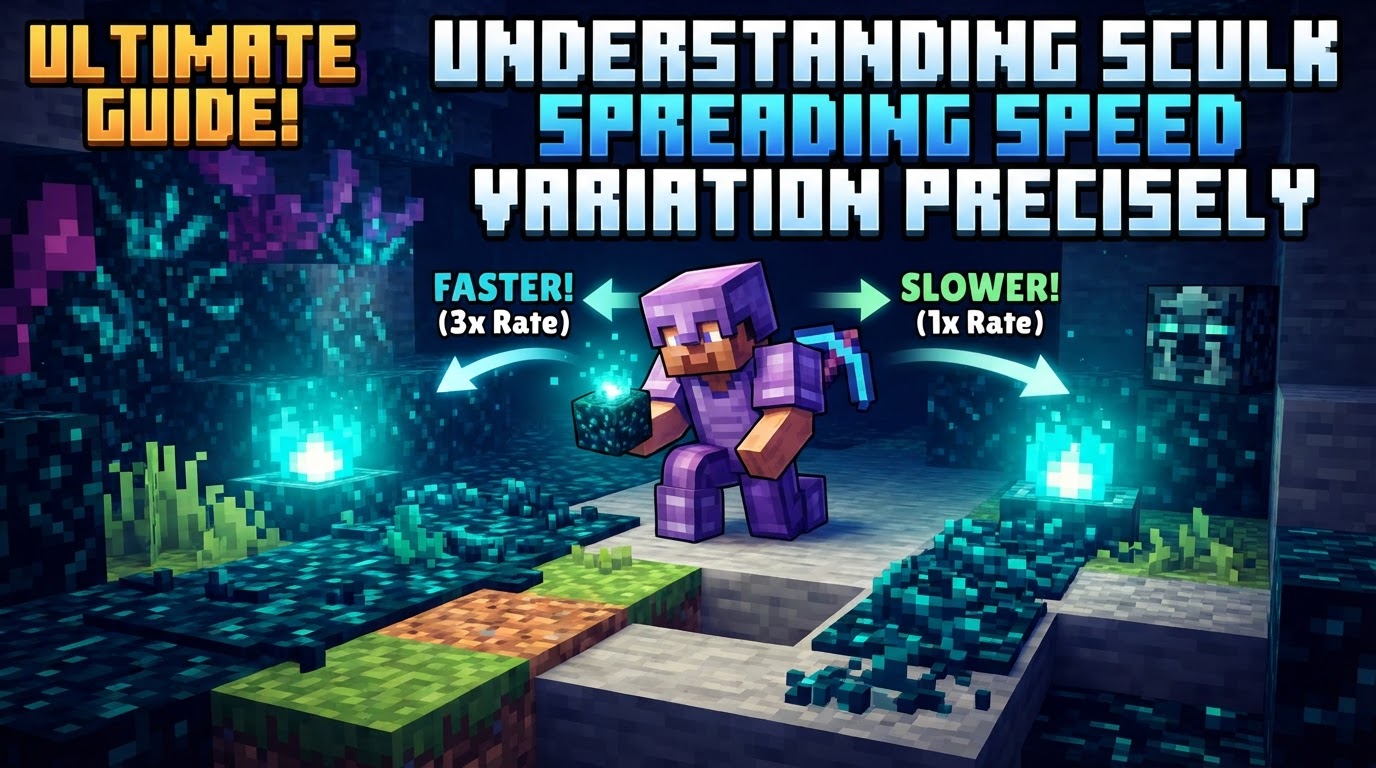
The Core Mechanics: How Sculk Begins its Bloom
Sculk propagation is initiated by a specific event: the death of a living entity within close proximity to a Sculk Catalyst. In Java Edition, this detection range is 8 blocks, while Bedrock Edition players benefit from a slightly larger 10-block radius. When a mob perishes within this sphere, the Sculk Catalyst springs to life, absorbing the experience points the mob would ordinarily drop. Crucially, the mob itself yields no XP to the player; all of it is channeled into the catalyst.
The absorbed XP is the engine of Sculk growth. The amount of Sculk that spreads, its overall range, and its density are all directly proportional to the experience points the deceased mob would have dropped. Mobs with higher XP yields, such as an Enderman, will trigger a far more extensive and potent wave of Sculk conversion compared to a low-XP mob like a chicken.
Once activated, the catalyst begins to convert nearby eligible blocks into various Sculk formations. Most natural and easily breakable blocks, including dirt, stone, deepslate, gravel, sand, and terracotta, are susceptible to transformation. However, harder or non-solid blocks act as natural barriers. Ores, obsidian, fire, soul fire, farmland, cobblestone, pointed dripstone, and slabs are examples of blocks that cannot be converted, effectively halting or directing the Sculk’s path.
Beyond basic Sculk blocks, the spreading process also carries a chance for secondary structures to generate. Sculk Sensors, which detect vibrations, and Sculk Shriekers, notorious for their ability to summon the Warden, can spontaneously appear on top of newly converted Sculk. Sculk Veins, thin tendrils of Sculk, also spread across surfaces, adding to the biome’s unique aesthetic and functional properties.
It’s worth noting that Sculk blocks themselves are a renewable source of XP. When mined without a Silk Touch enchantment, they drop experience points, making Sculk farms a viable alternative for leveling up. However, the frequent activation of Sculk Shriekers within a Sculk-rich area can lead to the summoning of the Warden, a formidable and dangerous foe, adding a layer of risk to uncontrolled expansion.
Unpacking the Spreading Process: A Step-by-Step Guide
To truly grasp the variations in Sculk spreading, it’s helpful to understand the precise sequence of events:
- A Sculk Catalyst is successfully placed in the world.
- A living entity dies within the catalyst’s specified detection range (8 blocks in Java Edition, 10 blocks in Bedrock Edition). This is the initial trigger.
- The Sculk Catalyst absorbs the mob’s XP. The dead mob will not drop any experience points for the player, as its essence is consumed by the catalyst.
- Soul particles are emitted from the catalyst, providing a visual cue of its activation, often referred to as “blooming.”
- Nearby convertible blocks are transformed. This transformation extends outward from the point where the mob died, not necessarily from the catalyst itself, though the catalyst must be within range of the death. These blocks can become standard Sculk blocks, Sculk Veins, and with a probability, Sculk Sensors or Sculk Shriekers.
This cycle repeats each time a mob dies near an active catalyst, with the intensity and extent of each subsequent spread determined by the XP yield of the recently deceased creature.
Precision in Propagation: Factors Dictating Sculk’s Pace and Reach
The “speed” and “variation” of Sculk spread aren’t about how quickly individual blocks convert in milliseconds, but rather the overall extent and density of the spread per activation event. This is where the precise mechanics truly shine:
- XP Yield is King: The single most dominant factor influencing Sculk spread is the experience point value of the dying mob. A high-XP mob, such as an Enderman (which drops 5 XP normally), will cause a significantly larger and denser area of Sculk to generate compared to a Zombie (5 XP) or a Spider (5 XP). For advanced farming, targeting mobs with naturally higher XP drops or using custom mobs with altered XP values can drastically increase yield. The greater the XP, the further the Sculk will radiate and the more blocks within that radius will be converted, often resulting in a thicker carpet of Sculk.
- Abundance of Convertible Blocks: The actual “speed” or effectiveness of the spread is also governed by the environment. If a catalyst is placed in an area surrounded by readily convertible blocks (like dirt, stone, or gravel), the Sculk will spread extensively. Conversely, if it’s placed in a confined space or next to non-convertible blocks like obsidian or ores, the spread will be severely limited, appearing to “stop” or be much slower in its overall impact. The available “canvas” directly dictates the potential for growth.
- Catalyst Placement and Mob Death Location: While the catalyst’s activation range is fixed, the spread itself originates from the mob’s death point. Strategic placement ensures that mobs die in optimal locations surrounded by convertible blocks, maximizing the outward expansion. If a mob dies in a spot with few adjacent convertible blocks, even a high-XP mob might result in a less impressive spread.
- Density of Secondary Spawns: Higher XP yields not only extend the reach but also increase the likelihood of Sculk Sensors and Shriekers generating. This indirectly influences the “variation” by creating a more complex and potentially dangerous Sculk biome faster.
Strategic Optimization for Efficient Sculk Farming
Harnessing Sculk’s properties requires thoughtful planning:
- Prioritize High-XP Mobs: To maximize both the area covered and the density of Sculk blocks (including potential Sensors and Shriekers), design your farms to kill mobs that drop substantial amounts of experience. Endermen are prime candidates due to their high XP yield.
- Integrate with Mob Farms: The most efficient way to generate Sculk is by incorporating Sculk Catalysts directly into existing mob grinders or XP farms. This automates the mob death process, ensuring a constant supply of XP for the catalysts.
- Strategic Catalyst Placement: Position catalysts in areas rich with replaceable blocks. Consider clearing out non-convertible blocks in the immediate vicinity to create an optimal spreading ground.
- Efficient Harvesting: For raw Sculk blocks, a hoe is the fastest mining tool. To collect Sculk Catalysts, Sensors, and Shriekers as items, always use a tool enchanted with Silk Touch.
Containing the Corruption: Guiding and Controlling Sculk Growth
While maximizing spread is often a goal, controlling it is equally important, especially to prevent unwanted Warden encounters:
- Utilize Non-Convertible Barriers: Blocks that Sculk cannot convert are your best friends for containment. Obsidian, fire, soul fire, cobblestone, and ores can be used to create impenetrable walls or floors, effectively stopping Sculk’s expansion in undesired directions. Wool is also an excellent choice, as it doesn’t conduct vibrations, making it useful around Shriekers and Sensors.
- Create Defined Boundaries: Before initiating large-scale Sculk generation, pre-build barriers around the intended farm area. This directs the growth to where you want it and prevents it from encroaching on your base or other important structures.
- Manage Shrieker Spawns: Be mindful that Sculk Shriekers can spawn during the spread. If left unchecked, their frequent activation can quickly lead to Warden summons. Consider limiting the spread in areas where you want to avoid this, or design your farm to either prevent Shrieker spawns or immediately break them.
Common Pitfalls and Misconceptions in Sculk Management
Avoiding these frequent errors will significantly improve your Sculk-related endeavors:
- Incorrect Mob Death Location: Sculk will not spread if mobs die on non-full blocks such as pointed dripstone, slabs, or other non-solid blocks, even if they are within the catalyst’s detection range. The mob must die on a full, convertible block for the spread to initiate correctly.
- Placing Catalysts Near Incorrect Block Types: Surrounding a Sculk Catalyst with non-convertible blocks (e.g., a room made entirely of cobblestone or ores) will severely hinder or completely stop the spread, wasting the mob’s XP.
- Expecting Spontaneous Spread: Sculk Catalysts do not spread on their own. They require the death of an XP-dropping mob within range to activate. Without this trigger, they remain inert.
- Believing in Infinite Spread: Sculk does not spread indefinitely. The process ceases if there are no more replaceable blocks within range of the dying mob’s location, or if no further mobs die near the catalyst to provide the necessary XP fuel. Its growth is finite per activation and limited by its environment.
Mastering the intricacies of Sculk spreading ultimately boils down to a precise understanding of its XP-driven mechanics. By leveraging high-XP mobs, optimizing catalyst placement, and strategically managing block types, players can transform this mysterious block into a powerful resource for XP generation or a captivating biome for exploration, all while mitigating the inherent risks of the Deep Dark.
Tags:
YOU MAY ALSO LIKE...


