

Understanding Why Axolotls Won’t Regenerate Health in Certain Situations
Unlike many other creatures in Minecraft, axolotls do not possess a continuous, passive health regeneration ability, a fact that often puzzles players when their beloved aquatic companions aren’t bouncing back as expected. These adorable aquatic predators have a unique and somewhat conditional method of restoring health, which can lead to situations where their survival seems precarious if you’re not aware of their specific mechanics.
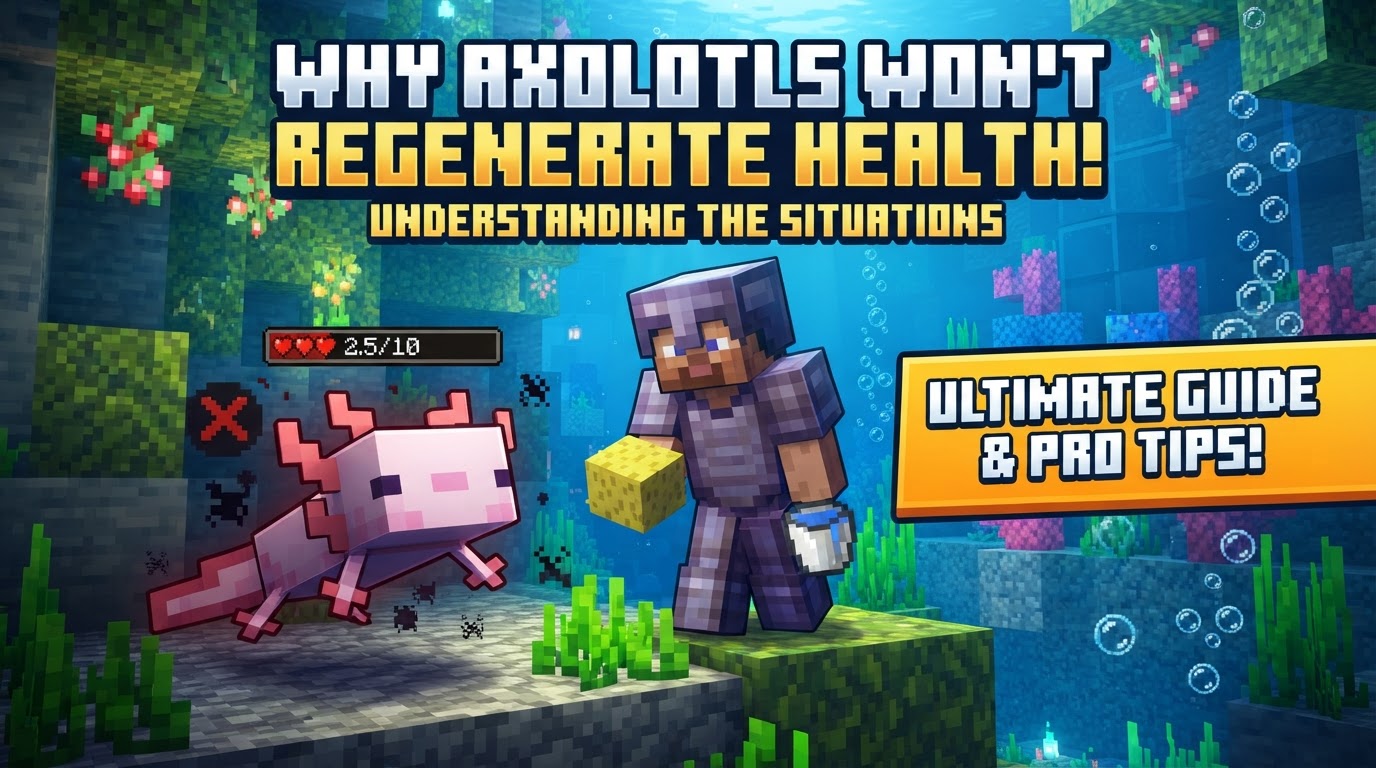
Understanding the intricacies of axolotl health and how they recover is crucial for any Minecraft enthusiast looking to effectively utilize or simply care for these fascinating mobs. Their regeneration is not a constant, background process, but rather a triggered event or a direct intervention, differing significantly from the player’s natural healing or that of some other passive mobs.
The “Playing Dead” Mechanic: Axolotl’s Primary Self-Healing
The cornerstone of an axolotl’s self-regeneration is a clever behavior known as “playing dead.” This isn’t a guaranteed response to damage, but rather a conditional one that offers a brief window of recovery and protection. When an axolotl takes damage while submerged in water, there’s a chance for this unique mechanic to activate, allowing it to regain some lost health and evade further aggression.
Here’s a detailed breakdown of how the “playing dead” regeneration works:
- Damage Trigger: The process begins when an axolotl takes any form of damage while it is underwater. This is a non-negotiable prerequisite; an axolotl damaged out of water will not attempt to play dead.
- Activation Conditions: The “playing dead” state has a specific set of conditions for activation. There is a default ⅓ chance for the axolotl to enter this state. However, it is also guaranteed to trigger if the axolotl’s health before taking damage falls below 50% of its maximum (which is 14 health points, or 7 hearts). Additionally, a more technical condition can trigger it: if a random integer between 0 and 2 (inclusive) is less than the amount of incoming damage, the axolotl will also play dead. This means higher damage hits are more likely to induce the state.
- The Stunned State: If successful, the axolotl immediately drops to the ground, becoming motionless for a duration of 10 seconds. During this critical period, hostile aquatic mobs that were previously attacking it will cease their aggression, perceiving the axolotl as defeated or no longer a threat.
- Regeneration I Effect: While in the “playing dead” state, the axolotl benefits from the Regeneration I effect. This effect allows it to recover 4 health points over the 10-second duration. It’s a short burst of healing, but often enough to pull it back from the brink of defeat.
It’s vital to remember that the ⅓ chance makes this mechanic inherently unreliable. There will be many instances where an axolotl takes damage, even severe damage, and simply doesn’t enter the “playing dead” state, leading to its demise.
Beyond Self-Healing: Player-Assisted Regeneration and Direct Care
While axolotls have a specific self-healing mechanism, players can also play a direct role in their health management and even benefit from their combat prowess.
Player Buffs in Combat
Axolotls aren’t just for show; they can be invaluable allies in underwater combat. When a player helps an axolotl kill a mob that the axolotl is fighting, the player receives a significant boon. This includes the Regeneration I effect for themselves, helping to mitigate damage taken during the fight. Furthermore, the player also gets Mining Fatigue removed, which is particularly useful in areas like Ocean Monuments where Elder Guardians inflict this debilitating status effect.
The duration of this player regeneration effect can stack. If multiple axolotls are involved in a fight and successfully help the player defeat enemies, the Regeneration I effect’s duration can extend up to a maximum of two minutes, making axolotls excellent companions for prolonged underwater skirmishes.
Direct Healing Through Food
For more immediate and reliable health restoration, players can directly heal axolotls by feeding them. The only item axolotls consume for healing is tropical fish. Each tropical fish fed will restore a certain amount of health, making it the most straightforward way to ensure your axolotl companions are at full health.
Understanding Axolotl Health Capacity
Axolotls have a maximum of 14 health points, which is equivalent to 7 hearts on the player’s health bar. This relatively low health pool, combined with the conditional nature of their “playing dead” mechanic, means they can be quite fragile, especially against strong hostile mobs or environmental hazards.
Why Your Axolotl Might Not Be Healing: Common Pitfalls and Misconceptions
Given their unique mechanics, several common misunderstandings and environmental factors can lead players to believe their axolotls are not regenerating health when, in fact, they are simply not meeting the specific conditions required.
Absence of Passive Regeneration
Perhaps the most significant misconception is the expectation of passive regeneration. Unlike some other Minecraft mobs or even the player character under certain conditions, axolotls do not continuously regenerate health over time. Their healing is specifically tied to the “playing dead” mechanic or direct player intervention. If an axolotl takes damage and doesn’t trigger “playing dead,” or isn’t fed tropical fish, its health will remain low.
The Unreliable Nature of “Playing Dead”
As mentioned, the “playing dead” mechanic is not a guaranteed response. With only a ⅓ chance to activate under general damage conditions, there’s a high probability that an axolotl will simply die before it can enter this regenerative state, especially when facing high-damage attacks or multiple attackers simultaneously. Players often observe their axolotls perishing without ever appearing to “play dead,” leading to frustration and confusion.
Environmental Constraints: The Water Requirement
Axolotls are aquatic creatures, and their survival is intrinsically linked to water. If an axolotl is out of water for more than five minutes, it will start taking continuous damage and eventually die. During this period of environmental damage, the “playing dead” mechanic will not trigger, as it specifically requires the axolotl to be submerged when taking damage. Therefore, an axolotl struggling on land will not regenerate; it will only decline.
Real-World Expectations vs. Game Mechanics
Real-life axolotls are renowned for their incredible regenerative abilities, capable of regrowing lost limbs and even organs. This real-world fact often leads players to mistakenly expect similar, extensive regeneration in their Minecraft counterparts. However, in the game, their regenerative powers are strictly limited to the described “playing dead” health recovery and do not extend to regrowing body parts or continuous, passive healing. This disparity between real-life biology and game mechanics can be a source of player disappointment.
Optimizing Axolotl Welfare and Combat Utility
To ensure your axolotls thrive and provide maximum benefit, keep these tips in mind:
- Safe Transportation and Persistence: Always use a water bucket to pick up and carry axolotls. Bucketed axolotls become “persistent,” meaning they will not despawn over time like wild axolotls. This is crucial for keeping your favorite companions safe.
- Strategic Combat Deployment: Employ axolotls strategically during underwater combat, particularly in challenging areas like Ocean Monuments. Their ability to draw aggro and grant player buffs can turn the tide of a difficult fight.
- Maximize Player Buffs: To extend the duration of the player’s Regeneration I effect and remove Mining Fatigue more effectively, deploy multiple axolotls in a fight. Their combined efforts can keep you healed and agile for longer periods.
- Keep Tropical Fish Handy: Always carry tropical fish for emergency healing. This is the most reliable way to restore an axolotl’s health when its “playing dead” mechanic fails or isn’t triggered.
In conclusion, axolotls in Minecraft are not passively regenerating creatures. Their health recovery is a delicate balance of a conditional “playing dead” mechanic, direct player feeding, and player-granted buffs during combat. By understanding these specific rules and avoiding common pitfalls like leaving them out of water or expecting constant healing, you can ensure your axolotls remain healthy, happy, and effective allies in your underwater adventures.
Tags:
YOU MAY ALSO LIKE...


