

Understanding Why Librarian Trades Change Randomly
Librarian trades in Minecraft aren’t truly random in their changes; rather, they are highly manipulable before a specific player interaction. This core mechanic allows players to meticulously “reroll” a librarian’s offers, particularly for enchanted books, until they acquire the precise enchantments they desire. Understanding the underlying rules of villager mechanics is crucial for mastering this process and building an efficient enchantment farm.
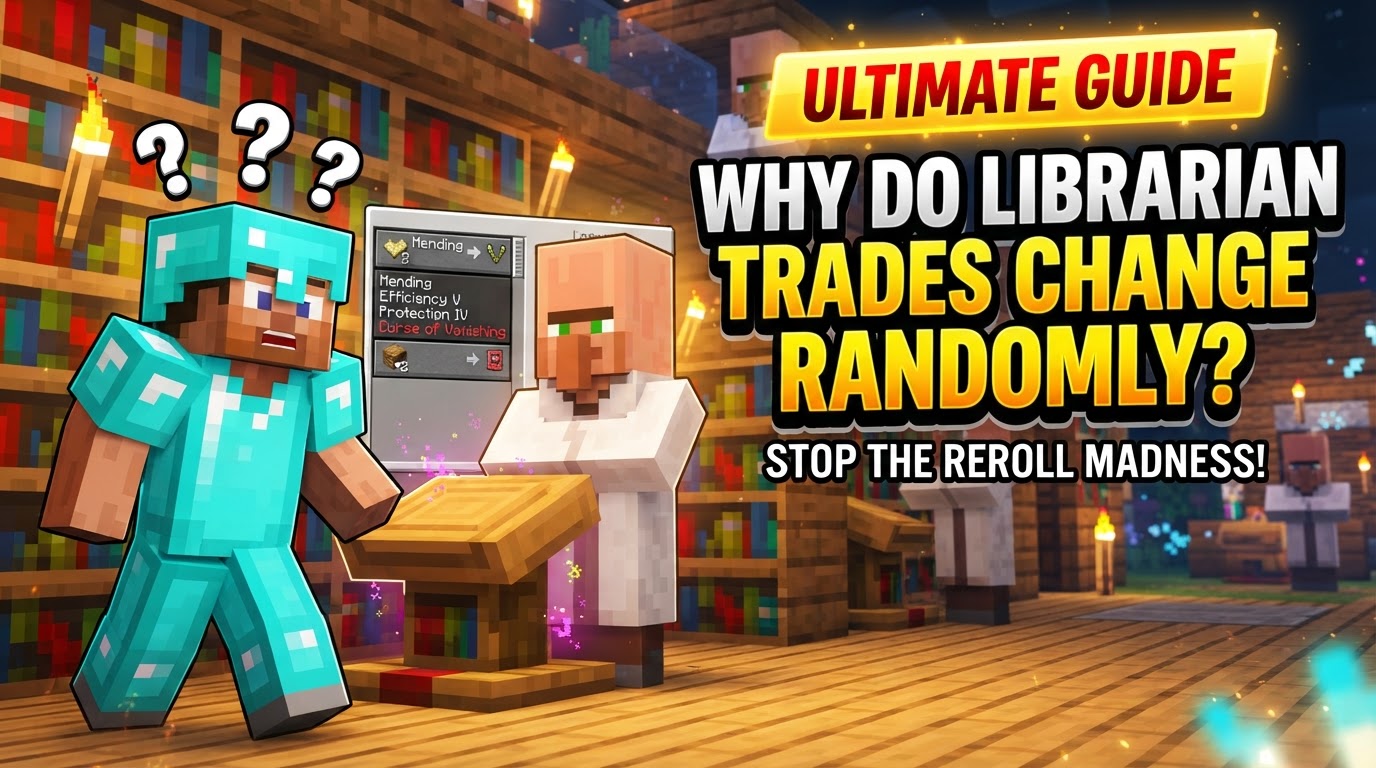
The Genesis of a Librarian’s Offerings
The journey of a villager becoming a Librarian begins with a specific job site block: the Lectern. When an unemployed villager claims a Lectern, it instantly adopts the Librarian profession. At this precise moment, its initial set of trade offers, including the valuable enchanted books, is randomly generated. This initial generation is a one-time event for that specific linking. Think of it as a lottery drawing; once the numbers are picked, they’re set for that particular villager and Lectern combination, but only until certain conditions are met.
Crucially, as long as a player has not yet performed even a single trade with this newly minted Librarian, its initial trade offers remain flexible. This flexibility is the cornerstone of the rerolling strategy. The trades are not yet “locked in” by player interaction, meaning they are still subject to change if the villager’s professional link is broken.
Mastering the Reroll: A Step-by-Step Guide
The ability to manipulate Librarian trades is a powerful tool for any Minecraft player looking to optimize their gear. The process is straightforward, relying on the mechanic of breaking and replacing the Lectern to force new trade generations.
- Step 1: Recruit Your Villager. Begin by finding an unemployed villager. These can be naturally spawned villagers, villagers bred by players, or even cured zombie villagers.
- Step 2: Establish the Profession. Place a Lectern near your chosen unemployed villager. The villager will claim this block as its job site, instantly transforming into a Librarian. This is the moment its first set of trades is generated.
- Step 3: Evaluate the Offers. Right-click on the Librarian to open its trade interface. Carefully check the enchanted book offers. Are they what you’re looking for? If not, proceed to the next step.
- Step 4: Break the Link. If the desired enchanted book is absent, break the Lectern. Upon the Lectern’s destruction, the Librarian will lose its profession and revert to being an unemployed villager. Its previous trade offers are now nullified.
- Step 5: Re-establish the Link for New Trades. Immediately replace the Lectern in the same spot, or nearby. The now unemployed villager will reclaim the Lectern. This act of re-claiming the job site triggers a fresh generation of initial trades, effectively giving you a new set of lottery numbers.
- Step 6: Repeat Until Satisfied. Continue to repeat steps 3 through 5 until the Librarian offers the specific enchanted book you desire (e.g., Mending, Fortune III, Efficiency V).
- Step 7: Lock in the Trades. Once you find the perfect trade, perform at least one transaction with the Librarian. This single trade is the critical action that permanently locks all of the villager’s current trade offers. From this point forward, these trades will never change, even if the Lectern is broken or moved.
The Immutable Law of the First Trade
Understanding why trades become permanent is paramount. The moment a player engages in even a single trade with a villager, a fundamental change occurs. All of that villager’s current profession and trade offers become permanently locked. This is not a temporary state; it’s an irreversible commitment. Even if you subsequently break the Lectern, move it, or the villager somehow loses its job site, those specific trades will remain tied to that villager. Should it reclaim a Lectern again, it will regain its Librarian profession and present the exact same set of locked trades it had when you first traded with it.
It’s important to differentiate this locking mechanism from restocking. Villagers will restock their available items up to twice per in-game day, provided they have access to their job site block. This restocking simply refreshes the quantity of items they have for sale, not the types of items or their prices (unless external factors like discounts apply).
Optimizing Your Rerolling Process
To make the rerolling process as efficient as possible, several tips can significantly speed up your enchantment acquisition:
- Containment is Key: Always trap your villager in a small, enclosed area with only one Lectern. This prevents it from wandering off, linking to unintended workstations, or despawning. A 1×1 or 1×2 cell is often sufficient.
- Automate with Pistons: For maximum efficiency, use a sticky piston connected to a lever or button to quickly break and replace the Lectern. This eliminates the need to manually mine and place the block, drastically reducing reroll time.
- Quick Check Method: When rapidly rerolling, hold an emerald in your main hand. Villagers will display an icon above their head indicating their first trade offer (often a bookshelf) if they have one. This allows for a very quick check without having to open the full trade interface every time, saving valuable seconds.
- Multiple Copies: Don’t limit yourself to just one Librarian for a specific enchantment. Once you’ve locked a desired trade with one, you can repeat the entire process with another unemployed villager to get a second, third, or even fourth Librarian offering the same valuable book. This is excellent for mass enchantments or multiplayer worlds.
Avoiding Common Pitfalls
While the rerolling strategy is powerful, several common mistakes can lead to frustration and wasted effort:
- The Peril of Premature Trading: This is arguably the most critical error. Making even a single, seemingly insignificant trade before you’ve found your desired enchanted book will permanently lock all of the Librarian’s current trades. If those trades are undesirable, you’ll be stuck with them, rendering that specific Librarian useless for your enchantment goals.
- Unsecured Villagers: Allowing a villager to roam freely or have access to multiple job blocks is a recipe for disaster. They might link to an unintended workstation, wander into danger, or even despawn if not properly contained, disrupting your entire rerolling effort.
- Forgetting to Lock: After finally finding that elusive Mending book, it’s easy to get excited and forget the final, crucial step. If you don’t perform at least one trade, the trades remain unlocked. Should the Lectern accidentally break or the villager somehow become unemployed again, all your hard work rerolling will be lost, and a new set of random trades will generate.
Beyond the Basics: Curing Zombie Villagers
For those looking to secure the absolute best deals, consider starting your Librarian recruitment with zombie villagers. Curing a zombie villager by throwing a Splash Potion of Weakness at it and then feeding it a golden apple results in significant, permanent discounts on all its trades. The first cure offers the most substantial discount, often reducing prices to a single emerald or even one of the traded items (e.g., one book for a rare enchantment). These discounts are permanent and apply to all trades, making the investment in curing well worth it for long-term savings.
By understanding these core mechanics and following the step-by-step process, players can transform the seemingly random nature of Librarian trades into a predictable and powerful system for acquiring the best enchantments in Minecraft.
Tags:
YOU MAY ALSO LIKE...


