Why Certain Biome Features Generate in Unlikely Locations
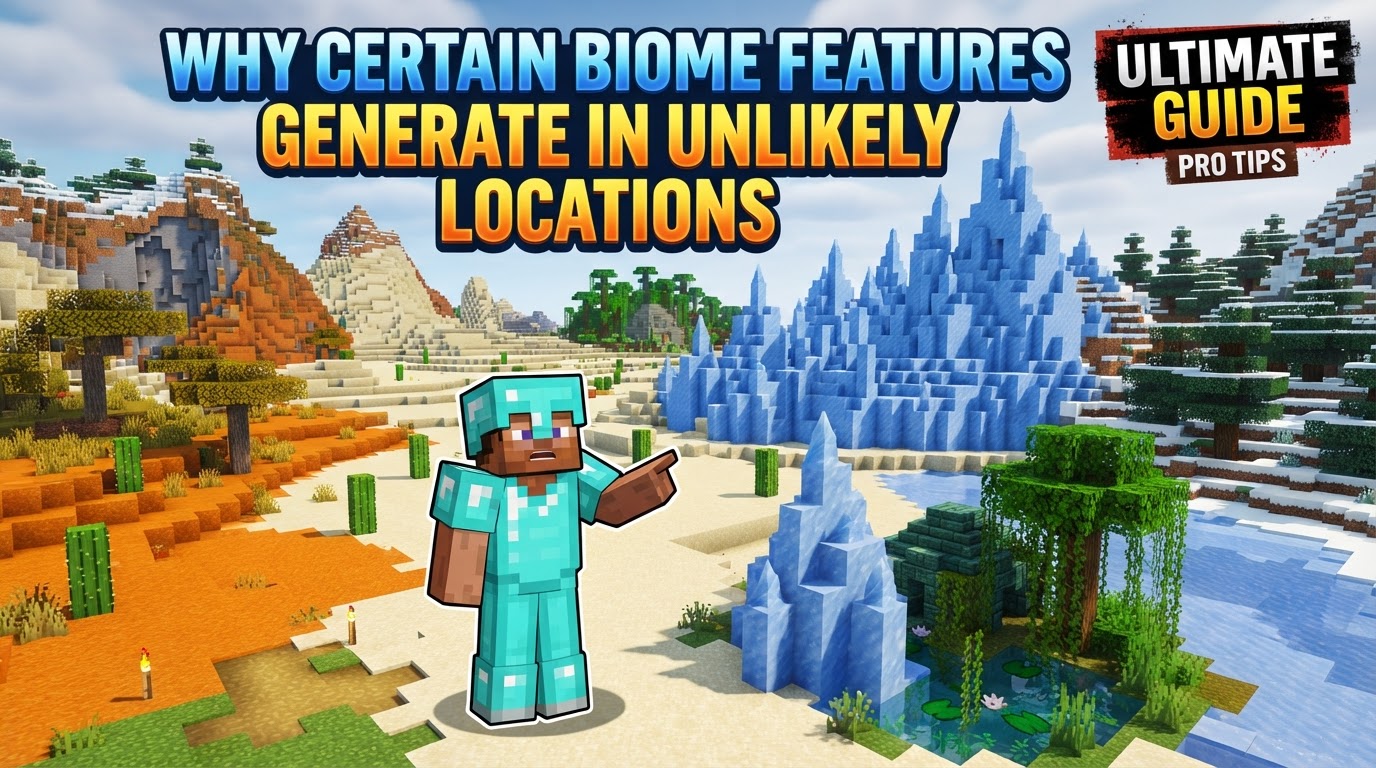
A desert biome, stark and parched, hosts a tranquil lake with lily pads. This seemingly illogical sight in Minecraft’s world generation isn’t a bug, but a fascinating outcome of its intricate design. The placement of biome features in locations that appear “unlikely” to players is a testament to the layered, algorithmic complexity that defines every block and landscape in the game. Far from being random glitches, these occurrences are deterministic results of how Minecraft’s world generation system processes a multitude of parameters and rules, creating a dynamic and often surprising world.
The Foundation: Seeds and Layered Generation
At the heart of every Minecraft world lies a numerical seed. This seed acts as the ultimate blueprint, dictating every aspect of terrain, biome distribution, and structure placement. The beauty of the seed is its determinism: the same seed, used with the same game version, will always produce an identical world. This ensures consistency and allows players to share and explore specific world layouts.
World generation itself is not a monolithic process but occurs in multiple, distinct passes. Initially, the fundamental shape of the world is established, laying down the groundwork for valleys, plains, and mountain ranges. Following this, biomes are assigned to different areas, coloring the landscape with their unique environmental characteristics. Only after these foundational steps are complete do features like trees, ores, lakes, and complex structures begin to populate the world, adhering to their own specific generation rules.
Deconstructing Biome and Feature Placement
The placement of biomes is governed by a sophisticated system known as the Multi-Noise Biome Source. Instead of simple, hard-coded regions, biomes are determined by the interplay of several “noise” variables. These include:
- Temperature: Influencing hot, temperate, or cold biomes.
- Humidity: Determining wet or dry environments.
- Continentalness: Defining proximity to large landmasses or oceans.
- Erosion: Shaping the ruggedness or smoothness of terrain.
- Weirdness: Introducing variations and unique biome variants.
- Depth: Affecting subterranean biomes and terrain height.
These variables are generated using mathematical functions based on the world seed, creating a complex 2D heightmap and assigning biomes accordingly. Features, on the other hand, are defined by “Configured Features” (what they are), “Placement Features” (how they are laid out), and “Biome Modifications” (where they are allowed to appear). These rules can be incredibly specific, dictating conditions for a feature’s attachment to a particular biome or even to the intersection of multiple biomes.
Complex structures, such as villages or strongholds, often utilize Structure Sets to define their distribution rules across the world and Jigsaw Blocks for modular assembly. Jigsaw blocks allow different pieces of a structure to snap together seamlessly based on defined connection points, enabling diverse and intricate layouts within a single structure type.
Why Features Stray: The Core Reasons for Unlikely Placements
The perceived “unlikelihood” of certain feature placements stems directly from the nuanced interaction of these underlying systems:
Biome Blending and Gradient Effects
Minecraft’s world isn’t a patchwork of sharply defined biome squares. Instead, biomes often transition smoothly into one another, creating natural-looking gradients. Features are tied to specific underlying noise values or conditions, not just the visually dominant biome label. If a feature’s conditions are met within one of these blend zones, it might appear in an area that visually resembles an adjacent biome, even if the underlying generation logic still considers it part of a transition or a specific noise signature.
The Complex Dance of Noise Variables
The many noise variables (temperature, humidity, erosion, etc.) can align in unexpected ways. A feature’s spawning condition might be met by a unique combination of these variables, even if the most prominent biome type suggests otherwise. For instance, a high erosion value might indicate the geological conditions for a swamp, regardless of the surface biome assigned, allowing for swamp-like features to appear in visually incongruous places. The “Weirdness” variable specifically enhances this, generating biome variants and unique terrain formations that can sometimes feel out of place but are entirely intentional.
Permissive Placement Rules and Biome Modifications
Some features have less stringent placement rules than players might assume. Their generation conditions might allow for a broader range of environmental factors or permit generation along biome intersections. This flexibility is often by design, ensuring a richer, more varied world. Custom feature rules, particularly for modders or datapack creators, can be explicitly set to trigger generation at biome borders or where specific noise values overlap, leading to features that deliberately straddle visual biome boundaries.
The Curious Case of Arid Water Features
A frequently cited example of “unlikely” generation is the appearance of rivers and lakes within arid biomes like deserts or savannas. From a player’s perspective, a desert should be dry. However, the game’s logic for generating water bodies might be tied to specific depth or erosion noise values that can occur independently of the ‘humidity’ or ‘temperature’ values primarily defining the desert biome. These features are not flaws but rather a consequence of how different generation layers interact, sometimes creating visual paradoxes that add to the world’s character.
Evolution of Generation: Version Changes
Minecraft’s world generation algorithms are not static. Significant updates, particularly the “Caves & Cliffs” update (1.18+), have drastically altered how worlds are generated. These changes can lead to different patterns, sometimes a perceived lack of coherence, or even increased repetitiveness compared to older versions. What might have been a rare occurrence in one version could become more common in another, simply due to tweaks in the underlying noise functions and feature placement rules.
Dispelling Common Misconceptions
Understanding these mechanisms helps to dispel common misconceptions:
- Strict Biome Borders: Biomes do not always have sharp, impenetrable boundaries. Blending and gradients are integral, allowing features to naturally appear in transition zones.
- Visual vs. Underlying Logic: What a player sees as a single, uniform biome might not fully represent the complex underlying noise values that dictate precise feature placement. The visual surface is an interpretation of deeper, more intricate data.
- Complete Isolation of Biome Features: While many features are strongly associated with specific biomes, their generation rules often allow for slight overlap or generation in visually “unlikely” spots due to the nuanced interaction of various generation parameters.
Navigating the Nuances: Tips for Players
For players keen to understand or even predict these phenomena:
- Study Noise Variables: A deeper understanding of temperature, humidity, continentalness, and erosion’s role in biome and feature placement can help predict where certain elements might appear, even if visually surprising.
- Embrace Determinism: Remember that a world’s generation is fixed by its seed. If something seems odd, it’s a programmed outcome, not a random glitch. This consistency is what allows for shared seeds and predictable world exploration.
- Explore Custom Generation: For those interested in deeper control, modding and datapacks allow for defining very specific “feature rules” and “feature placement” conditions. This includes checking for biome intersections, providing unparalleled precision over generation.
Conclusion: Engineered Serendipity
The generation of biome features in seemingly unlikely locations in Minecraft is not an oversight but a deliberate outcome of a highly sophisticated, layered algorithmic design. It’s a system that balances predictability with emergent complexity, ensuring that while the world is always consistent for a given seed, it also offers endless opportunities for discovery and surprise. These “unlikely” features are a testament to the game’s depth, showcasing how mathematical functions and intricate rules combine to create a truly dynamic and immersive blocky universe.
Tags:
YOU MAY ALSO LIKE...