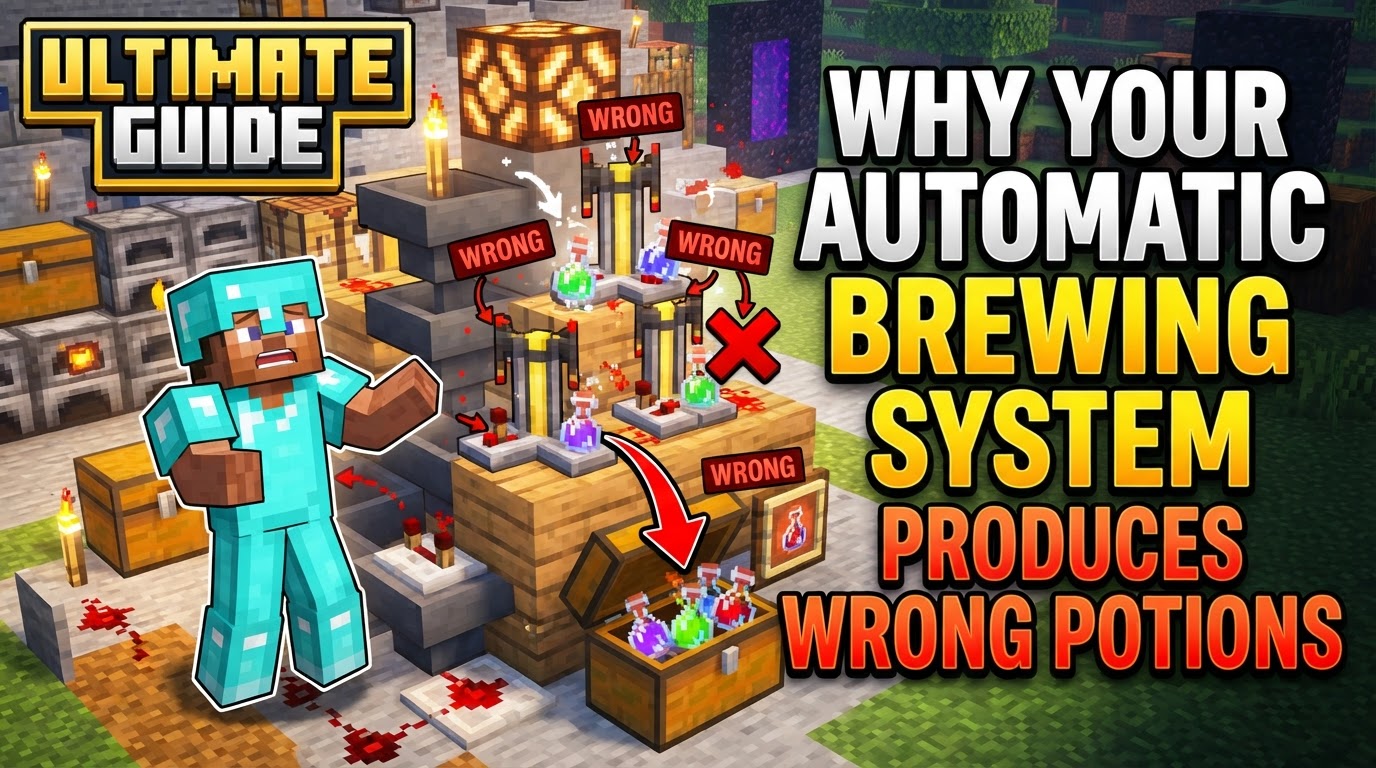
Why Your Automatic Brewing System Produces Wrong Potions
One of the most frustrating moments for any Minecraft alchemist is watching their meticulously designed automatic brewing system churn out a seemingly endless supply of useless Mundane Potions, or worse, entirely incorrect effects. The core of this widespread issue often lies not in a fundamental flaw of the brewing stand itself, but in the precise, often unforgiving, sequence of ingredient delivery within an automated setup.
The Alchemical Fundamentals: How Brewing Works
Before diving into what goes wrong, it’s crucial to understand the foundational mechanics of brewing in Minecraft. At its heart, a brewing stand requires Blaze Powder as fuel, with a single unit capable of powering 20 brewing operations. The process begins with 1-3 glass bottles filled with water placed in the bottom slots. An ingredient is then placed in the top slot, initiating the transformation.
Most useful effect potions start with a critical intermediate step: brewing Nether Wart into water bottles to create Awkward Potions. These Awkward Potions serve as the universal base for almost all positive effect potions. Without this step, attempting to brew primary ingredients directly into water bottles will often result in a Mundane Potion, which generally has very limited utility.
Once an Awkward Potion is created, further ingredients are added to modify its properties. For instance, Redstone Dust increases a potion’s duration, while Glowstone Dust amplifies its potency, often at the cost of duration. Gunpowder converts a potion into a splash potion, making it throwable, and Dragon’s Breath creates lingering potions, which leave a cloud of effect. A particularly interesting modifier is the Fermented Spider Eye, which corrupts potions, reversing their effects (e.g., a Potion of Swiftness becomes a Potion of Slowness).
The Ideal Brewing Sequence
To produce the correct potion manually or automatically, a specific step-by-step process must be followed:
- Place 1-3 water bottles in the brewing stand’s bottom slots.
- Ensure Blaze Powder is present in the fuel slot.
- Add Nether Wart to the top slot. This converts the water bottles into Awkward Potions.
- Once the Awkward Potions are brewed, add the desired primary ingredient (e.g., Sugar for a Potion of Swiftness, Glistering Melon Slice for a Potion of Healing) to the top slot. This creates the base effect potion.
- (Optional) To further enhance or modify the potion, add modifier ingredients (Redstone Dust, Glowstone Dust, Gunpowder, Fermented Spider Eye) to the top slot. This step determines duration, strength, splash/lingering effects, or corruption.
Understanding this precise order is the bedrock upon which any successful automatic brewing system must be built.
Automating the Alchemist: Tools and Techniques
Automatic brewing systems rely heavily on Minecraft’s redstone mechanics and inventory management blocks. Hoppers and droppers are indispensable for feeding water bottles, ingredients, and fuel into the brewing stand, as well as collecting the finished potions. Hoppers are typically configured to feed ingredients into the top of the brewing stand, while finished potions are often pulled out from the bottom or sides into a collection system.
Redstone circuitry, particularly involving comparators, is crucial for orchestrating the process. Comparators can detect the contents of a brewing stand, allowing for precise timing of ingredient delivery. This prevents premature item extraction and ensures that each brewing stage is completed before the next ingredient is introduced. The design must handle ingredient order meticulously, as sequential dispensing is absolutely key for crafting complex potions.
Common Pitfalls: Why Your Potions Go Wrong
Despite careful planning, several issues can plague an automatic brewing system, leading to incorrect or useless potions:
Incorrect Ingredient Order
This is arguably the most frequent error in automated setups. If your system dispenses ingredients in the wrong sequence-for example, adding a primary effect ingredient like Sugar before the Awkward Potion stage is complete-it will almost certainly lead to unintended potions or, more commonly, Mundane Potions. Redstone timing and careful hopper configurations are vital to prevent this.
Skipping the Awkward Potion Stage
As highlighted earlier, the Awkward Potion is the essential intermediary. If your system directly brews a primary effect ingredient (like Sugar) into water bottles, bypassing the Nether Wart step entirely, you will typically end up with a Mundane Potion. This often occurs due to faulty redstone logic or incorrect hopper priority, where the primary ingredient is introduced too early.
Lack of Fuel
A simple yet critical oversight: if the brewing stand runs out of Blaze Powder, the brewing process will halt. This leaves incomplete potions in the stand or, if ingredients are still being fed, can lead to a backlog and subsequent incorrect brewing once fuel is replenished, as the timing will be off.
Improper Modifier Application
Adding the wrong modifier at the wrong time can drastically alter the final product. For instance, if you intend to extend a potion’s duration with Redstone Dust but your system accidentally dispenses Glowstone Dust, you’ll get a stronger but shorter-lasting potion. Similarly, introducing a Fermented Spider Eye at an unintended stage will corrupt the potion, reversing its effect. Precision in modifier delivery is paramount.
Timing Issues
In automated systems, timing is everything. If ingredients are pushed into the brewing stand too quickly, or if finished potions are pulled out before brewing is fully complete, it can result in an incorrect or incomplete batch. This often manifests as partially brewed items being extracted or the next ingredient being added before the current one has finished processing. Robust Redstone comparators and repeaters are essential for managing these delays.
System Jams and Blockages
An incorrect ingredient flow, often caused by a design flaw or an unexpected item entering the system, can lead to a backlog of items. This jam prevents subsequent, correct ingredients from entering the brewing stand when needed, disrupting the brewing sequence and leading to wrong potions.
Mixing Potions in Storage
While less common for standard vanilla automatic systems, advanced setups or those incorporating mods might face issues if different potions (e.g., varying durations or strengths of the same effect) are allowed to mix in a single fluid storage or output chest before being sorted. This can create confusion and make it difficult to retrieve the desired potion type.
Designing for Alchemical Success
To build a robust and reliable automatic brewing system, meticulous planning is key. Prioritize precise ingredient order in your design, using distinct hopper lines for each ingredient type. Implement sophisticated Redstone circuitry with comparators to detect brewing stand states and ensure that each step completes before the next begins. Always include a reliable Blaze Powder resupply mechanism. Finally, design an efficient collection system for finished potions, ideally with sorting capabilities, to prevent any unintended mixing or backlog.
By understanding the core mechanics of brewing and carefully addressing these common pitfalls, you can transform your frustrating potion factory into a well-oiled, efficient alchemical marvel, consistently producing exactly the elixirs you need.
Tags:
YOU MAY ALSO LIKE...