Why Your Automatic Chicken Farm Sometimes Fails
One of the most frustrating moments for a Minecraft farmer is discovering their automatic chicken farm, once a beacon of efficiency, has inexplicably stopped producing cooked chicken and feathers. These seemingly simple contraptions can be surprisingly finicky, often failing due to subtle misconfigurations, changes in game mechanics, or overlooked environmental factors. Understanding the underlying principles and common pitfalls is crucial for troubleshooting and building a truly reliable source of avian bounty.
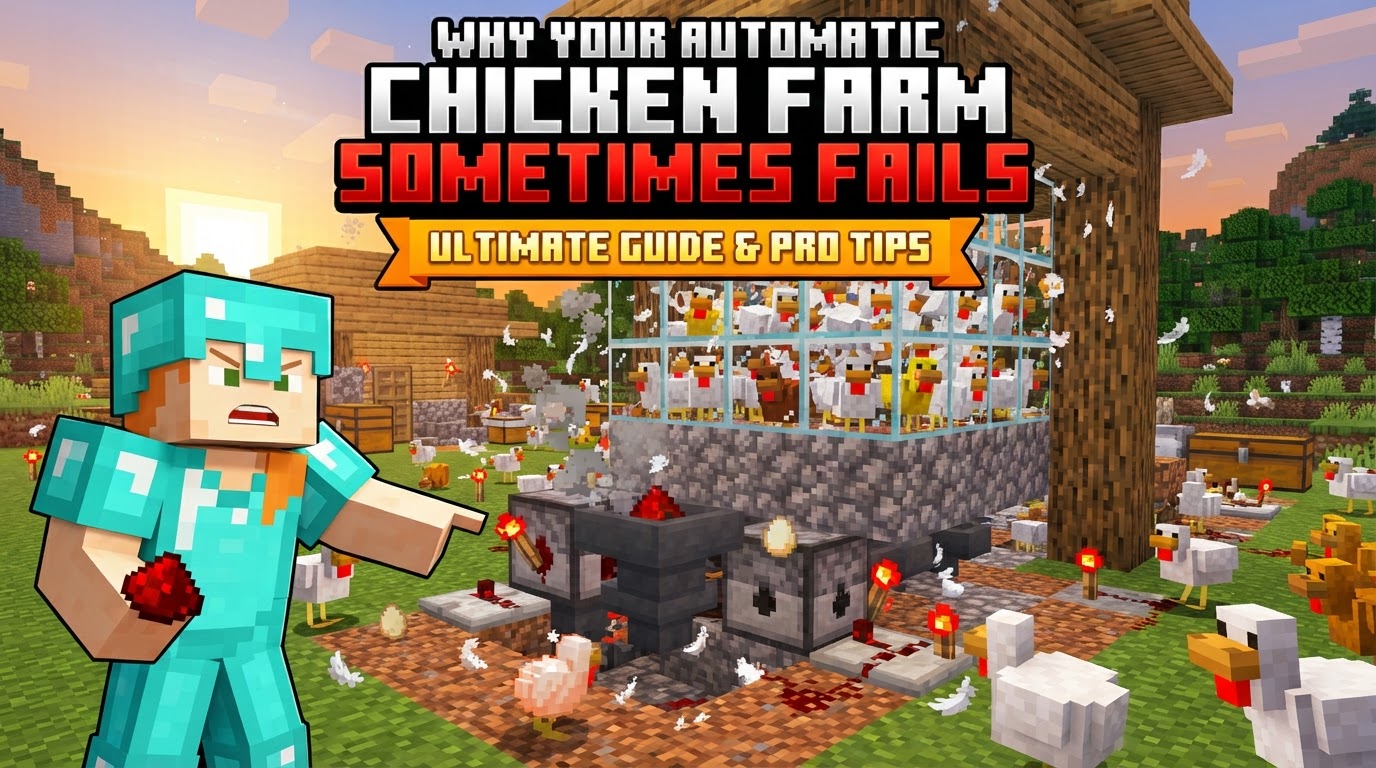
The Ingenious Core of Chicken Automation
At its heart, an automatic chicken farm is a marvel of redstone engineering and creature mechanics, designed to be entirely self-sustaining. The process begins with adult chickens periodically laying eggs. These eggs are ingeniously collected by hoppers and funneled into a dispenser. The dispenser then “throws” these collected eggs, each possessing a 1/8 chance to hatch a baby chick. This low probability means a steady supply of eggs is essential for consistent production.
Once hatched, these baby chicks embark on a growth journey until they become adult chickens. The farm’s design typically funnels these mature chickens into a killing mechanism, most commonly a lava source, which efficiently cooks and dispatches them. The resulting cooked chicken and feathers, dropped upon their demise, are then meticulously collected by hoppers positioned beneath the killing area and deposited into a central chest for easy retrieval. This continuous cycle, where eggs from existing adults replenish the population, ensures the farm remains self-sufficient, provided it remains within a loaded chunk.
Central to this automation is a sophisticated redstone circuit, often leveraging an observer block in conjunction with the dispenser. This circuit activates the dispenser to fire eggs at regular intervals, maintaining the flow of new chicks into the system.
Constructing the Avian Assembly Line: A General Overview
While designs can vary, a typical automatic chicken farm follows a general construction sequence to achieve its automated goals:
- Collection Point: The journey begins with a chest, serving as the ultimate collection point for all farm output.
- Initial Hopper: A hopper is attached, feeding directly into this chest, ready to receive items.
- Killing Platform: A stonecutter (or a similar half-block/slab) is placed directly on top of the hopper. This block is crucial as it positions the adult chickens correctly for the killing mechanism and ensures item collection.
- Egg Dispenser: A dispenser is positioned to face the stonecutter, its purpose to launch eggs towards the growth area.
- Egg-Laying Chamber: A dedicated chamber is built above the dispenser. This is where the initial “laying” chickens reside, and hoppers within this chamber collect their eggs, feeding them into the dispenser below.
- The Cooker: A lava-filled cauldron (or a single lava source, depending on the specific design and game version) is strategically placed above the stonecutter/slab. Its placement is paramount: it must be high enough to kill adult chickens but low enough to avoid burning the valuable item drops.
- Redstone Brain: A redstone clock or an observer mechanism is implemented to activate the dispenser, ensuring eggs are fired consistently.
- Seeding the Farm: Finally, initial chickens are lured or spawned into the egg-laying chamber to kickstart the production cycle.
When the Cluck Stops: Common Reasons for Farm Failure
Even with a meticulously followed design, automatic chicken farms are prone to various issues. Here’s a breakdown of the most common reasons your farm might be failing:
The Blaze of Waste: Burning Drops
One of the most disheartening failures is when your cooked chicken and feathers are incinerated by lava before they even reach the collection hopper. This is typically an issue with the killing mechanism’s setup. An open lava source might be too low, allowing items to touch the lava’s surface. A common fix is to ensure you’re using a lava-filled cauldron instead of a direct lava block, and that the chicken stands on a stonecutter or a correctly placed slab. These blocks often allow the lava to kill the chicken while keeping the drops just out of the lava’s reach, falling safely into the hopper below.
The 1.21.10+ Chick Killing Conundrum
A significant change in Minecraft 1.21.10 and later versions introduced a new entity collision behavior that can cripple older farm designs. Now, when a dispenser fires an egg, the impact can knock a newly hatched baby chick upward. If the lava source is too close or improperly positioned, this upward knock can send the baby chick directly into the lava, killing it instantly before it can grow and without dropping any items. Solutions often involve adjusting the farm’s layout, perhaps by temporarily replacing the lava with a solid block to allow chicks to grow, or by adopting a modified design that accounts for this new collision mechanic to prevent premature deaths.
Hoppers Hiding Eggs: Collection Malfunctions
If your dispenser isn’t receiving eggs, the problem often lies with your hoppers. Hoppers might not collect eggs if the redstone circuit powering the dispenser is built too close, inadvertently blocking the hopper’s inventory access or functionality. Another common error is a hopper pointing in the wrong direction; hoppers only collect items from above or from inventories they are pointing into. Always double-check the direction hoppers are facing, especially those collecting eggs from the laying chamber and feeding the dispenser.
Dispenser Dysfunction: The Silent Shooter
A dispenser that refuses to fire eggs is a clear sign of a redstone problem. This could be due to an incorrectly configured redstone circuit, such as a clock that isn’t cycling correctly or a signal that isn’t reaching the dispenser. It’s also possible the dispenser itself is placed improperly, facing the wrong direction or not aligned with the egg collection system. Furthermore, an empty dispenser can sometimes halt an observer-based redstone loop, as observers often detect changes in block states, and an empty dispenser might not trigger the necessary update.
Lag, Cramming, and Chicken Overload
While more chickens might seem like a good idea for efficiency, too many can be detrimental. A confined space with an excessive number of chickens can lead to significant game lag, especially on less powerful systems. More critically, it can trigger entity cramming, a game mechanic where too many entities in a single block space will cause them to take damage and eventually die without dropping items. Reducing the number of chickens in the top egg-laying layer can alleviate both lag and cramming issues, ensuring a healthier and more productive farm.
Incorrect Block Placement: A Foundation for Failure
The seemingly minor detail of block choice can have major repercussions. Using a full block where a slab or a stonecutter is required can disrupt item collection or prevent baby chickens from growing properly. For instance, a full block might prevent items from falling into the hopper below, or it might prevent the lava from reaching the adult chickens correctly without burning the drops. Always adhere strictly to the block types specified in your chosen farm design.
Stunted Growth: Baby Chickens Not Maturing
If your baby chickens aren’t growing into adults, several factors could be at play. They might be in an incorrect position, perhaps clipping into a block that prevents their growth tick updates. In some versions, an improperly designed lava setup could interfere with their growth mechanics, even if it’s not directly killing them. Ensure the area where chicks are meant to grow is clear and allows for their natural maturation process.
Optimizing for Success: Tips for a Robust Farm
Beyond troubleshooting, a few key considerations can ensure your automatic chicken farm runs smoothly and efficiently:
- Maximizing Egg Production: To boost your farm’s output, consider expanding the egg-collecting hopper area. More egg-laying chickens (some designs suggest up to 96) mean a higher volume of eggs, leading to more chicks and ultimately, more cooked chicken.
- Keeping Chunks Loaded: For continuous operation, your farm must be located within a loaded chunk. Unloaded chunks halt all redstone activity and entity processing, effectively pausing your farm. Consider using a chunk loader if you need the farm to run while you’re far away.
- Patience and Version Specifics: Remember, it takes time for initial baby chickens to grow and for the farm to become fully productive. Don’t expect immediate results. Furthermore, Minecraft’s mechanics evolve with updates. Designs can vary significantly between Java and Bedrock editions, and older designs may cease to function correctly in newer game versions. Always verify that your chosen design is compatible with your current game version and edition.
By understanding these core mechanics, common failure points, and optimization tips, you can build, troubleshoot, and maintain an automatic chicken farm that consistently delivers a steady supply of delicious cooked chicken and valuable feathers, making your Minecraft survival much more comfortable.
Tags:
YOU MAY ALSO LIKE...