Why Your Automatic Furnace Output System Bottlenecks
Many Minecraft players assume that when their automatic furnace system chokes, it’s the humble hopper to blame for sluggish item transfer. The surprising truth, however, is that your furnace itself, operating at a deliberate pace of one item every 10 seconds, is almost always the primary bottleneck, not the relatively speedy hoppers designed to move items at 2.5 per second.
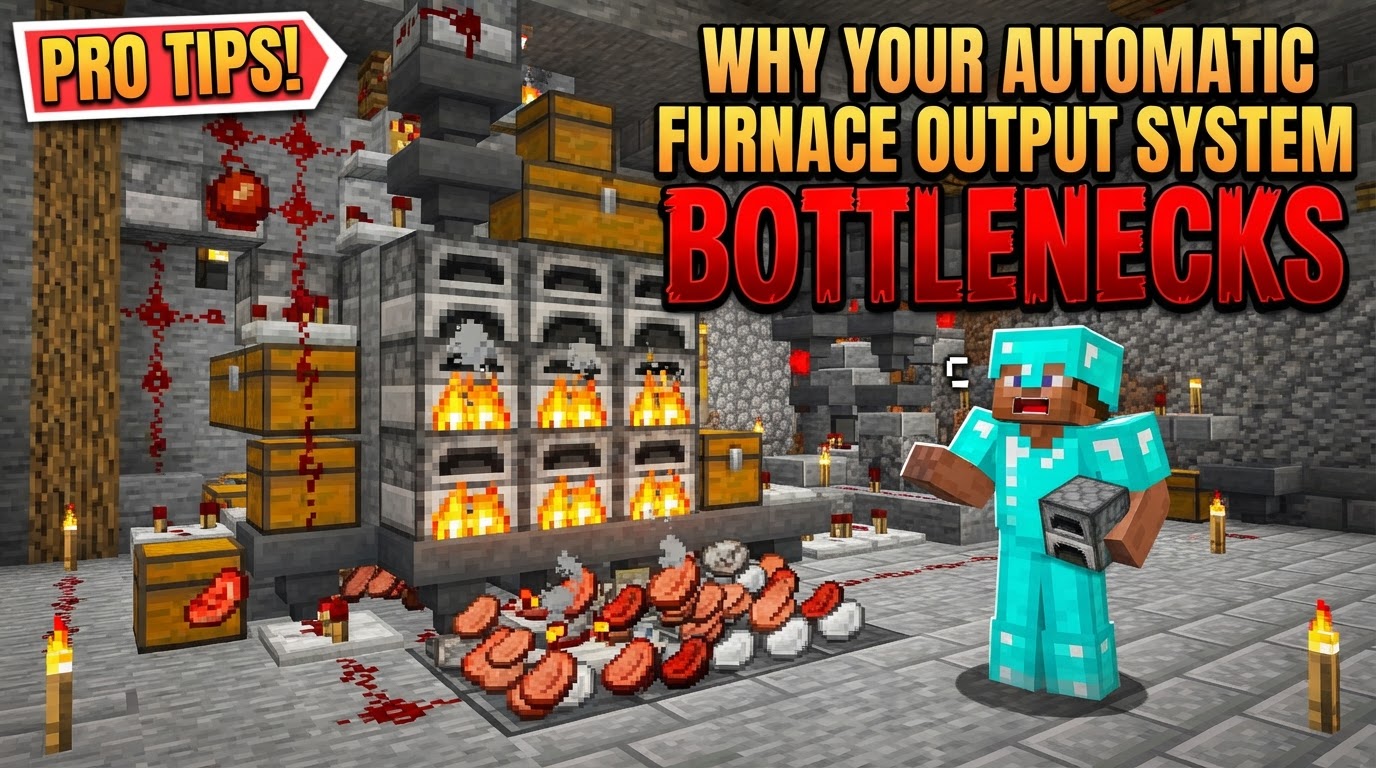
Designing an efficient automatic smelting system in Minecraft requires a deep understanding of its underlying mechanics. While a basic setup might seem straightforward, scaling it up or expecting rapid output often reveals hidden limitations. This guide will dissect the common reasons your automated furnaces aren’t performing as expected and provide strategies to overcome these throughput challenges.
Deconstructing the Core Mechanics: The Pace Setters
Before optimizing, it’s crucial to understand the fundamental rates and rules governing item flow and processing:
- Furnace Smelting Speed: A standard furnace is the slowest link in most chains, processing one item every 200 game ticks, which translates to a full 10 seconds per item. This rate yields a mere 6 items per minute per furnace.
- Hopper Transfer Rate: In stark contrast, hoppers are quite efficient, capable of moving 2.5 items per second, or 150 items per minute. This rate is significantly faster than a single furnace’s output, meaning a hopper can easily keep up with, and even outpace, a furnace’s production.
- Input and Output Logic: Furnaces have specific entry points: items to be smelted must enter from the top, fuel must enter from any of the four sides, and smelted products will exit from the bottom. Misdirection here results in complete system failure.
- Specialized Furnace Advantages: For specific tasks, specialized furnaces offer a substantial speed boost. Blast Furnaces smelt ores at double the speed of regular furnaces, while Smokers cook food twice as fast. Leveraging these can cut smelting times in half for their respective item types.
- Hopper Locking: Hoppers can be temporarily deactivated by applying Redstone power. This mechanism is vital for advanced systems that require precise control over item flow, preventing items from moving until a specific condition is met.
The Anatomy of a Basic Automatic Furnace System
To illustrate where bottlenecks emerge, let’s first outline the standard, functional automatic furnace setup:
- Input Chest: Placed directly above the furnace, this chest holds the raw materials destined for smelting.
- Input Hopper: Connects from the bottom of the input chest to the top of the furnace. This ensures raw items are fed into the correct slot.
- Fuel Chest: Positioned to the side of the furnace (or above a fuel hopper leading to the side).
- Fuel Hopper: Connects from the bottom of the fuel chest (or directly from the chest itself) to any side of the furnace. This supplies the necessary fuel.
- Output Hopper: Attached to the bottom of the furnace, collecting the smelted items and depositing them into an output chest or storage system.
This simple configuration works, but its efficiency quickly plateaus due to the inherent speed limitations of the furnace itself.
Unmasking the Bottlenecks: Where Systems Fail to Scale
Understanding the core mechanics reveals the true culprits behind slow automatic smelting. It’s rarely the humble hopper struggling to keep up:
- The Single Furnace Limitation: Your Primary Constraint
The most significant bottleneck, by an overwhelming margin, is the furnace’s internal processing speed. With one item taking 10 seconds to smelt, a single furnace can only produce 6 items per minute. Regardless of how quickly you feed it or how fast you extract its products, this internal clock dictates the maximum throughput. Trying to push more items through a single furnace is like trying to drain an ocean with a teacup – the rate is fixed by the teacup’s capacity, not the size of the ocean or how fast you pour water into it. - Incorrect Hopper Direction: A Fatal Design Flaw
This isn’t a bottleneck as much as a complete stoppage. Items to be smelted must enter the top slot of the furnace, and fuel must enter one of the side slots. Attempting to feed fuel into the top or raw materials into the side will prevent the furnace from operating correctly. Always double-check your hopper connections by looking at the furnace itself; the hopper’s “spout” should point directly into the desired slot. - Uneven Distribution in Large Arrays: The Super Smelter’s Bane
When building “super smelters” with dozens or hundreds of furnaces, distributing raw materials and fuel evenly becomes a complex challenge. Systems relying on long lines of hoppers or hopper minecarts can suffer from uneven distribution. If a minecart isn’t adequately filled, or if hoppers in a line prioritize certain furnaces, some furnaces may sit idle, waiting for resources, while others are oversupplied. This leads to reduced overall efficiency despite having many furnaces. - Hopper Chain Length: A Subtle Drag
While individual hoppers are fast, very long chains of hoppers (e.g., for transporting items across a vast distance) can introduce minor delays and create backlogs, especially if the source is producing items faster than the chain can consistently move them. This is less common as a primary bottleneck in smelting itself but can impact the overall flow to and from a large system. - Unloaded Chunks: The Invisible Barrier
Minecraft only processes game mechanics within loaded chunks. If your large automatic furnace system, especially one relying on moving entities like hopper minecarts, extends into chunks that are not actively loaded (e.g., you’ve moved too far away, or the server isn’t actively loading them), parts of your system will simply stop functioning. This can bring an otherwise perfect design to a grinding halt until the relevant chunks are reloaded.
Optimizing for Throughput: Strategies to Overcome Limitations
Once you understand the bottlenecks, the solutions become clear. Focus on these strategies to maximize your automatic furnace system’s output:
- Embrace Parallel Processing: The Ultimate Solution
Since the single furnace is the primary bottleneck, the most effective way to increase throughput is to build multiple furnaces side-by-side in an array. If one furnace processes 6 items per minute, ten furnaces will process 60 items per minute. This is the cornerstone of any high-capacity smelting operation. - Leverage Specialized Furnaces for Specific Tasks
Don’t use a regular furnace for everything. For ores (like iron, gold, or raw materials like sand and cobblestone), always use a Blast Furnace. For all food items, use a Smoker. These specialized blocks process items at double the speed, effectively cutting your required furnace count in half for those specific tasks. - Implement Efficient Fuel Management
Choose fuels with high burn times to minimize the frequency of fuel resupply. Lava buckets (which burn 100 items), blocks of coal (80 items), and even coal (8 items) are far more efficient than small quantities of wood or saplings. Using high-burn-time fuels reduces the chance of furnaces idling due to lack of fuel, simplifying your distribution systems. - Utilize Minecart Distribution for Large-Scale Systems
For very large furnace arrays, especially those exceeding 10-20 furnaces, using hopper minecarts traveling over input hoppers (for raw materials and fuel) and output hoppers (for collecting smelted items) is often the most efficient distribution method. Hopper minecarts can pull items through a block above them and deposit items into a hopper below them, allowing a single track to serve many furnaces. Ensure the minecart is adequately filled and travels efficiently to prevent uneven distribution. - Strategic XP Collection
Furnaces store accumulated XP from smelting, which is usually collected when you manually retrieve items. If you want to collect all this XP at once (a common practice to avoid XP waste), you can temporarily disable the output hopper with a Redstone lever. Once the furnace is full of smelted items and has stored XP, manually retrieve just one item from the furnace’s output slot. This will release all accumulated XP into your character. Then, re-enable the hopper to resume automation.
In conclusion, the key to a high-performing automatic furnace system in Minecraft lies not in perfecting individual hopper speeds, but in scaling the number of furnaces and intelligently utilizing specialized blocks. Address the furnace’s inherent processing limits, ensure correct item flow, and plan for even distribution in larger builds, and your days of waiting for smelted items will be a thing of the past.
Tags:
YOU MAY ALSO LIKE...