Why Your Fishing Farm Stops Producing After Updates
Over the past several years, Minecraft’s developers have systematically introduced numerous changes that have impacted the functionality and efficiency of AFK (Away From Keyboard) fishing farms. These updates, often referred to as “nerfs,” have frequently left players wondering why their once-reliable automated setups suddenly stopped producing the valuable items they once did.
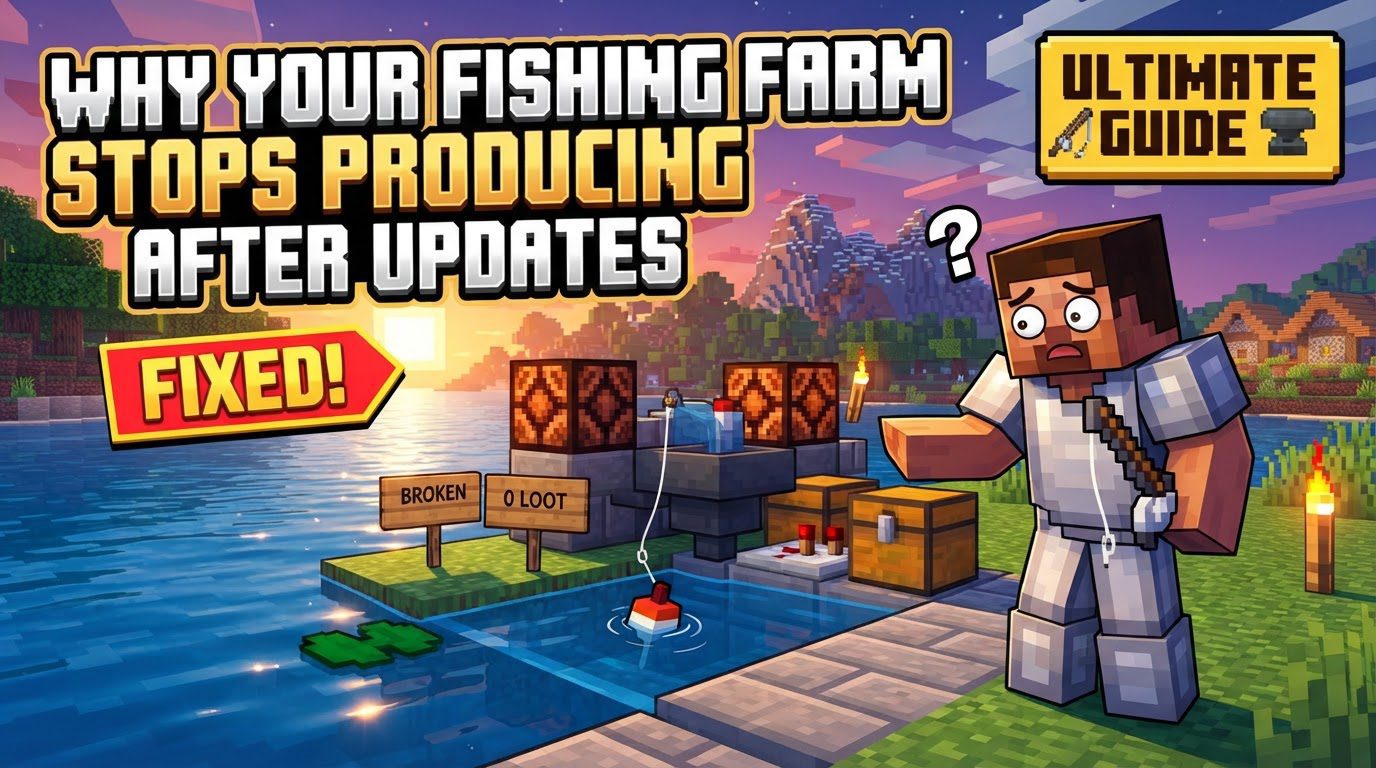
The core reason behind these changes stems from a desire to rebalance gameplay, particularly concerning the ease with which players could acquire rare items, experience points, and the coveted Mending enchantment without active engagement. As a result, many ingenious farm designs that once thrived have become obsolete. Here are the primary reasons why your Minecraft fishing farm may have ceased production after a recent update:
Bedrock Edition AFK Fishing Disable
One of the most significant and sweeping changes occurred in Minecraft Bedrock Edition, where updates effectively disabled traditional automated AFK fishing. This was not a subtle tweak but a fundamental alteration to how fishing mechanics interact with automated input. Previously, players could construct intricate Redstone-based systems or simple tripwire/pressure plate setups that would automatically cast and reel in a fishing rod, allowing for continuous item collection while the player was idle.
After these updates, the in-game designs that once facilitated this automation no longer function as intended. The game no longer registers the necessary sequence of actions for continuous fishing without direct player input or external assistance. For players who had invested time and resources into building these farms, this change meant their existing setups became entirely useless for true AFK operation. The only remaining method for AFK fishing on Bedrock Edition typically involves using third-party auto-clicker software or external hardware, which falls outside the realm of in-game mechanics and official support. This change aimed to encourage more active gameplay, but it rendered nearly all traditional, in-game AFK farm designs ineffective on Bedrock Edition.
Open Water Requirement (Java 1.16 Nerf)
Java Edition 1.16 brought a pivotal change that drastically altered the output of compact AFK fishing farms, specifically concerning treasure items. This update introduced a stringent “open water” requirement for catching valuable loot such as enchanted books, bows, and fishing rods. According to the new mechanics, a fishing bobber must be in an “open water” block to yield treasure.
The definition of “open water” is precise: it requires a 5x5x4 area (5 wide, 5 long, 4 high) around the bobber. Within this area, there must be at least two water blocks deep directly beneath the bobber, and two air blocks directly above it, with no other blocks obstructing this space. This meant that the popular, highly compact AFK farm designs, often built in small ponds or even single water blocks, were severely nerfed. While these farms could still produce common fish and junk items, their ability to generate valuable treasure loot was virtually eliminated. This change effectively pushed players towards fishing in larger, more natural bodies of water for any hope of acquiring rare items, thereby removing much of the incentive for compact AFK treasure farming.
Right-Click Interaction Patches (Iron Doors, Trapdoors, Fences)
Many early and highly effective AFK fishing farm designs relied on exploiting specific game mechanics involving right-click interactions. These farms often incorporated interactive blocks such as iron doors, trapdoors, or fence gates. The trick was that right-clicking these blocks would momentarily interrupt the fishing action, causing the rod to reel in instantly, often synchronized with a fish biting. This allowed for rapid, continuous fishing without manual intervention.
Mojang systematically identified and patched these specific right-click interaction exploits across various updates. Each patch targeted and removed the unintended interaction behavior that allowed these blocks to trigger a reel-in. As a result, older AFK farm designs that were dependent on these interactive blocks for their automation mechanism simply stopped working. Players were forced to constantly adapt their builds, leading to a cat-and-mouse game between farm designers and developers. These patches rendered approximately 90% of older AFK farm designs obsolete with each iteration that specifically targeted these interactions, effectively preventing unintended automation and the exploitation of these game mechanics.
1.13 Fishing Rod Bug
Java Edition 1.13 introduced a particularly frustrating bug that plagued AFK fishing farms during its tenure. This bug sometimes caused the fishing line to disappear shortly after the initial cast. In a functional AFK farm, the bobber’s landing and subsequent movement (when a fish bites) are critical for triggering pressure plates or other detection mechanisms that automate the reel-in process.
When the fishing line disappeared, the bobber would not consistently land on or remain on the pressure plate, or it would simply fail to register the necessary state changes. This disruption broke the continuous AFK fishing cycle, leading to farms that would stop working intermittently or completely. While eventually patched, this bug caused significant headaches for players relying on automated fishing during version 1.13, leading to inconsistent operation and frequent breakdowns of their setups.
Sculk Sensor Bobber Sound Changes
More recently, around Java Edition 1.20.4, observations have indicated potential changes in how sculk sensors detect the sound of a fishing bobber. Sculk sensors, introduced as a Redstone component that reacts to vibrations, have been ingeniously integrated into some modern AFK fishing farm designs. These designs typically use the sculk sensor to detect the distinct sound made when a fishing bobber lands in water or when a fish bites, triggering a Redstone signal to reel in the rod.
If the sensitivity or detection parameters for these specific fishing-related sounds have been altered in updates, farms relying on sculk sensors for automation may cease to function correctly. A change in sound propagation, detection range, or the specific vibration frequency associated with fishing actions could mean that the sensor no longer reliably triggers the reel-in mechanism. This can lead to a complete failure in sculk sensor-based automation systems for fishing, requiring players to either redesign their detection system or find alternative solutions.
Mending Enchantment’s Impact
While not a direct “nerf” to fishing mechanics itself, the introduction and widespread popularity of the Mending enchantment played a significant role in motivating Mojang’s subsequent decisions to curb AFK fishing. Mending, which repairs items using experience points gained, made AFK fishing incredibly powerful. Players could use a single fishing rod indefinitely, as the experience gained from catching fish would continuously repair the rod, even when AFK.
This created a self-sustaining system where players could accumulate vast amounts of items-including rare enchanted books, bows, and more fishing rods-along with significant experience, all without active participation. The ability to obtain high-tier enchantments, particularly Mending itself, from an AFK setup was perceived as overpowered and undermined the intended progression of the game. This immense popularity and efficiency of AFK fishing, largely driven by the Mending enchantment, is often cited as a direct catalyst for Mojang’s numerous nerfs aimed at rebalancing the game’s economy and encouraging more active engagement in resource acquisition.
AFK fishing farms, in their essence, are automated contraptions designed to cast and reel in a fishing rod continuously, allowing players to gather resources, experience, and valuable items without needing to be actively present at their keyboard. They gained immense popularity for their efficiency in acquiring food, enchanted books (especially Mending), and other rare treasures, making them a staple for many survival players seeking an easy source of wealth and progression. However, as demonstrated by the array of updates above, Mojang has consistently worked to curtail their effectiveness, shifting the landscape of automated resource gathering in Minecraft.
Tags:
YOU MAY ALSO LIKE...