Creating Player Housing Districts on SMPs
Failing to implement a robust land-claiming system is one of the quickest ways to derail a promising Minecraft SMP server, leaving player builds vulnerable to griefing and discouraging community participation. Creating well-structured player housing districts is paramount for fostering a stable and engaging environment where players can invest time and creativity without fear of loss. These districts, carefully planned and secured, transform a chaotic landscape into an organized, thriving digital community.
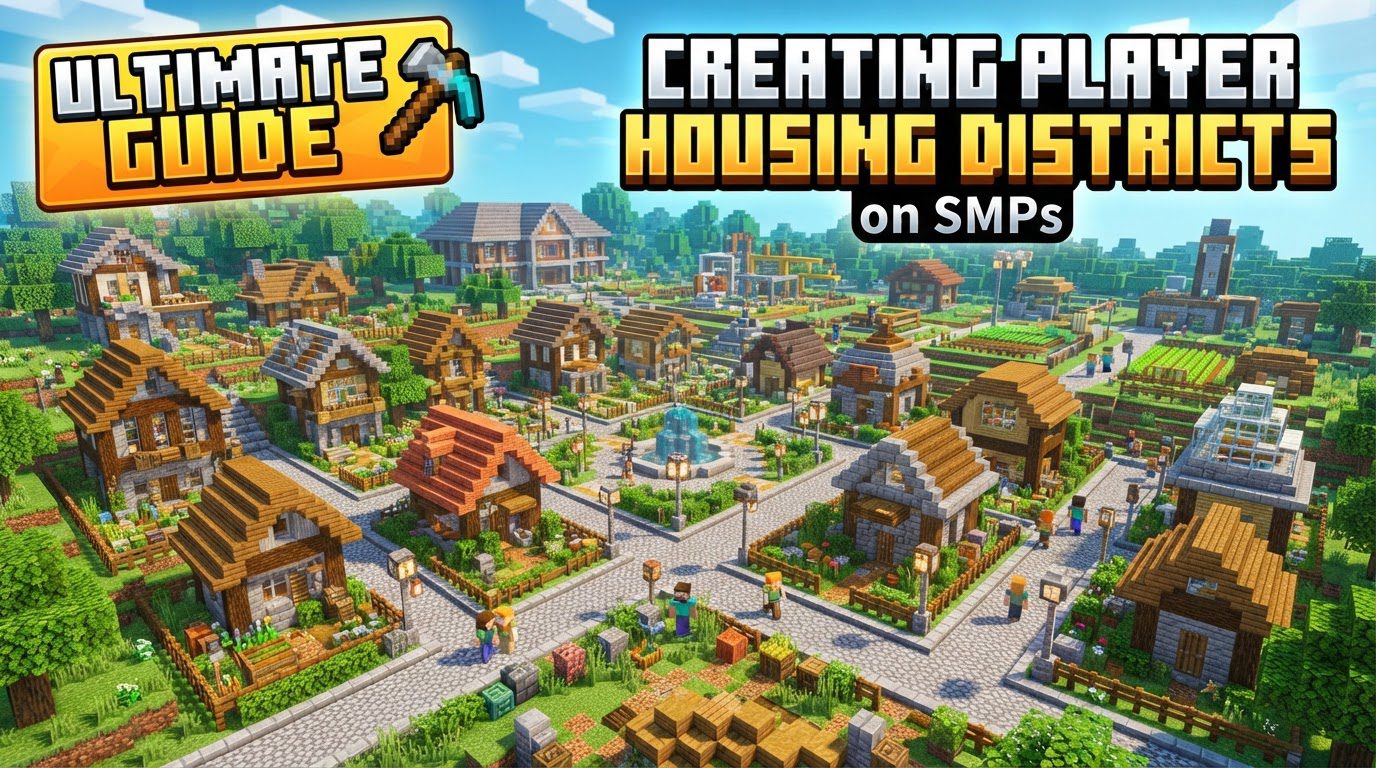
The Foundation: Essential Plugins
The backbone of any successful player housing district on an SMP lies in its technical infrastructure. Without the right plugins, managing land ownership, preventing malicious acts, and facilitating a player-driven economy becomes an impossible task. Two categories of plugins are particularly critical for this endeavor: land claiming and economy management.
Securing Your Space: Land Claiming Plugins
Land claiming plugins are the absolute cornerstone of player housing districts. Tools such as “LandClaiming” or “Lands” empower players to secure plots of land, transforming open wilderness into personal sanctuaries. This protection is not merely cosmetic; it provides comprehensive safeguards against a multitude of threats.
- Grief Prevention: The primary function of these plugins is to prevent griefing. Once a player claims land, it becomes immune to unauthorized modifications. This includes protection from fire spread, lava placement, and destructive actions like unauthorized mining or building. Crucially, it also extends to preventing interference with chests, gates, animals, and crops, ensuring that players’ hard-earned resources and progress remain safe.
- Claim Management: These plugins offer flexible ways to define and manage protected areas. Many operate on a chunk-based system, meaning players claim 16×16 block protection zones. Some even feature auto-claiming as players traverse new territory, simplifying the protection process. The ability to require claims to be adjacent encourages more organized and contiguous development within districts.
- Advanced Features: Modern land claiming plugins go beyond basic protection, offering sophisticated functionalities. These can include customizable claim profiles, granular roles for managing members within a claim (e.g., trust levels for building or chest access), and the ability to form alliances with other claims. Integration with web maps is a particularly useful feature, allowing players and administrators to visualize all claims across the server, aiding in planning and navigation.
- WorldGuard Integration: For server administrators, compatibility with WorldGuard is a significant advantage. This allows specific claiming rules to be applied to predefined areas. For instance, spawn regions or designated warzones can be set up to disallow player claims or enforce different protection parameters, maintaining server-wide consistency and order.
- Combat Tagger Integration: To prevent players from abusing claim mechanics during PvP combat, many plugins integrate with combat taggers. This ensures that players cannot use claim commands, such as teleporting to their claim or abandoning it, while actively engaged in a fight, promoting fair play.
Fueling the Economy: Money & Trade
While protection is vital, a dynamic economy adds another layer of depth and interaction to housing districts. Economy plugins manage the server’s digital currency, facilitating a wide range of transactions that support land acquisition, resource exchange, and service provision within these communities.
- Features: Standard economy plugins offer core functionalities such as giving, taking, and setting player money balances. They enable secure player-to-player transfers, allow players to check their current balance, and some advanced versions even support the creation of multiple currencies, adding complexity and realism to the server’s financial ecosystem.
Building Your District: A Step-by-Step Approach
With the technical foundations in place, the next step involves the practical implementation of your housing districts. This process moves from initial configuration to fostering a vibrant, navigable community.
Phase 1: Initial Server Configuration
The very first step is to install and meticulously configure your chosen land-claiming plugin (e.g., LandClaiming, Lands) and, if desired, an economy plugin. Proper configuration is critical to ensure that claim sizes, permissions, and economic interactions align with your server’s vision and rules. This phase sets the stage for all subsequent development.
Phase 2: Defining the Urban Landscape
Designate specific areas on your server’s map where player housing will be permitted. This can be achieved by simply communicating the designated zones or, more robustly, by using WorldGuard to define clear boundaries. Establishing these boundaries early prevents haphazard development and ensures that housing clusters in logical, manageable locations.
Phase 3: Empowering Players to Claim
Clearly communicate to your player base how they can claim land. Different plugins have different methods. For instance, the “LandClaiming” plugin might allow players to automatically claim a 9×9 plot by simply placing a chest in an unclaimed area. Other plugins might rely on specific commands, such as /claim. Making this process intuitive and well-documented is crucial for player adoption.
Phase 4: Growing the Community
Encourage players to begin by building individual houses. As the community grows, foster the development of neighborhoods, complete with communal structures like markets, parks, or public farms. Gradually, this organic expansion can lead to the creation of businesses, adding economic activity and social hubs within the district.
Phase 5: Navigating the Streets
As districts expand, effective navigation becomes essential. Implement systematic routes and highways throughout the housing areas. Utilize signs, color-coding, number systems, or letter systems to clearly mark roads and destinations. This structured approach helps both residents and visitors find their way, reducing confusion and enhancing the overall player experience.
Strategic Tips for Thriving Districts
Beyond the fundamental steps, several strategic considerations can significantly enhance the quality and longevity of your player housing districts.
Location, Location, Location: Choosing Your Terrain
While creative terraforming is always an option, building settlements on naturally flat biomes like deserts, plains, or savannas can vastly simplify the initial construction process. These biomes require less groundwork preparation, allowing players to focus more on building their structures rather than extensively reshaping the landscape.
Aesthetics and Order: Designing for Success
Encourage an organized design from the outset. Districts with systematic streets and a variety of architectural styles tend to be more visually appealing and enjoyable to inhabit. A well-planned layout not only looks better but also facilitates easier navigation and future expansion.
Organic Growth: Starting Small, Expanding Smart
Resist the urge to over-plan every detail from day one. Begin by focusing on individual houses and gradually allow the community to expand. This organic growth can lead to the natural formation of neighborhoods, businesses, and eventually, a full village or even a city, reflecting the unique character of your player base.
Efficient Use of Space: Density Considerations
For servers anticipating a large population or those wishing to create more urbanized settings, consider building density. Placing houses together, perhaps in multi-story residential buildings or apartment blocks, can make efficient use of space and allow for larger individual dwellings within a compact footprint.
User-Friendly Management: Intuitive Claiming
Always prioritize ease of use for your players. Utilize plugins that offer intuitive graphical user interface (GUI) menus for claim management. A system that is easy to understand and interact with will lead to higher player satisfaction and better utilization of the housing districts.
Avoiding Pitfalls: Common Mistakes to Sidestep
Even with the best intentions, certain missteps can undermine the success of player housing districts. Being aware of these common mistakes can help server administrators preemptively avoid them.
The Peril of Unprotected Land
Failing to implement a reliable land-claiming system is perhaps the most critical error. Without robust protection, player builds are constantly vulnerable to griefing, theft, and vandalism. This quickly erodes player trust and discourages participation, as players are hesitant to invest time and resources into something that can be destroyed in moments.
Complexity Kills: Simplifying Claiming
An overly complex claiming system can be just as detrimental as no system at all. If the process for players to understand, initiate, or manage their claims is too difficult or convoluted, it will lead to frustration and underutilization of the housing districts. Players will either avoid claiming altogether or struggle to protect their property effectively.
The Cost of Haphazard Growth
Poor planning for expansion can result in a chaotic and disorganized district. Without a vision for how the district will grow, layouts can become jumbled, navigation can become a nightmare, and valuable space can be inefficiently used. This lack of foresight can make future development and management significantly more challenging.
Performance Matters: Don’t Overlook Server Health
While ambitious builds and numerous plugins can enhance the player experience, ignoring server performance is a critical mistake. Overly complex builds, inefficient plugin configurations, or a sheer volume of unoptimized structures can negatively impact server performance, leading to lag, crashes, and a generally poor experience for all players. Regular monitoring and optimization are essential.
By carefully considering these mechanics, processes, and potential pitfalls, any Minecraft SMP administrator can cultivate thriving, secure, and engaging player housing districts that become the heart of their server community.
Tags:
YOU MAY ALSO LIKE...