Comparing Different Mob Grinder Drop Collection Methods
One of the most frustrating experiences in Minecraft is watching the hard-earned drops from your mob grinder disappear into the void because your collection system couldn’t keep up. An efficient item collection system is just as crucial as the grinder itself, ensuring that every valuable item makes it into your storage. Without a robust collection method, even the most productive mob farm is just a fancy way to despawn loot.
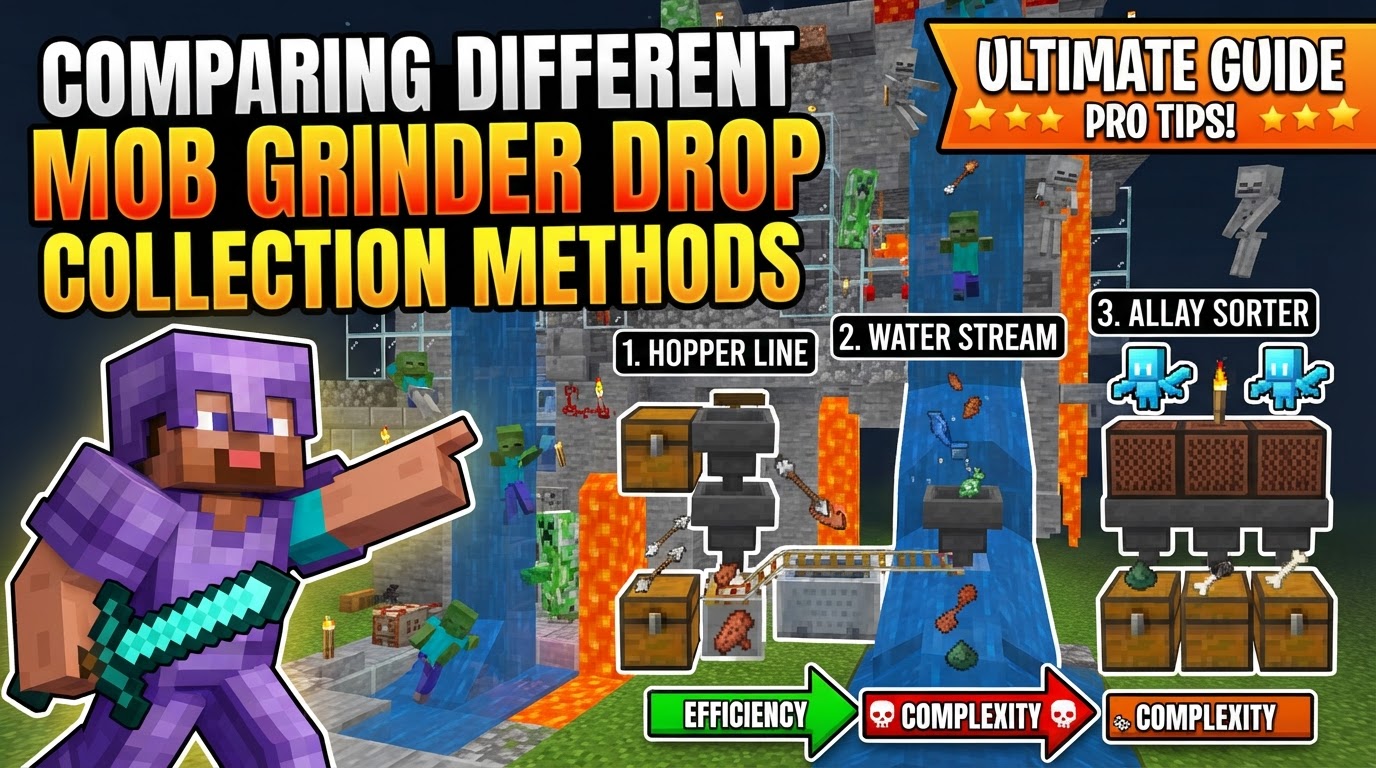
Understanding the Core Item Collection Mechanics
Effective mob grinder collection hinges on mastering a few fundamental mechanics that govern how items move and are stored in the game. Each method has its strengths and ideal use cases.
Hoppers: The Foundation of Item Transfer
- Functionality: Hoppers are versatile blocks designed to automatically collect item entities directly above them. They act as funnels, immediately transferring collected items into an attached container (like a chest) or another hopper.
- Collection Rate: A single hopper processes items at a steady pace of one item every 0.8 seconds, equivalent to four redstone ticks. While reliable, this rate can become a bottleneck for high-volume farms.
- Redstone Control: Hoppers can be locked by a redstone signal, temporarily halting all item movement. This feature is useful for advanced sorting systems or when you need to pause collection.
Water Streams: Guiding Items with Fluid Dynamics
- Movement Mechanism: Water flows are indispensable for moving dropped items across large surfaces. Items caught in a water current will travel along with it, making them perfect for converging drops from a wide area to a single collection point.
- Interaction with Mobs and Items: Water can be cleverly integrated with killing mechanisms. For instance, items will float on top of water, allowing them to be safely collected, while mobs might be pushed into damage sources like magma blocks below the water’s surface.
- Despawn Timer Consideration: Items remain in the game world for a maximum of 5 minutes before despawning. Therefore, any water stream system must be designed to transport items to storage well within this timeframe to prevent loss.
Hopper Minecarts: High-Throughput and Versatile Collection
- Enhanced Collection: A hopper minecart is essentially a hopper mounted in a minecart, granting it superior collection capabilities. Unlike static hoppers, a hopper minecart can collect items from above even through a solid block.
- Speed and Volume: These entities are significantly faster and more efficient for high-volume item collection compared to a chain of static hoppers. Their mobility allows them to cover more ground quickly.
- Long-Distance Transport: When placed on a rail system, hopper minecarts become an excellent solution for transporting items over considerable distances, seamlessly bridging the gap between a remote grinder and a central storage facility.
Constructing an Efficient Collection System: A General Blueprint
Regardless of the mob grinder type, the general principles for setting up an effective collection system remain consistent. It’s a multi-stage process designed to funnel items from the point of origin to secure storage.
Integrating with the Kill Chamber
The first step in any collection system begins directly below or adjacent to your mob grinder’s kill chamber. Once mobs are eliminated (whether by fall damage, lava blades, magma blocks, or player interaction), their drops are released. The collection system must be positioned to immediately capture these items.
Designing the Collection Area
Below the kill chamber, a dedicated collection area is established. This area is where the primary collection method (hoppers, water streams, or a combination) goes into action:
- For Hopper-based Systems: Hoppers are placed directly beneath the kill zone, feeding into chests. For larger kill zones, multiple hoppers may be required to cover the entire area.
- For Water Stream Systems: Water is used to push items from the kill zone towards a central point. This point typically features a hole where items drop into hoppers for further processing. The design must ensure all items converge without getting stuck.
Automated Storage Solutions
Once items are collected by hoppers, they need a place to go. This is where automated storage comes in:
- Chest Arrays: Hoppers should feed directly into chests. For high-output farms, consider building large chest arrays, often in a tiered or stacked design, to accommodate the sheer volume of drops. Each hopper can feed into a double chest, and hoppers can feed into other hoppers that feed into chests below.
Optional: Long-Distance Item Transport
If your storage facility is not directly beneath your grinder, you’ll need a transport system:
- Hopper Chains: For shorter distances, a chain of hoppers feeding into one another can work, though this can be resource-intensive and slow for very long hauls.
- Water Streams: Items can be transported via long water streams, especially efficient if running over ice blocks to increase item speed.
- Hopper Minecarts on Rails: For the most efficient long-distance transport of high volumes, hopper minecarts on powered rails are the preferred method. They can rapidly move items to a distant storage area, where they are then unloaded into chests via hoppers.
Optimizing Item Flow: Expert Tips for Peak Performance
Even a well-designed system can be improved. These tips focus on maximizing the efficiency and reliability of your drop collection.
Addressing High-Volume Needs
Mob grinders that produce a large number of drops per minute demand a robust collection infrastructure. To prevent item overflow and despawning:
- Multiple Hoppers: Place several hoppers side-by-side beneath the kill zone to increase the collection rate.
- Hopper Minecarts: For peak efficiency, especially with wide kill areas or extremely high output, a hopper minecart running back and forth beneath the collection area is often the best solution. It can pick up items faster and through blocks.
Mastering Water Stream Design
Water streams, while powerful, require careful planning:
- Consistent Flow: Ensure water sources are placed correctly to create a uniform flow that covers the entire collection surface. Avoid “dead spots” where items might come to rest.
- Ice Block Advantage: Items move significantly faster on ice blocks (packed ice or blue ice) when pushed by water. Incorporating these blocks into your water streams can dramatically reduce transport time, mitigating the risk of despawning.
Precision Hopper Placement
Correct hopper alignment is non-negotiable for item transfer:
- Sneak-Click Placement: Always sneak-click (shift-click) when placing a hopper onto a container (like a chest) or another hopper. This ensures the hopper is correctly oriented to feed items into the target block. A hopper’s “spout” must point towards the container it’s feeding into.
The AFK Sweet Spot
Your “Away From Keyboard” (AFK) spot plays a critical role in the entire operation:
- Spawn Radius: Mobs typically spawn within a certain radius around the player. Your AFK spot should be positioned to maximize mob spawns within your grinder.
- Despawn Radius: Items despawn after 5 minutes. Your AFK spot must be close enough to the collection area that items are collected and moved into storage before this timer runs out. Ensure the entire collection path is within this active range.
Common Mistakes to Sidestep for Flawless Collection
Even experienced players can fall victim to common errors that cripple a grinder’s efficiency. Being aware of these pitfalls can save you significant time and resources.
Insufficient Hopper Capacity
One of the most frequent mistakes is underestimating the number of hoppers needed for a high-output farm. If items are being generated faster than your hoppers can process them, they will pile up on the ground and eventually despawn. Always err on the side of more hoppers or implement hopper minecarts for high-volume collection.
Incorrect Hopper Placement and Orientation
A hopper that isn’t correctly oriented will simply hold items rather than transferring them. Always double-check that your hoppers are pointing into the intended chest or other hopper. A misaligned hopper acts as a roadblock, stopping the entire flow of items.
Unoptimized Water Flow
Poorly designed water streams can create numerous problems. If the flow is weak, inconsistent, or has “dead spots” (areas not covered by flowing water), items can get stuck and despawn. Test your water streams thoroughly to ensure items move smoothly and efficiently to the collection point.
Ignoring the Item Despawn Timer
The 5-minute despawn timer for items is a hard limit. If your collection, transport, or storage system is too slow, or if your AFK spot is too far from the active parts of the collection, items will simply vanish. Design for speed and ensure continuous item movement.
Neglecting Spawn-Proofing Surrounding Areas
While not directly a collection method issue, failing to light up or otherwise spawn-proof caves and dark spots in the surrounding chunks can significantly reduce the efficiency of your mob grinder. Mobs will spawn in these unlit areas instead of your grinder, leading to fewer drops for your collection system to handle. Always ensure your grinder is the most attractive spawning location for mobs.
Tags:
YOU MAY ALSO LIKE...