Getting Started With Ad Astra Space Exploration
Imagine launching your meticulously crafted rocket to the Moon, exploring its desolate surface, only to realize you have no way to get back home. This all-too-common oversight is just one of many challenges awaiting new spacefarers in Ad Astra, a transformative Minecraft mod that redefines exploration, pushing players beyond the familiar Overworld into the cold, dark expanse of space.
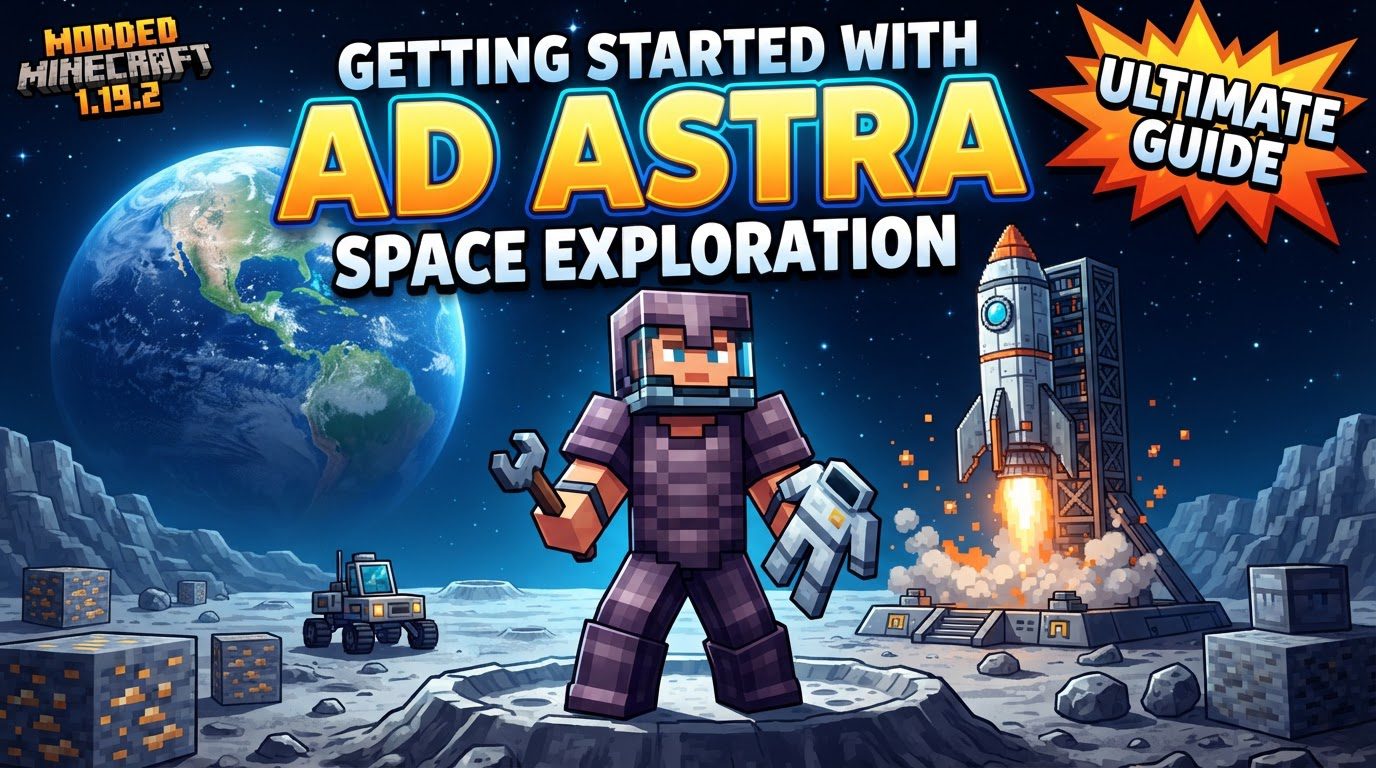
Ad Astra is not merely an addition; it’s an entirely new layer of gameplay, turning your blocky world into a cosmic adventure. Progression is meticulously designed, demanding technological advancement, strategic resource gathering, and rigorous preparation for the unique hazards of extraterrestrial environments. From crafting your first space suit to establishing bases on distant planets, every step in Ad Astra is a testament to ingenuity and survival.
Core Mechanics: The Pillars of Space Exploration
Before embarking on your interstellar journey, understanding Ad Astra’s foundational mechanics is paramount. These systems dictate your progress and survival.
- Powering Your Endeavors: The Coal Generator is your primary early-game power source, burning coal to energize machines. Energy is transferred via Steel Cables.
- Transforming Raw Materials:
- The Compressor converts ingots into plates (e.g., Iron Ingots to Iron Plates, Steel Ingots to Steel Plates), which are crucial for many recipes.
- The Etrionic Blast Furnace creates Steel Ingots by combining iron ingots and coal in alloy mode.
- The Art of Rocketry:
- The NASA Workbench is the specialized crafting station where rockets are assembled from components like nose cones, fins, metal blocks, tanks, and engines.
- The Fuel Refinery processes crude oil (found in ocean biomes) into rocket fuel. Each rocket launch consumes 3,000 units of fuel, equivalent to three fuel buckets. Cryo Fuel, made from ice shards in a Cryofreezer, is more efficient, requiring only one bucket per launch.
- Rocket Tiers: There are four tiers of rockets, each unlocking new planets and requiring materials from the previously explored celestial body.
- Surviving the Void:
- Space Suits: Essential for protection against vacuum and extreme temperatures, requiring a full set (helmet, suit, pants, boots) and an Oxygen Gear component.
- Oxygen Loader: Fills space suits and oxygen tanks with oxygen generated from water.
- Oxygen Distributor: Used to create breathable atmospheres within sealed bases on airless planets.
- The Cosmic Ladder: Planet Progression: Your journey begins on Earth, progressing to the Moon with a Tier 1 Rocket, then Mars, Venus, Mercury, and finally Glacio in the Proxima Centauri system.
Your First Steps Off-World: A Detailed Guide
Your initial foray into Ad Astra will focus on establishing an industrial base on Earth and preparing for your maiden voyage.
Earthbound Preparations: Infrastructure & Materials
Begin by gathering ample iron and coal. Craft a Coal Generator and connect it to your first machines with Steel Cables. Next, build a Compressor to turn iron ingots into Iron Plates. Progress to an Etrionic Blast Furnace to produce Steel Ingots from iron and coal, then compress them into Steel Plates. Steel is vital for your first rocket and numerous components.
Fueling Your Ambitions: Crude Oil to Rocket Fuel
Locate and collect crude oil in ocean biomes using buckets. Construct a Fuel Refinery to process the oil into rocket fuel. Remember, a round trip to the Moon requires at least six fuel buckets (three for launch, three for return).
Gearing Up for the Void: Space Suits and Oxygen
Craft a full Space Suit set (helmet, suit, pants, boots) using iron and steel plates, including the crucial Oxygen Gear component. Build an Oxygen Loader and connect it to water to fill your suit with oxygen. Craft extra oxygen tanks for extended travel.
Assembling Your Vessel: The Tier 1 Rocket
Construct a NASA Workbench. Here, you will assemble your Tier 1 Rocket using steel components: a Steel Nose Cone, Steel Fins, Steel Blocks for the body, Steel Tanks for fuel storage, and a Steel Engine.
The Launch: Your First Journey to the Moon
Before launch, a critical step: craft at least two Launch Pads – one for your initial takeoff, and the other for your vital return journey. Place your rocket onto a Launch Pad, fuel it with your refined rocket fuel, and load any extra fuel buckets, tools, and resources into its internal inventory. Step inside, and prepare for liftoff to the Moon!
Mastering Space Travel: Essential Tips & Tricks
Beyond the basic progression, a few seasoned astronaut tips can significantly enhance your Ad Astra experience.
- Never Forget Your Return Ticket: This cannot be stressed enough. Always carry a second Launch Pad in your inventory when traveling to a new celestial body. Your rocket’s original Launch Pad cannot be retrieved after landing, and forgetting a spare will leave you stranded, necessitating a new rocket on Earth just to retrieve your gear.
- Portable Power Solutions: When establishing a new outpost on a distant world, immediate power can be a challenge. Craft and fully charge an Energizer on Earth. Break it, carry it to your new planet, and deploy it to provide initial power for your machines before you can set up local power generation.
- Establishing a Breathable Haven: On airless worlds like the Moon, standard torches will extinguish. Opt for Soul Torches or Glowstone for reliable illumination. To create a breathable and comfortable base, set up an Oxygen Distributor connected to a Water Pump via Fluid Pipes. Crucially, pair this with a Gravity Normalizer for a complete habitat. A clever trick is to bring a pre-filled Large Gas Tank with Oxygen to efficiently “seed” your Oxygen Distributor, preventing pipes from freezing before the water pump can establish a flow.
- Controlled Descent: Landing a rocket can be tricky. As you descend, hold the space bar to slow your craft, allowing for a much softer and controlled landing, preventing unwanted crashes.
- Your In-Game Companion: The Astrodux: Ad Astra provides an invaluable in-game guide called the Astrodux. Whenever you’re unsure about a recipe, a mechanic, or your next step in progression, consult this comprehensive guidebook. It’s your personal space exploration manual.
Avoiding Common Pitfalls
Even experienced players can stumble. Be aware of these common mistakes to ensure a smoother spacefaring journey.
- The Stranded Astronaut Syndrome: The most frequent and frustrating mistake is failing to bring an extra Launch Pad. This will leave you stuck on another planet, watching your resources dwindle. Always double-check!
- Oxygen System Missteps: When setting up an Oxygen Distributor with a Water Pump loop, ensure you either have a pre-filled Oxygen Tank to kickstart the system or understand the pipe freezing mechanics. An unseeded system trying to pull water through cold pipes can lead to issues.
- Lighting the Lunar Night: Don’t make the rookie mistake of placing regular torches on airless celestial bodies. They will simply go out, leaving you in the dark. Stick to oxygen-independent light sources.
- Interaction Warnings: While generally stable, be cautious with certain interactions. Pasting Ad Astra blocks with copy-paste tools, especially if they are powered, has been known to cause server crashes. Similarly, connecting a Pipez liquid pipe directly to an Ad Astra oxygen compressor can also lead to server instability. Always exercise caution with cross-mod interactions or powerful block manipulation tools.
Ad Astra transforms Minecraft into an epic saga of discovery and engineering. With careful planning, resourcefulness, and a keen eye on these guidelines, you’ll be well on your way to conquering the cosmos, one celestial body at a time. The universe awaits!
Tags:
YOU MAY ALSO LIKE...