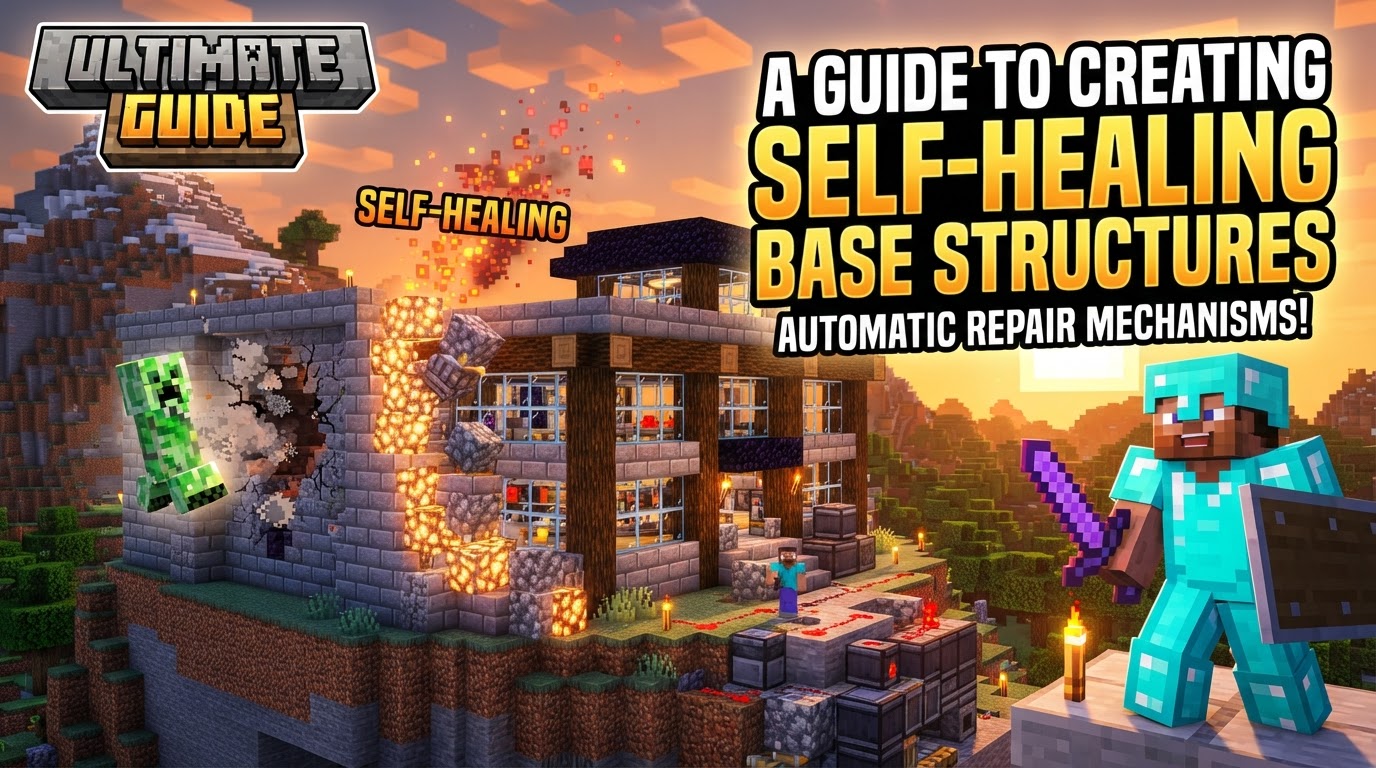
A Guide to Creating Self-Healing Base Structures
Imagine a base that repairs itself, a fortress that automatically rebuilds its walls after creeper explosions or hostile attacks. This seemingly magical feat is entirely possible in Minecraft, leveraging clever redstone contraptions and the game’s block generation mechanics. These automated defenses offer unparalleled protection and convenience, allowing players to focus on exploration, building, or resource gathering without constant worry about structural integrity.
Understanding the Core Mechanics of Self-Healing
At the heart of any self-healing Minecraft structure lies a combination of specific game mechanics working in concert. Mastering these fundamental principles is crucial for designing effective and reliable automated defenses.
The Perpetual Block Factory: Cobblestone Generators
The cornerstone of most self-healing designs is the cobblestone generator. This device exploits a simple in-game interaction: when flowing water meets flowing lava, a solid cobblestone block is instantly created. This provides an infinite, renewable source of building material directly at the point of construction. Cobblestone is the easiest and most common block for this purpose due to its simple generation method.
The Builders: Pistons
Once cobblestone is generated, it needs to be moved into position. Pistons are used for this. Regular pistons, when activated by a redstone signal, can push up to twelve blocks in a straight line. Strategically placed near a cobblestone generator, pistons systematically push newly formed blocks to create the desired structure, with their facing direction determining the push direction.
The Brains: Redstone Circuits
Redstone is essential for automating the pistons and generators. Key components include:
- Redstone Clocks: These provide a continuous, timed pulse to activate pistons, causing them to push blocks at regular intervals. The clock’s speed dictates the construction rate of the self-healing structure.
- Repeaters: Essential for managing the timing of redstone signals, extending their reach over longer distances, and fine-tuning delays within complex circuits.
- Observers: These blocks detect changes in adjacent blocks. They can sense when a wall block is broken and trigger a repair mechanism more responsively than a simple clock, enabling ‘on-demand’ repair rather than just continuous building.
The Boundaries: Containment Blocks
To prevent your self-healing structure from expanding indefinitely or lava from spilling uncontrollably, containment blocks are used. Non-flammable and immovable blocks, such as obsidian, define the build’s limits, ensuring pistons only push blocks within the intended area and hazardous liquids remain contained.
Advanced Applications: Structure Blocks (Creative Mode)
For highly complex or large-scale regeneration, primarily in creative mode or custom maps, structure blocks can save and load entire blueprints of structures. They feature an “integrity” setting to simulate gradual decay or repair by partially loading the structure over time.
Building Your First Self-Healing Wall: A Step-by-Step Guide
Let’s put these principles into practice by constructing a basic self-healing cobblestone wall. This fundamental design can be adapted and scaled for various applications.
1. Foundation and Piston Placement
Begin by laying out a foundation for your wall. Place a row of pistons along this foundation, ensuring they all face the direction the wall will extend (e.g., upwards or horizontally).
2. Water and Lava Setup
Create your cobblestone generator adjacent to the pistons. This involves placing a source block of water on one side and a source block of lava on the other, allowing their flows to meet at a single point directly in front of (or above) the piston head, where cobblestone will generate.
3. Automating with Redstone
Connect your pistons to a redstone circuit. For continuous building, use a redstone clock to provide regular pulses, pushing newly formed cobblestone. For faster, damage-responsive repair, incorporate observers facing the wall to detect broken blocks and trigger immediate replacement. Utilize redstone repeaters to ensure signal strength and correct timing throughout the circuit.
4. Defining Boundaries
Place containment blocks such as obsidian or bedrock at the end of the piston’s push limit. This prevents the wall from extending indefinitely and ensures your structure remains within its intended dimensions.
Optimizing Your Designs: Essential Tips
Beyond the basic setup, several considerations can enhance the efficiency and versatility of your self-healing structures.
- Cobblestone is Simplest: Due to its easy generation method, cobblestone remains the easiest and most common block to use for self-healing structures.
- Timing is Crucial: Adjust the speed of your redstone clock using repeaters to control how quickly new blocks are generated and pushed, balancing rapid repair with potential resource strain.
- Versatile Application: Don’t limit these principles to just walls; they can also be applied to create self-repairing bridges or floors.
- Cross-Platform Compatibility: Many basic self-repairing wall designs using cobblestone generators work on both Minecraft Java and Bedrock editions.
- Consider “Dustless” Designs: Some simpler designs can generate cobblestone walls using only water and lava flow without extensive redstone, though they may be less controlled.
Avoiding Pitfalls: Common Mistakes to Sidestep
Even experienced builders can stumble. Being aware of common errors can save you significant time and resources.
- Incorrect Water/Lava Placement: Improper placement can lead to the generation of unwanted blocks like obsidian or regular stone, or lead to uncontrolled lava flow. Always ensure flowing water meets flowing lava at the generation point.
- Improper Redstone Timing: Incorrectly configured redstone clocks or repeaters can cause the system to be too slow, too fast, or not function at all. Test your timings thoroughly before relying on the system.
- Exceeding Piston Push Limit: A single piston can only push up to 12 blocks. Attempting to push more will break the mechanism, requiring multiple piston arrays for larger structures.
- Lack of Containment: Without proper boundaries made of non-pushable blocks, the regenerating structure might expand beyond its intended area, causing unintended environmental changes.
- Underestimating Lag: Complex redstone contraptions, especially those constantly generating and pushing blocks, can cause significant performance lag in the game. Design efficiently and consider the impact on your game’s frame rate.
Building self-healing structures in Minecraft is a rewarding endeavor that combines creativity with technical understanding. By mastering the interplay of cobblestone generators, pistons, and redstone, you can construct defenses that actively protect your creations, offering peace of mind and an impressive display of engineering prowess. Experiment with these core principles, and watch your base become an unyielding bastion against the dangers of the Minecraft world.
Tags:
YOU MAY ALSO LIKE...