Advanced Large Steam Boiler Modern Industrialization
Overlooking the critical initial steam requirement for automated water pumps is a frequent misstep for those venturing into advanced industrialization within Minecraft’s Modern Industrialization mod. This seemingly small detail can halt an entire production line before it even begins, highlighting the intricate dependencies involved in mastering high-tier machinery like the Advanced Large Steam Boiler.
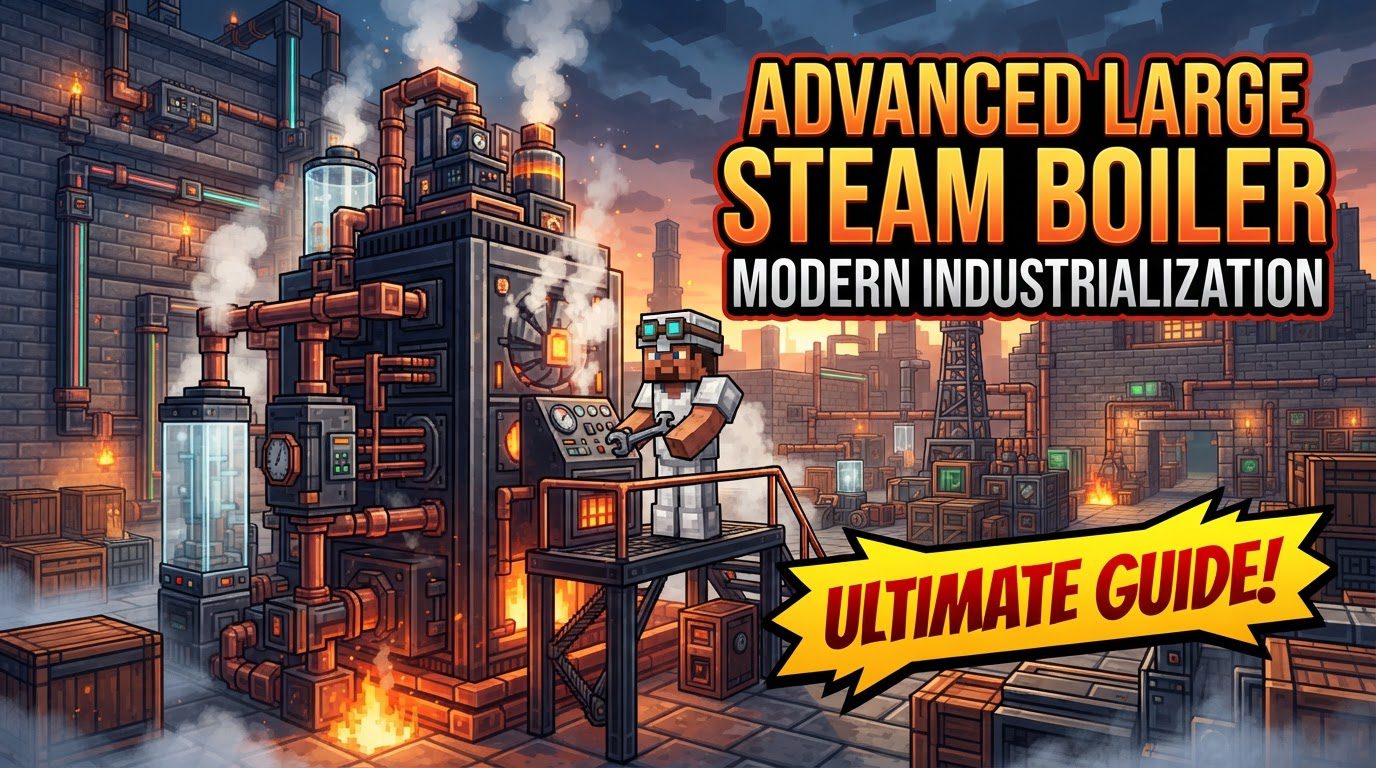
The Advanced Large Steam Boiler stands as a pivotal component in any ambitious industrial setup, representing a significant leap forward in steam generation capabilities. It’s an upgrade from earlier boiler tiers, designed to provide substantial quantities of steam with superior efficiency, essential for powering a wide array of industrial machinery that demands a robust energy supply. Understanding its mechanics and proper implementation is paramount for sustainable, large-scale production.
Core Principles of Steam Generation in Modern Industrialization
At its heart, the Advanced Large Steam Boiler operates on a fundamental principle: heating water with fuel to produce steam. This steam, a crucial fluid resource, then acts as the driving force for various machines. Modern Industrialization employs a tiered system for its boilers, progressing from Bronze to Steel, and culminating in the powerful Advanced Large Steam Boiler. Each successive tier offers increased output and improved efficiency, making the Advanced Large Steam Boiler the go-to choice for high-demand scenarios.
Unlike simpler machines, this boiler is a multiblock structure, meaning it requires a precise assembly of specific blocks to function correctly. Its design accommodates a broader range of fuel types, particularly liquid fuels, which are often more efficient and easier to automate at an advanced stage compared to the solid fuels used by lower-tier boilers. The boiler must reach a specific internal temperature to begin generating steam, with the Advanced Large Steam Boiler boasting an impressive maximum operating temperature of 2500 °C, capable of producing up to 1024 mB/t of steam.
Constructing Your Advanced Steam Powerhouse
The journey to harnessing the Advanced Large Steam Boiler begins with its meticulous construction. As a multiblock machine, its assembly is non-negotiable. You will need to carefully arrange various blocks, including heatproof machine casings, specific fluid input hatches for both water and fuel, a dedicated liquid output hatch for steam, and appropriate plated bricks such such as bronze plated bricks or steel plated bricks. Any deviation from the correct multiblock structure will prevent the boiler from activating.
Once the structure is complete, the next crucial step is supplying a continuous flow of water. Initially, this can be managed manually with water buckets, but for any serious industrial application, automation is key. A common and highly effective automated setup involves a bronze water pump drawing from a 9-block infinite water source. However, a unique challenge arises here: bronze water pumps require steam to operate. To kickstart this loop, a clever trick involves smelting a water bucket in a furnace to produce a “steam bucket,” which can then be manually input into the water pump to get it running. This initial burst of steam allows the pump to begin feeding water to the boiler, initiating the full cycle.
Fueling the Fire and Managing Fluids
With water supply established, the boiler demands a suitable fuel source. For the Advanced Large Steam Boiler, this often means liquid fuels, delivered via a fluid input hatch. Ensuring a consistent and automated fuel supply is just as important as water to maintain uninterrupted steam production. Connect appropriate Modern Industrialization fluid pipes to channel the water into the boiler’s input hatch and to direct the generated steam from its output hatch. These pipes will lead to your steam-consuming machinery or, crucially, to storage tanks.
Fluid handling extends beyond just input and output. Steam can be efficiently stored in tanks, such as bronze tanks, which act as buffers, evening out any fluctuations in production or demand. For continuous operation, the ultimate goal is a closed-loop system: the water pump feeds water into the boiler, and the generated steam powers both your industrial machines and, ideally, the water pump itself. Modern Industrialization fluid pipes offer configuration options for priority settings, allowing you to fine-tune the flow and ensure critical components, like your water pump, always receive the steam they need.
Optimizing for Peak Performance and Advanced Concepts
The true power of the Advanced Large Steam Boiler lies in its capacity for scale and efficiency. A single boiler can efficiently power multiple machines; for instance, even a bronze steam boiler can run four machines at full capacity, implying the Advanced Large Steam Boiler can handle significantly more. Upgrading machines and boilers to higher tiers, like transitioning from Bronze to Steel, consistently results in increased speed and enhanced steam efficiency.
Automation is not merely a convenience but a necessity for maximizing output. Automating both water and fuel input as early as possible prevents downtime and ensures a steady supply of steam. Furthermore, utilizing steam storage in tanks is vital for buffering production, ensuring machines have a consistent steam supply even if boiler output momentarily dips or demand spikes. For those seeking the pinnacle of energy generation, integrating heat exchangers and steam turbines with High-Pressure (HP) steam systems unlocks greater power generation and significantly improved resource efficiency, transforming raw steam into potent electrical energy.
Monitoring your industrial ecosystem is also crucial. Employing comparators on storage tanks allows you to monitor steam levels, providing valuable data for further automation and regulation, preventing both overproduction and shortages.
Navigating Common Industrial Pitfalls
Even with careful planning, several common mistakes can hinder your industrial progress. The most frequent is an incorrect multiblock structure; the Advanced Large Steam Boiler will simply not function if its blocks are not assembled precisely as required. Another common error involves improper fuel input, such as attempting to use liquid fuel in a boiler not designed for it, or feeding it through an item input instead of the correct fluid input hatch.
Temperature capping can also be a subtle issue. While the Advanced Large Steam Boiler is rated for 2500 °C and 1024 mB/t, it might occasionally operate slightly below its theoretical maximum, perhaps at 2499 °C, leading to a minor reduction in steam output (e.g., 1023 mB/t). While seemingly small, these discrepancies can add up in large-scale operations. Fluid pipe configuration is another frequent source of frustration; not setting pipes to the correct input/output modes or priorities can easily prevent fluids from flowing as intended. Lastly, as highlighted at the outset, the lack of initial steam for automated water pumps is a surprisingly common oversight. Remember the “steam bucket” trick to bypass this initial hurdle. Finally, always remember that some interactions and configurations within Modern Industrialization may specifically require the mod’s wrench, so keep it handy.
Mastering the Advanced Large Steam Boiler is a cornerstone of achieving true industrial might in Modern Industrialization. By understanding its construction, fuel requirements, fluid dynamics, and embracing automation, you can establish a robust and efficient steam generation system that will power your factories to new heights of productivity.
Tags:
YOU MAY ALSO LIKE...