Comparing Different Redstone Clock Designs for Compactness
The rhythmic pulse of a Redstone clock is the unseen engine driving the most ingenious contraptions in Minecraft, from automated farms to complex mini-games. But while functionality is paramount, the true mark of a Redstone master often lies in their ability to condense these crucial timing mechanisms into the smallest possible footprint. Understanding the nuances of different clock designs and their inherent compactness is key to building efficient, lag-free, and aesthetically pleasing Redstone machines.
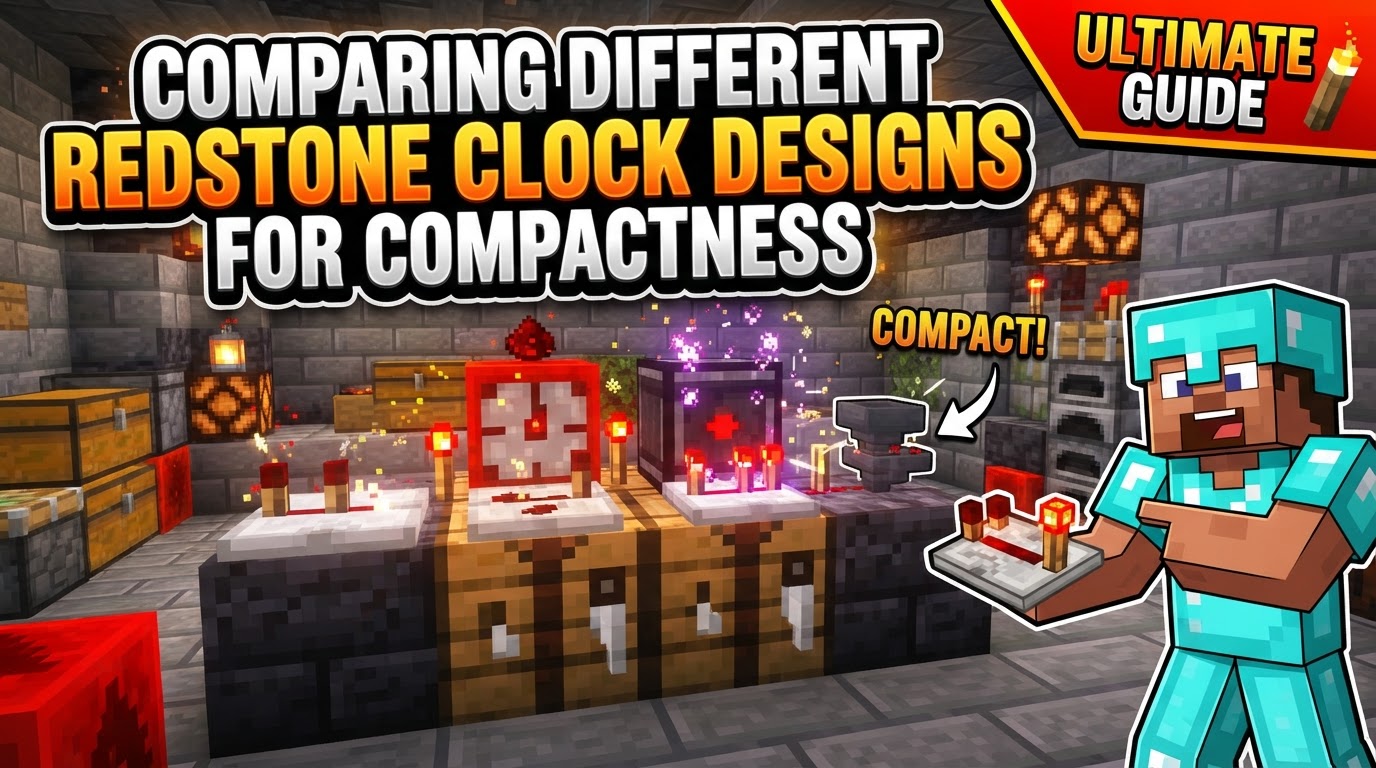
Redstone clocks, at their core, are circuits designed to emit a repeating redstone signal. The ideal clock for any given task balances signal frequency, adjustability, and, critically, the space it occupies. This guide delves into the most common and compact Redstone clock designs, comparing their mechanics, footprint, and ideal applications, empowering you to choose the perfect pulse for your next build.
Observer Clocks: The Tiny Titans of Speed
When extreme speed and minimal space are the primary concerns, the observer clock stands unparalleled. These designs are often the most compact you can achieve, typically requiring just two observers.
- Mechanics: An observer clock operates on a simple, yet ingenious, feedback loop. Two observers are placed facing each other. Each observer continuously detects changes in the block or component in front of its ‘detection’ face. When one observer detects the output of the other, it emits a brief pulse, which is then detected by the first observer, perpetuating the cycle. This creates a rapid, self-sustaining pulse. For even faster initial activation, pushing the second observer into place with a piston can be employed.
- Compactness: These clocks are incredibly small, often fitting within a 1x2x1 or 1x2x2 block area, making them ideal for tight spaces where a quick, repetitive signal is needed.
- Speed: Observer clocks are exceptionally fast, producing very short intervals. They are perfect for rapid-fire dispensers, quick piston extenders, or any mechanism requiring a high-frequency input.
- Construction Principle: To build one, simply place a single observer. Then, place a second observer so its detection face is aimed directly at the output face of the first observer. The clock will begin pulsing immediately upon the second observer’s placement.
Repeater Clocks: Adjustable and Versatile
Repeater clocks offer a balance of compactness and adjustability, making them a cornerstone of many Redstone builds. They leverage the repeater’s ability to introduce controlled delays into a circuit.
- Mechanics: These clocks typically consist of a loop of redstone dust and one or more redstone repeaters. The repeaters introduce a delay into the circuit, ensuring the signal propagates around the loop at a controlled pace. The signal continuously travels, creating a repeating pulse.
- Compactness: Repeater clocks can be very compact, with some simple designs using as few as one redstone torch, three redstone wire, and one repeater. They can also be designed to utilize vertical space, further minimizing their horizontal footprint.
- Adjustability: A major advantage of repeater clocks is their highly customizable pulse length. By adding more repeaters to the loop or adjusting the delay settings on individual repeaters (right-clicking them), you can fine-tune the clock’s frequency from very fast to relatively slow.
- Construction Principle: Arrange redstone dust to form a closed loop, ensuring at least one redstone repeater is part of this loop. To initiate the clock, you can quickly place and then break a redstone torch attached to the loop, or temporarily power a block within the loop with a lever. While some designs integrate a permanent redstone torch, be mindful of redstone torch burnout in very fast configurations. Adjust the delay settings on your repeaters as needed to achieve the desired pulse frequency.
Hopper Clocks (Etho Hopper Clock): Precision for Longer Intervals
When your contraption demands longer, highly configurable timing, the hopper clock, famously popularized by Etho, becomes the go-to solution. It trades a slightly larger footprint for unparalleled control over extended delays.
- Mechanics: The core of a hopper clock involves two hoppers facing into each other. Items are placed into one hopper, which then slowly transfers them to the other. A redstone comparator is used to read the number of items in one of the hoppers. As items transfer, the comparator’s output signal strength changes. This change is then used to toggle a Redstone mechanism (often a sticky piston with a redstone block or a direct redstone line) that powers and depowers the hoppers, reversing the item flow. The number of items in the hoppers directly dictates the duration of the clock cycle.
- Compactness: While not as tiny as an observer clock, hopper clocks are considered quite compact for the extensive range of adjustable delays they offer. Many designs can fit within a 6x2x4 block area, and they are often tileable for use in larger arrays.
- Speed/Adjustability: Hopper clocks excel at producing longer, highly consistent timings, ranging from a few seconds to several minutes, or even hours, simply by varying the number of items within them. This makes them perfect for automated crop farms, mob grinders, or any system requiring precise, long-duration timing.
- Construction Principle: Begin by placing two hoppers so they face directly into each other. Place a redstone comparator reading one of these hoppers. Connect the comparator’s output to a mechanism that can switch the power state of the hoppers. A common method is to use a sticky piston with a redstone block that, when extended, powers one hopper and depowers the other, and vice versa when retracted. Finally, place any number of stackable items into one of the hoppers; the more items you add, the longer each half-cycle of the clock will be.
Ultra-Compact Bedrock Designs: Edition-Specific Ingenuity
Minecraft’s two primary editions, Java and Bedrock, sometimes feature distinct Redstone mechanics. This can lead to unique, ultra-compact designs exclusive to one version. In Bedrock Edition, for instance, some incredibly small clock designs can be achieved due to differences in how components power blocks.
- Mechanics: Certain Bedrock-specific designs exploit quirks like how redstone torches can power adjacent blocks in specific ways, allowing for very tight feedback loops. These often involve minimalist setups that wouldn’t function identically in Java Edition.
- Compactness: These designs can be astonishingly small, sometimes fitting into a mere 2×2 block space, using as few as two redstone torches and one to two pieces of redstone dust.
- Speed: Their speed varies, but they are generally quick, providing a consistent pulse suitable for many basic automation tasks within Bedrock Edition.
- Note: Always verify that a design intended for one edition will function as expected in the other, as cross-compatibility is not guaranteed.
Principles for Maximizing Compactness
Regardless of the clock type you choose, adhering to certain design principles will help you achieve the smallest possible footprint for your Redstone contraptions.
- Select the Right Clock Type: This is fundamental. Don’t use a large, adjustable hopper clock for a rapid-fire dispenser that an observer clock could handle in a fraction of the space. Match the clock’s inherent speed and adjustability to your specific need.
- Utilize Vertical Space: Look for opportunities to build upwards. Many repeater and even some hopper clock designs can be stacked or arranged vertically, drastically reducing their horizontal surface area.
- Minimize Components: Every block and every Redstone component takes up space. Always strive for the most minimalist design that still achieves the desired functionality. Sometimes, a slightly different arrangement of existing components can save several blocks.
- Leverage Game Mechanics: Understand the subtle differences and unique properties of Redstone components in your specific game edition. Mechanics like quasi-connectivity in Java Edition or specific block-powering behaviors in Bedrock can unlock incredibly compact and efficient designs that might not be immediately obvious.
Common Pitfalls to Avoid
Even seasoned Redstone engineers can fall victim to common mistakes that hinder compactness or functionality. Being aware of these can save you time and frustration.
- Redstone Torch Burnout: A frequently encountered issue. Redstone torches will “burn out” and temporarily deactivate if they are forced to change state more than 8 times within a 3-second period. If your clock design relies on a redstone torch within a very fast, oscillating loop, it’s highly susceptible to burnout, leading to a non-functional clock. Designs built purely from repeaters and comparators are immune to this problem.
- Bedrock vs. Java Incompatibility: This is a crucial distinction. Redstone mechanics, component interactions, and even block physics can differ significantly between Minecraft Java and Bedrock editions. A wonderfully compact design that works perfectly in one version might fail entirely, or behave unexpectedly, in the other. Always specify or verify the edition when seeking or implementing designs.
- Unnecessary Lag: Over-engineering or using an overly fast/complex clock for a simple, slow task can introduce unnecessary computational load, leading to game lag. While a single fast clock might not be an issue, multiple such clocks in a concentrated area can noticeably impact performance. Choose the slowest functional clock for the job.
- Forgetting Delays: In certain Redstone circuits, especially those involving pistons or complex logic gates, failing to include sufficient delay with repeaters can lead to components activating out of sequence, immediate burnout of torches, or the entire clock failing to function. Proper timing is crucial.
Mastering Redstone clock compactness is an art that blends technical understanding with creative problem-solving. By carefully considering the requirements of your build and selecting the most appropriate clock design, you can construct efficient, reliable, and space-saving Redstone contraptions that bring your Minecraft visions to life. Experiment with these designs, understand their underlying mechanics, and soon you’ll be building masterpieces in miniature.
Tags:
YOU MAY ALSO LIKE...