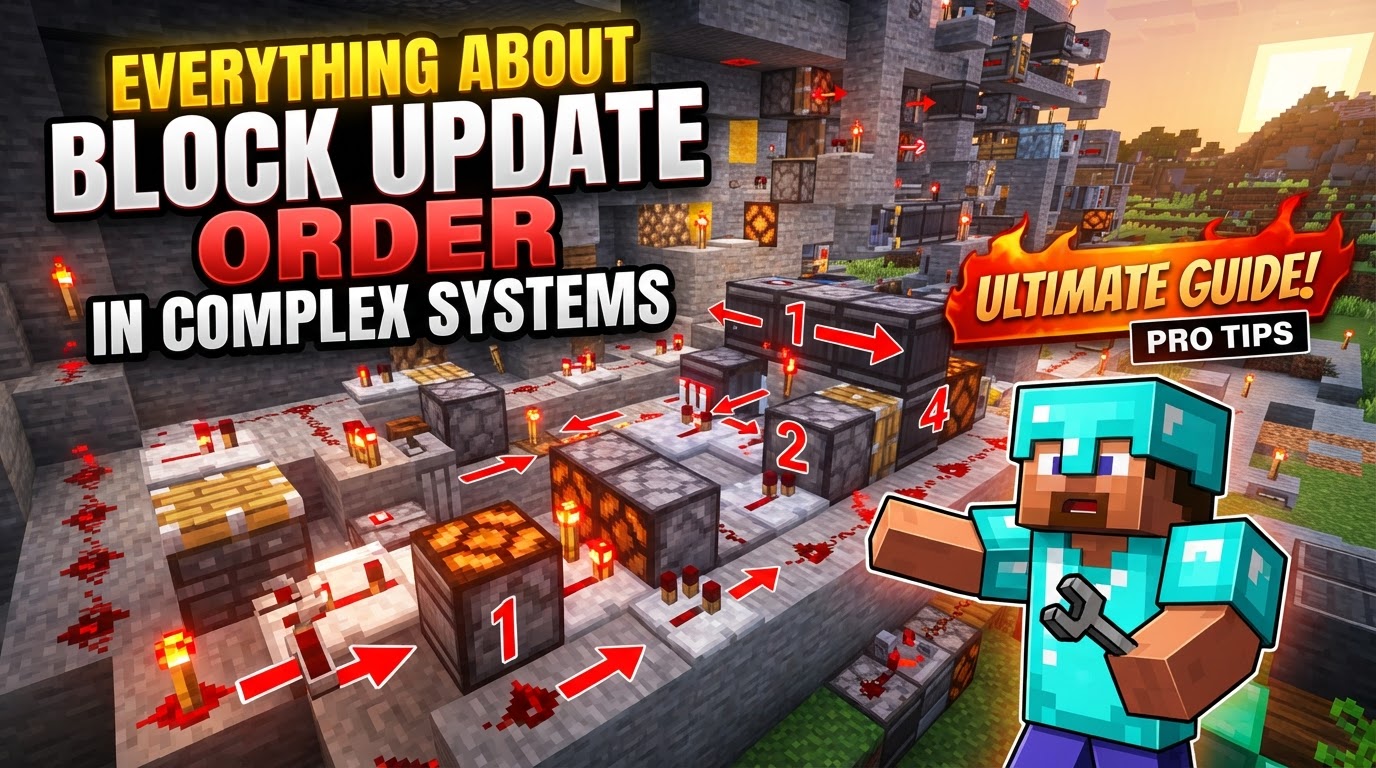
Everything About Block Update Order in Complex Systems
Many a seasoned Minecraft player has scratched their head in frustration as their meticulously designed redstone contraption fails to fire, or fires out of sequence. The culprit, more often than not, is an intricate and often misunderstood system: block update order. This fundamental mechanic dictates the sequence in which the game processes changes to blocks, forming the backbone of all complex systems, from simple doors to elaborate automated farms and computing devices.
Understanding how Minecraft handles block updates is not just an academic exercise; it’s a critical skill for designing reliable redstone contraptions and advanced mechanics. Every time a block is placed, destroyed, or has its state altered, the game sends out notifications to its neighbors. These notifications can trigger a cascade of events, and the precise order in which these events unfold determines whether your build functions flawlessly or breaks down unexpectedly. While the principles are universal, it’s crucial to note that this order can vary significantly between Java and Bedrock editions, with Java generally offering a more predictable and consistent environment for complex engineering.
Key Mechanics of Block Updates
At its core, a block update is the game’s way of informing surrounding blocks about a change. These changes initiate a chain reaction, which is then processed according to a defined set of rules and priorities.
Block Updates Triggered by Changes
A block update is fundamentally a reaction. It occurs whenever a block undergoes a modification. This can be as simple as:
- Placement: A new block is put into the world.
- Destruction: An existing block is broken or removed.
- Replacement: One block is swapped out for another.
- Block State Change: A block’s properties are altered (e.g., a lever being flipped, a door opening, water flowing).
Each of these actions triggers notifications to nearby blocks, prompting them to respond to the altered environment. For instance, placing a redstone torch might update an adjacent door, causing it to open.
Types of Updates (Java Edition)
Java Edition, known for its more consistent redstone behavior, employs several distinct types of block updates, each with specific roles and priorities:
- Post Placement (PP) Updates: These are among the most common updates, primarily used for blocks that connect to or attach to others. Examples include stairs automatically orienting themselves, fences connecting, or torches attaching to a wall. They typically have a priority of 2, meaning they are processed relatively early in the update cycle.
- Neighbor Changed (NC) Updates: The most general type of update, sent by most blocks to their immediate neighbors whenever they are placed, destroyed, or have their block states changed. This is the bedrock of how blocks react to their surroundings.
- Comparator Updates: Specific to redstone comparators, these updates are sent and received when a comparator detects changes in the power level of its input sources, allowing it to accurately measure and compare redstone signals.
- Tile Ticks: These are crucial for introducing delays into redstone components. Blocks like repeaters, comparators, observers, and redstone torches use tile ticks to schedule future actions. Tile ticks themselves have assigned priorities; a lower priority value means the scheduled action will execute earlier within the game tick.
- Block Events: Pistons rely on block events to schedule their extension and retraction. Unlike other updates that might propagate immediately, block events are queued and executed in the precise order they were created, which is vital for understanding complex piston mechanisms.
Update Priorities
Not all updates are created equal. Minecraft assigns priorities to different update types, and even to specific block behaviors within those types. This priority system dictates the order of execution: a lower priority number signifies that the update will be processed earlier. For instance, redstone repeaters are designed to respond very quickly; when a repeater turns on, its associated tile tick often has a negative priority (-1), and when it turns off, an even lower priority (-2). This ensures that repeaters activate or deactivate before blocks with a default priority of 0, like comparators, allowing for precise timing in redstone circuits.
The Step-by-Step Process in Java Edition
When a block changes in Java Edition, the game follows a relatively predictable sequence for propagating updates.
General Update Order
When a block is placed, destroyed, or its state changes, it typically sends updates to its immediate neighbors in a specific, cardinal directional order: West, then East, then North, then South, then Down, and finally Up. While this is the general rule, some specific blocks or scenarios might have exceptions to this directional propagation.
Neighbor Changed Update Direction
For standard Neighbor Changed (NC) updates, the directional order is slightly different but still consistent: West, East, Down, Up, North, then South. This specific sequence is important for subtle interactions between adjacent blocks.
Redstone Wire Updates
Redstone wire has its own unique update behavior. When a redstone wire changes its power state, it not only sends updates to its direct neighbors but also triggers Post Placement (PP) updates to the blocks directly above and below any non-redstone wire blocks it points horizontally to. This can create unexpected interactions if not accounted for.
Observer Updates
Observers are fundamental for compact redstone, and their update mechanism is precise. When an observer detects a change, it first updates the block it is directly facing. Following that, it updates the immediate neighbors of that faced block (excluding the observer itself), in the standard order of West, East, Down, Up, North, then South. This two-stage update allows observers to react to changes and then propagate those reactions.
Piston Updates
Piston block events are executed strictly in the order they were created. This is crucial for understanding complex piston mechanics, especially with moving structures. When pistons interact with slime block contraptions, the game processes lines of blocks involved in the movement. Often, blocks further away from the piston are processed first. Within a given line of blocks being pushed or pulled, those further ahead in the direction of movement are processed earlier. This intricate logic contributes to the “recursive nightmare” often associated with advanced piston builds.
Depth-First Search (DFS) Principle
Block updates can exhibit a Depth-First Search (DFS) principle. This means that if Block A changes and sends updates to Block B and Block C, the game might fully process the consequences of Block B’s update (including any updates B sends to D and E) before it even gets around to processing the update Block C received from A. This cascading effect can lead to long chains of updates propagating deeply into a system before other parts of the system are even notified of the initial change.
Game Tick Processing Order
Within each game tick, Minecraft generally processes different categories of updates in a specific order: first, block updates (which notably include piston actions), then shape updates (anything that changes a block’s visual shape, color, or state), and finally, tile tick updates (which handle scheduled delays from components like repeaters and observers).
Mastering the Order: Practical Tips
Given the complexity, especially in Java Edition, and the inconsistencies in Bedrock, practical approaches are often necessary.
Empirical Testing
Due to the sheer number of block interactions and the subtle nuances of update order, particularly with redstone, empirical testing remains one of the most reliable methods. Building small test setups to observe specific update sequences in-game can clarify behavior far better than theoretical understanding alone.
Understand Block Priorities
Familiarizing yourself with the inherent priorities of different redstone components is invaluable. Knowing that repeaters often activate before comparators, for example, allows for more precise timing and helps prevent race conditions in your circuits.
Strategic Placement
The direction from which you place a block, or the order in which you update a series of blocks, can directly influence the outcome of complex redstone contraptions. Understanding the directional update orders (West, East, North, South, Down, Up) allows for intentional manipulation of update propagation.
Navigating the Pitfalls: Common Issues & Considerations
While Java Edition offers a predictable framework, other aspects of block update order present significant challenges.
Bedrock Edition Inconsistency
Redstone on Bedrock Edition is notoriously inconsistent when it comes to block update order. Updates often appear to occur randomly within the same game tick, leading to highly unpredictable results for complex circuits. This lack of a consistent, defined update order makes advanced redstone engineering significantly more challenging. Proposed solutions to bring more predictability to Bedrock have included delay-based, strength-based, or cardinal direction-based update orders, but as of now, its behavior remains a major hurdle for builders.
Quasi-Connectivity and Redstone Dust
The interaction between quasi-connectivity (where certain blocks, like pistons, can be activated by power sources one block away diagonally or above) and the specific update order of redstone dust can lead to unexpected failures. For instance, droppers might not update correctly if relying solely on redstone dust for activation. In such cases, alternative update triggers, like repeaters or observer chains, are often necessary to ensure reliable operation.
Piston Complexity
As touched upon earlier, the update order of pistons, especially when dealing with large slime block structures that push or pull many blocks, can be an incredibly complex, almost “recursive nightmare.” Predicting the exact movement and state of every block in such a system is extremely difficult without deep knowledge of the game’s internal code or extensive in-game observation.
Update Suppression
An advanced, often experimental technique, update suppression involves creating conditions that force the game to skip block updates altogether. While useful for highly specialized applications, its behavior can be unstable and is often subject to changes or “fixes” in new game versions, making it an unreliable long-term solution.
In conclusion, mastering block update order is paramount for any aspiring Minecraft engineer. It’s a journey of understanding the game’s internal logic, observing its behaviors, and iteratively refining designs. While Java Edition offers a more structured environment for this learning, the principles of how blocks communicate and react are universal, making this knowledge invaluable for pushing the boundaries of what’s possible in Minecraft.
Tags:
YOU MAY ALSO LIKE...