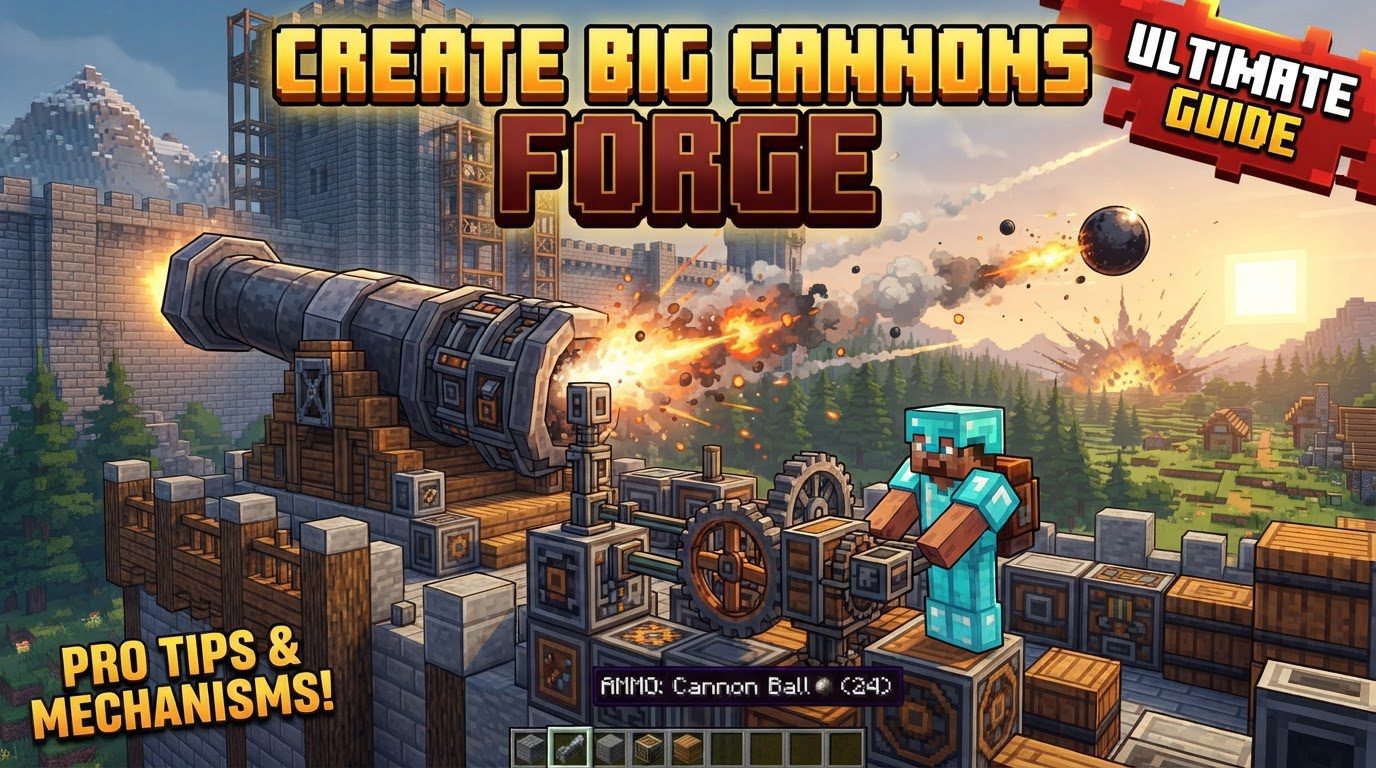
Create Big Cannons Forge
A single misplaced powder charge can reduce your meticulously crafted cannon to scrap in an instant, a harsh lesson many learn when delving into the intricate world of Create Big Cannons Forge. This powerful add-on for the beloved Create mod transforms Minecraft into a battlefield engineer’s dream, introducing complex, functional artillery capable of unleashing devastating power. It’s not just about placing blocks; it’s about understanding kinetic energy, material science, and the delicate balance required to harness explosive force.
Unveiling Create Big Cannons Forge
Create Big Cannons Forge is an extension that brings advanced artillery mechanics to your Minecraft world. Moving beyond simple TNT cannons, this mod demands a deep understanding of its components and systems. Players can construct everything from small, quick-firing field guns to colossal, long-range siege weapons, each requiring precise assembly, careful loading, and strategic operation. It integrates seamlessly with Create’s kinetic energy infrastructure, making it a natural fit for those who enjoy automation and complex contraptions.
The Anatomy of Artillery: Essential Components
Building a functional cannon in Create Big Cannons is an exercise in modular design. Each component plays a vital role in the cannon’s performance, strength, and firing mechanism. Understanding these parts is the first step towards constructing your own formidable weapon.
- Cannon Mounts: These form the foundation of your cannon, providing the base upon which all other parts are assembled. They also feature levers crucial for finalizing the cannon’s construction.
- Barrels: The length and material of your barrels directly impact accuracy and range. More barrel segments generally lead to improved shot precision.
- Breeches: These are critical for loading and sealing the cannon’s chamber. Different types offer distinct advantages:
- Screw Breeches: Ideal for larger, high-range cannons, particularly those made from advanced materials like Nethersteel. They offer robust sealing for powerful shots.
- Quickfire Breeches: Designed for faster reloading, making them suitable for cannons where a high rate of fire is prioritized over sheer power per shot.
- Sliding Breeches: Another variant, offering different trade-offs in loading speed and structural integrity.
- Muzzles: The very end of the cannon, shaping the exit of the projectile.
- Rotation Controllers: These ingenious devices allow for precise aiming. By applying rotational force (from Create’s kinetic energy system), you can raise or lower the cannon’s muzzle, controlling its elevation.
Fueling the Fire: Ammunition & Loading Mechanics
A cannon is only as good as its ammunition and the care taken in loading it. Create Big Cannons introduces a two-part ammunition system: powder charges and shells, alongside specialized fuzes that dictate explosive behavior.
- Powder Charges: These provide the propellant force. They are inserted into the cannon’s chamber, which is typically behind the breech.
- Shells: These are the projectiles themselves, loaded into the cannon’s barrel, in front of the breech.
- Fuzes: Shells can be equipped with various fuzes, dramatically altering their impact.
- Impact Fuzes: Detonate immediately upon contact.
- Delayed Impact Fuzes: Detonate a short time after impact, allowing the shell to penetrate before exploding.
- Proximity Fuzes: Detonate when close to a target, ideal for airbursts or targeting moving entities. Equipping fuzes on autocannon rounds significantly boosts their explosive power.
The loading process is critical: first, open the breech (often by applying rotation), then right-click to insert a shell, followed by a powder charge. Finally, close the breech. Incorrect loading is the primary cause of cannon explosions. Placing a powder charge in the barrel instead of the chamber, or using too much powder, guarantees a catastrophic failure. Conversely, too little powder will result in a stuck shell, necessitating the use of a “Worm” tool to safely remove it.
Precision and Power: Aiming, Firing, and Material Impact
Operating a cannon involves more than just loading. Aiming and firing require kinetic energy and careful consideration of the materials used in construction.
- Aiming and Rotation: Cannons are aimed by applying rotational force to a gun rotation controller. This kinetic input allows you to precisely adjust the muzzle’s elevation. While the mod primarily focuses on elevation, players often integrate Create contraptions for horizontal rotation as well.
- Firing: Once loaded and aimed, firing involves applying kinetic energy to a designated fire control key. This kinetic impulse is what ignites the powder charge and propels the shell.
- Material Impact: The choice of material for your cannon components profoundly affects its strength, power, and durability.
- Wood: Extremely fragile and prone to exploding, making it suitable only for the most basic, low-power experiments.
- Cast Iron: A stronger starting material, offering better resilience.
- Bronze: Provides a good balance of strength and accessibility.
- Steel: Significantly stronger, allowing for more powerful charges and larger cannons.
- Nethersteel: The strongest material, capable of withstanding immense pressures, making it ideal for the largest and most destructive artillery. The material also dictates the type of breech a cannon can accommodate, with stronger materials supporting more advanced breech types.
Building Your Arsenal: A Step-by-Step Construction Guide
Constructing a cannon, while complex, follows a logical progression:
- Craft Components: Begin by crafting individual cannon pieces such as barrels, breeches, and muzzles. This often involves sand casting processes, typical of the Create mod.
- Assemble Cannon Body: Start by placing a cannon mount. Then, stack barrel segments directly onto it, followed by a breech, and finally a muzzle. Once all parts are in place, right-click the levers on the cannon mount to finalize the assembly, merging the individual parts into a single cannon structure.
- Install Controllers: Attach a cannon rotation controller to the side of the cannon (usually near the mount or breech) and connect it to a source of Create’s kinetic energy for aiming. Set up a separate kinetic energy mechanism for the fire control key, which will be used to fire the cannon.
- Load Ammunition: If your cannon has a breech, apply rotation to the breech to open it. Right-click the open breech to insert a shell, then right-click again to insert a powder charge. Once loaded, apply rotation again to close the breech.
- Aim and Fire: Use your configured controls (often W/S for elevation, A/D for horizontal rotation via a separate contraption) to aim the cannon using the rotation controller. When ready, activate the designated fire control key to unleash your projectile.
Mastering the Art of War: Advanced Tips and Strategies
Beyond basic construction, several strategies can significantly enhance your artillery’s performance and reliability:
- Fuse Your Shells: For autocannons, always equip shells with fuzes. This dramatically increases their explosive power and utility against targets.
- Optimize Autocannon Fire Rate: To achieve the maximum rate of fire for autocannons, utilize two hoppers or a dedicated shoot system for continuous ammunition feeding. Recoil springs are largely decorative on autocannons, not essential for function.
- Choose Breech Wisely: Match your breech type to your cannon’s purpose. Screw Breeches are best for larger, high-range cannons (especially Nethersteel ones), offering maximum power. Quickfire Breeches excel at rapid reloading for more sustained fire.
- Load Correctly: This cannot be stressed enough. Powder charges go into the chamber; shells go into the barrel. Deviating from this order results in an explosion.
- Enhance Accuracy: Adding more barrel segments to your cannon will noticeably improve the accuracy and consistency of your shots.
- Handle Parts with Care: When disassembling cannon parts, always use a tool enchanted with Silk Touch. Failing to do so will cause the parts to break down into scrap nuggets, forcing you to re-craft them.
- Material Sourcing: For advanced materials like brass and steel, you may need to integrate other Create add-ons or related mods, as Big Cannons often relies on their material production pipelines.
Avoiding Catastrophe: Common Pitfalls to Sidestep
The path to becoming a master artillerist is paved with explosions. Avoiding these common mistakes will save you resources and frustration:
- Incorrect Loading Order/Placement: The most frequent cause of cannon self-destruction. Placing a powder charge in the barrel instead of the chamber will result in an immediate, violent explosion.
- Improper Powder Charges: A delicate balance is required. Too little powder will leave the shell stuck in the barrel (requiring a “Worm” tool for extraction), while too much powder will cause the cannon to explode.
- Breaking Cannon Parts Improperly: Not using Silk Touch when deconstructing cannon parts will turn them into useless scrap nuggets, wasting valuable materials.
- Ignoring Cannon Strength: Attempting to build powerful cannons from fragile materials like wood is a recipe for disaster. Wood cannons are highly prone to exploding even with minimal powder.
- Loading Closed Breeches: For breech-loading cannons, ensure the breech is open before attempting to insert shells or powder. Trying to load a closed breech will simply fail.
- Underestimating Complexity: The mod can be challenging due to its nuanced mechanics, especially regarding uncommunicated stress and power ratios for different cannon pieces. Experimentation and careful observation are key.
Create Big Cannons Forge offers a deeply engaging and rewarding experience for those willing to master its intricacies. From designing the perfect siege weapon to automating its loading and firing, the mod provides endless opportunities for creative engineering and destructive fun within the Minecraft world.
Tags:
YOU MAY ALSO LIKE...