Dive Ball Cobblemon
Many aspiring Cobblemon trainers overlook a crucial detail when attempting to capture aquatic Pokémon, often leading to wasted Poké Balls and missed opportunities. The secret to significantly boosting your success in underwater encounters lies with a specialized item: the Dive Ball. Far from a generic capture device, this unique Poké Ball is meticulously designed to excel in the watery depths of your Minecraft world, offering an unparalleled advantage when used correctly.
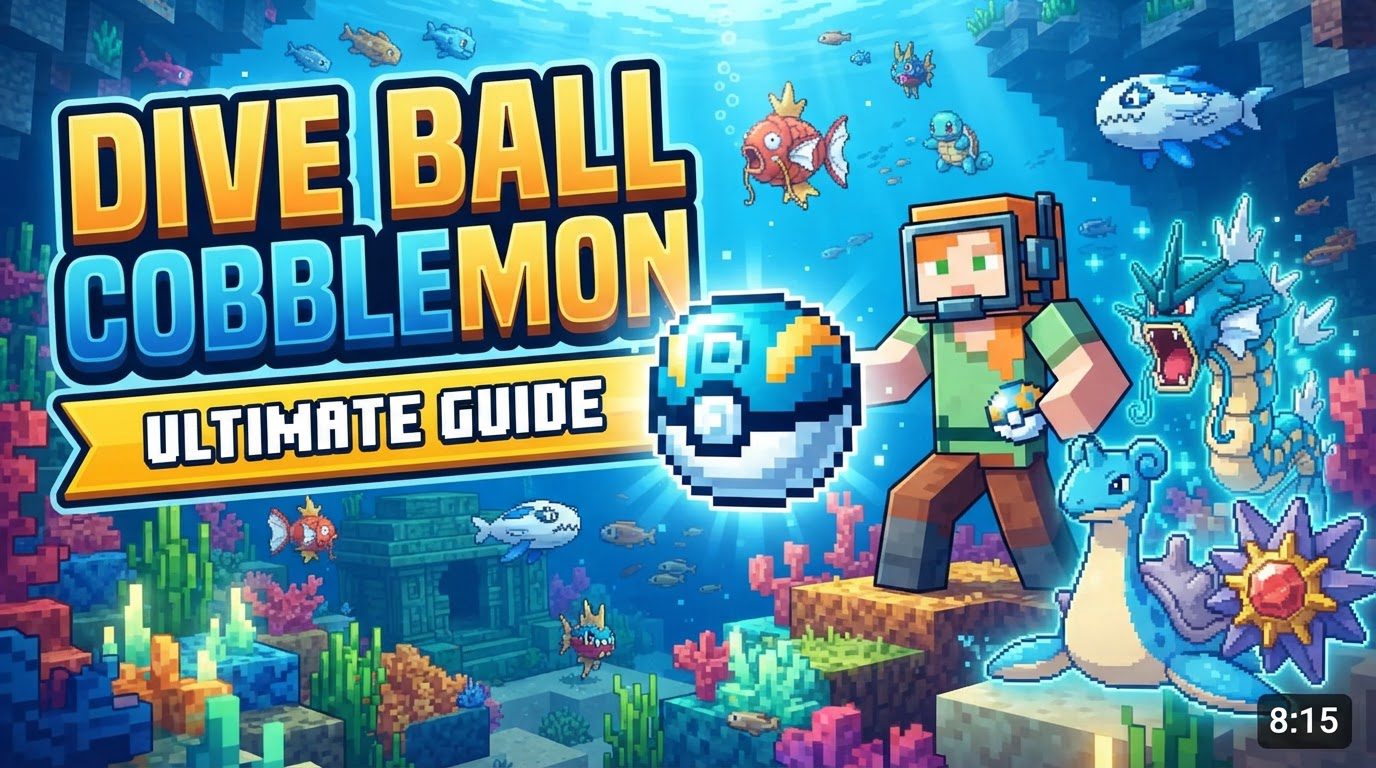
The Aquatic Advantage: Understanding the Dive Ball’s Core Mechanics
The Dive Ball isn’t just another color variant; it’s a strategic asset for any trainer venturing into lakes, rivers, or oceans. It holds a distinct position as a “second-tier” Poké Ball, meaning it offers a substantial upgrade over basic options. Its primary allure is a staggering 3.5x catch rate modifier. This incredible bonus, however, comes with a specific condition: it applies exclusively when the target Pokémon is fully submerged in water.
It’s crucial to understand that “fully submerged” means the Pokémon must be entirely within a water block, not just partially touching it or swimming near the surface. If this condition isn’t met, the Dive Ball functions identically to a standard Poké Ball, granting only a 1x catch rate. This precise requirement underscores the need for careful observation and positioning during aquatic encounters.
Beyond its impressive catch rate, the Dive Ball boasts another subtle yet significant advantage: it is completely unaffected by “underwater drag.” Unlike most projectiles that slow down or alter their trajectory when thrown underwater in Minecraft, the Dive Ball moves with the same speed and predictability as it would above ground. This seemingly minor detail provides a smoother, more reliable throwing experience, especially in fast-paced underwater battles where every millisecond counts.
Forging Your Aquatic Arsenal: Crafting Dive Balls
To harness the power of the Dive Ball, you’ll first need to craft it. The process is straightforward, requiring a few specific Apricorns and a common metal. Crafting yields a batch of four Dive Balls, making it an efficient way to stock up for your underwater expeditions.
Gathering the Ingredients:
- One White Apricorn: These can be found growing on specific Apricorn trees in various biomes.
- Three Blue Apricorns: Blue Apricorns are also found on their respective trees, often in biomes associated with water or temperate climates.
- One Iron Ingot: A staple resource in Minecraft, obtained by smelting Iron Ore.
The Crafting Recipe:
Once you have your ingredients, head to a crafting table. The typical arrangement for crafting four Dive Balls is as follows:
- Top Row: Blue Apricorn, White Apricorn, Blue Apricorn
- Middle Row: Blue Apricorn, Iron Ingot, Blue Apricorn
- Bottom Row: (Empty)
While this is the most commonly accepted pattern, it’s worth noting that some server configurations or modpack versions might have slightly altered layouts. However, the core materials – White Apricorns, Blue Apricorns, and an Iron Ingot – remain consistent across all known crafting recipes for Dive Balls.
Mastering the Throw: Effective Dive Ball Usage
Crafting your Dive Balls is only the first step; knowing how to use them effectively is key to maximizing their potential. The process involves precise timing and an understanding of the conditions required for the bonus to activate.
Here’s a step-by-step guide to successful Dive Ball deployment:
- Equip the Dive Ball: Select the crafted Dive Ball from your inventory and place it in your hotbar. Hold it in your hand, ready for action.
- Locate Your Target: Find a wild Pokémon that you wish to capture. This step is critical: ensure the Pokémon is fully submerged in water. Observe its position carefully; if any part of its model is above the water’s surface, the bonus will not apply.
- Initiate Capture: You have two primary methods for throwing a Dive Ball:
- Direct Overworld Throw: Simply aim at the submerged Pokémon and throw the Dive Ball as you would any other item. This is often used for quick captures of weaker or unsuspecting Pokémon.
- Battle Capture: During a Pokémon battle, select the “Catch” option from your combat menu. This will allow you to choose the Dive Ball from your inventory and throw it at the opposing Pokémon.
- Player Submersion (Highly Recommended): For the catch rate bonus to reliably apply, it is strongly recommended that the player also be submerged underwater when throwing the Dive Ball. While the bonus is technically for the Pokémon’s state, being submerged yourself helps ensure the game registers the throw within the correct aquatic context. This can be achieved by simply being in a body of water or, if necessary, by placing a water bucket above yourself to momentarily submerge your character.
Tactical Advantages and Underwater Wisdom
Beyond the basic usage, several tips can further enhance your Dive Ball effectiveness and overall underwater hunting experience.
- Prioritize Submerged Targets: Always reserve your Dive Balls for Pokémon that are unequivocally fully submerged. Using them on land or partially submerged targets is a waste of a valuable resource.
- Prepare for the Deep: When planning extensive underwater expeditions, consider equipping yourself with water breathing enchantments (like Respiration on a helmet) or crafting Water Breathing Potions. This will prevent drowning and allow you to focus on the battle and capture process without the added pressure of your oxygen meter.
- Instant Submersion Trick: If you encounter a desirable submerged Pokémon while you are on land or only partially in water, you can quickly place a water bucket directly above your character. This will submerge you, fulfilling the recommended condition for the Dive Ball’s bonus. Just remember to pick up your water source afterwards!
- Comparing Catch Rates: The Dive Ball’s 3.5x multiplier for submerged Pokémon makes it superior to many other specialized balls in its specific niche. For instance, the Net Ball offers a 3x rate for all Water or Bug-type Pokémon, regardless of submersion. The Lure Ball provides a 2x rate generally, or a 4x rate specifically for Pokémon caught with a Poké Rod. While the Lure Ball can offer a higher rate in very specific fishing scenarios, the Dive Ball’s consistent 3.5x for *any* submerged Pokémon makes it incredibly versatile for general aquatic exploration.
Avoiding Common Pitfalls
Even with the Dive Ball’s clear advantages, trainers often make simple mistakes that negate its special properties. Being aware of these pitfalls can save you frustration and precious resources.
- The Submersion Misconception: The most frequent error is using a Dive Ball on a Pokémon that is not fully submerged. If even a pixel of the Pokémon’s model is above the water, the Dive Ball will only provide a 1x catch rate. Always double-check the target’s position before throwing.
- Type vs. Environment Confusion: Another common mistake is assuming the Dive Ball’s bonus applies to all Water-type Pokémon. This is incorrect. The bonus is strictly tied to the Pokémon’s environmental state (being submerged), not its elemental typing. A Water-type Pokémon on land will not receive the Dive Ball bonus, just as a Grass-type Pokémon fully submerged in water *would* receive the bonus.
- Forgetting Player Submersion: While the primary condition is the Pokémon’s submersion, neglecting to submerge yourself can sometimes lead to inconsistencies. Always aim to be underwater yourself for the most reliable application of the Dive Ball’s bonus.
The Dive Ball is an indispensable tool for any serious Cobblemon trainer dedicated to exploring the aquatic biomes of Minecraft. By understanding its unique mechanics, mastering its crafting, and employing it strategically, you can dramatically increase your success rate in capturing the diverse array of Pokémon that call the underwater world home. Dive in with confidence, and let the Dive Ball be your guide to a treasure trove of aquatic companions!
Tags:
YOU MAY ALSO LIKE...