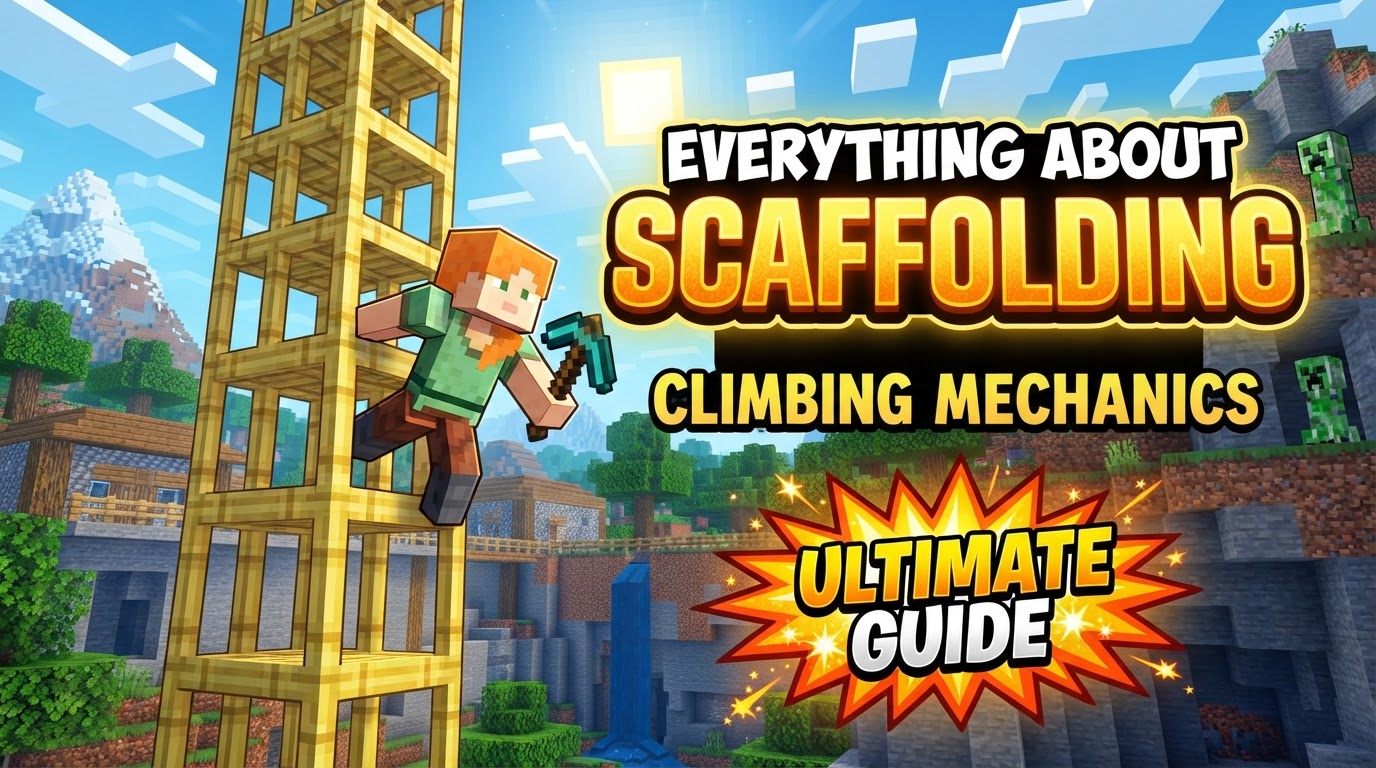
Everything About Scaffolding Climbing Mechanics
A common mistake many builders make is underestimating the true versatility of scaffolding. Often seen merely as a temporary ladder, this unique block in Minecraft is, in fact, a dynamic tool that fundamentally changes how players approach vertical construction, traversal, and even hazard mitigation. Mastering its distinct climbing mechanics can dramatically speed up large-scale projects and offer safe passage in perilous situations.
Crafting Your Vertical Advantage
Before you can revolutionize your building process, you’ll need to craft scaffolding. The recipe is straightforward and resource-efficient, making it accessible even in early-game survival. To craft scaffolding, you require 6 bamboo and 1 string. Arrange three bamboo stalks in the left-most column of your crafting grid, and another three bamboo stalks in the right-most column. Place the single string in the top-middle slot. This yields 6 scaffolding blocks, providing a generous supply for initial projects.
The Unique Properties of Scaffolding
Scaffolding operates under a set of rules that distinguish it from almost every other block in Minecraft. Understanding these core mechanics is crucial for effective use:
- Fully Climbable: Unlike ladders or vines, scaffolding allows for seamless ascent and descent. Players can simply press the jump key to climb up and the sneak (shift) key to slide down, offering fluid vertical movement.
- No Collision Detection: Perhaps one of its most unique traits, players can move directly through the sides of scaffolding blocks. This means you won’t get stuck on edges, can easily pass through a scaffolding tower, and it won’t impede movement in tight spaces. However, the top surface is solid for standing.
- Horizontal Placement Limit: Scaffolding can extend horizontally up to a maximum of 6 blocks out from its base of support. Any new scaffolding placed beyond this seventh block will immediately fall, indicating its need for a stable foundation or connection point.
- Instant Break: Scaffolding can be broken instantly with any tool, or even by hand. This makes it incredibly convenient for temporary structures, as there’s no delay in removal.
- Chain Reaction Dismantling: A truly powerful feature for builders. If the very bottom block of a scaffolding tower is broken, all scaffolding blocks directly above it will also break in a chain reaction, dropping as individual items. This is similar to how chorus plants or bamboo stalks break.
- Fall Damage Negation: A lifesaver in many situations. If a player falls onto at least two blocks of scaffolding while actively sneaking (holding the shift key), all fall damage will be completely negated. This provides a safe landing platform from any height.
- Waterlogging Capability: Scaffolding can be waterlogged, meaning it can contain water within its block space. This can be useful for certain redstone contraptions or aesthetic builds, though it doesn’t directly impact climbing.
- Piston Interaction: Like many solid blocks, scaffolding can be pushed and pulled by pistons, allowing for dynamic, moving structures or temporary barriers.
Ascending with Ease: Vertical Placement and Movement
Scaffolding excels in vertical traversal, offering multiple methods for rapid ascent and descent.
Building Upwards
- From the Ground Up: The most efficient way to build a tall scaffolding tower from a safe position. Place your first scaffolding block on the ground. Then, while holding more scaffolding, simply right-click (use) on any side of the existing scaffolding. A new scaffolding block will be placed directly on top of the highest scaffolding in that column, allowing you to build sky-high towers without ever leaving the ground.
- Building as You Climb: For a more direct approach, you can jump and place scaffolding blocks directly on top of the one you’re standing on as you ascend. This is useful for quickly getting to a specific height or adjusting an existing column.
Climbing and Descending
- Climbing Up: To ascend scaffolding, simply look up and hold down your jump key. Your character will rapidly climb the column.
- Climbing Down: To descend, look down and hold your sneak (shift) key. You will quickly slide down the scaffolding without taking any fall damage, provided you maintain the sneak key until you reach the ground or a safe platform.
Extending Your Reach: Horizontal Placement
Scaffolding isn’t just for verticality; it’s also excellent for creating temporary horizontal platforms and bridges.
- Side-by-Side Extension: To extend scaffolding horizontally from an existing tower or block, stand next to it and sneak (hold shift). While sneaking, right-click (use) on the side of a scaffolding block. This will place a new scaffolding block directly adjacent to the one you clicked, allowing you to create walkways.
- Top-Face Placement: If you place scaffolding on the top face of an existing scaffolding block, it will automatically add a new scaffolding block to the side, extending horizontally in the direction you are currently facing. This provides a quick way to build out from a central point.
Always remember the 6-block horizontal limit when building outwards. If you attempt to place a seventh block without additional support, it will immediately break and fall.
The Art of Rapid Dismantling
One of scaffolding’s greatest strengths is its ease of removal. Unlike other temporary blocks like dirt or cobblestone, which require individual mining, scaffolding can be cleared in moments.
- Instant Break: As mentioned, any scaffolding block can be broken instantly by hand or with any tool, making minor adjustments quick and painless.
- Column Collapse: For entire towers, simply break the very bottom scaffolding block. This will trigger a chain reaction, causing every scaffolding block above it in that column to break and drop as items. This efficient dismantling process saves immense amounts of time in large construction projects.
Strategic Scaffolding: Tips for Master Builders
Leveraging scaffolding effectively can transform your Minecraft experience.
- Efficient Temporary Structures: Use scaffolding for any structure that needs to be built high and then removed, such as temporary platforms for ceiling placement, outer walls for large buildings, or bridges over dangerous terrain. Its rapid placement and removal are unmatched.
- Quick and Safe Descents: When you need to get down from a great height quickly, place a few scaffolding blocks and hold sneak. You’ll slide down rapidly and safely, negating all fall damage upon landing if you maintain the sneak. This is far safer and faster than mining down or building stairs.
- Rapid Expansion: Utilize the right-click-on-side placement method to build towering structures from ground level, saving you the tedious climb for each new layer.
- Bridging Gaps: Create temporary horizontal bridges over chasms or water bodies by sneak-placing scaffolding. Just be mindful of the 6-block horizontal limit from your last supported point.
- Resource Management: Bamboo is a renewable and often plentiful resource, especially if you set up a farm. This makes scaffolding a highly cost-effective and sustainable solution for even the most ambitious building projects.
Common Missteps to Avoid
Even with its simplicity, a few common errors can hinder efficient scaffolding use:
- Exceeding the Horizontal Limit: The most frequent mistake. Attempting to place scaffolding more than 6 blocks horizontally from its last point of support will always result in the new block falling. Always ensure adequate support.
- Accidental Descent: Players sometimes accidentally descend scaffolding when trying to perform other actions that involve the sneak key, especially when near the bottom of a column. Be mindful of your key presses.
- Awkward Sneak-Placing: Placing blocks while sneaking on scaffolding can sometimes feel disorienting or difficult, particularly when trying to build outward from a tall, narrow tower. Practice helps, but sometimes a temporary platform can make it easier.
- Lack of Underlying Support for Horizontal Extensions: While scaffolding can extend horizontally, if the initial supporting block itself is floating or poorly supported, the entire horizontal section may collapse if the base is removed. Always ensure your primary support is solid.
By understanding and applying these mechanics, scaffolding transforms from a simple temporary block into an indispensable tool for any serious Minecraft builder, offering unparalleled efficiency in vertical construction and traversal.
Tags:
YOU MAY ALSO LIKE...