How Block Hardness Affects Mining Speed Calculation
Did you know that mining a single block of obsidian in Minecraft can take over 33 times longer than mining a block of dirt, even with the same tool? This stark difference immediately reveals the profound impact of block hardness on your mining efficiency. Far from a simple aesthetic detail, a block’s hardness value is the bedrock upon which all mining speed calculations are built, dictating how quickly you can excavate resources and progress in your world.
The Core Concept: Block Hardness Values
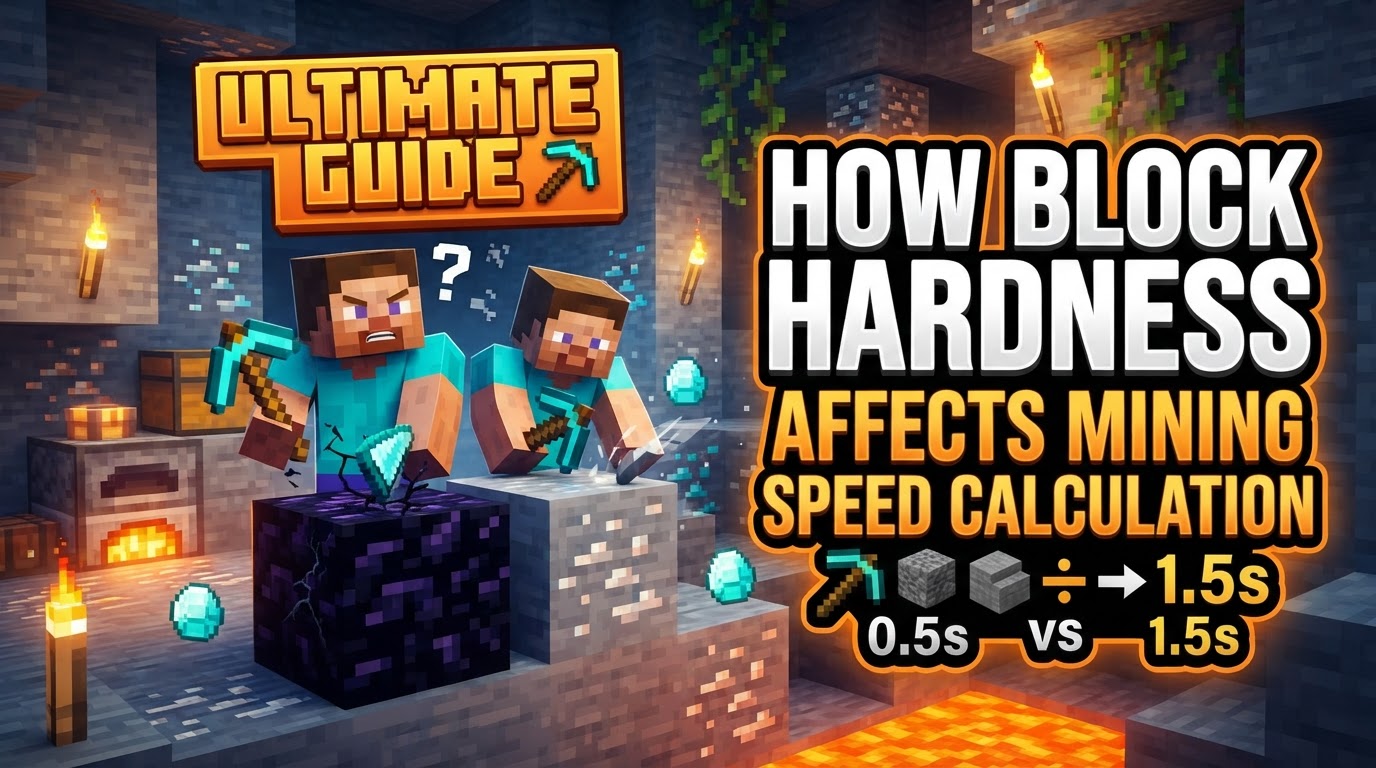
At the heart of Minecraft’s mining mechanics lies the block hardness value. Every single block in the game is assigned a numerical hardness, directly corresponding to the effort required to break it. A higher value signifies a harder block that demands more time and effort to mine. For instance, common dirt boasts a hardness of a mere 0.5, allowing for swift removal. Stone, a ubiquitous material, has a hardness of 1.5. On the other end of the spectrum, the incredibly resilient obsidian carries a formidable hardness of 50. Understanding these intrinsic values is the first step in optimizing your mining endeavors.
Tools of the Trade: Material, Type, and Effectiveness
While block hardness sets the baseline, your choice of tool dramatically alters the mining equation. Each tool possesses a base mining speed, which scales with its material tier – wood, stone, iron, diamond, netherite, and gold. Beyond raw speed, the tool’s type (e.g., pickaxe, shovel, axe) is paramount. Using the correct tool for a block’s material type (a pickaxe for stone-based blocks, a shovel for dirt/sand, an axe for wood) grants a significant boost to mining speed. This “correct tool usage” is critical; if the appropriate tool is used, a “damage per tick” value is calculated by dividing the tool’s mining speed by the block’s hardness, then dividing by 30. Conversely, attempting to mine a block with the wrong tool, or bare hands, drastically slows down the process, as the divisor becomes 100, making mining much, much slower.
Enchantments That Supercharge Your Digging
Once you have the right tool, enchantments elevate your mining capabilities to new heights. The Efficiency enchantment is perhaps the most impactful in terms of raw speed. This enchantment directly increases a tool’s mining speed, with higher levels providing greater benefits. Efficiency V, the maximum legitimate level, adds a substantial bonus of (level^2 + 1) to the tool’s speed, provided the tool is already effective against the block. This means an Efficiency V tool adds (5^2 + 1) = 26 to its speed, a significant boost that can turn slow mining into rapid excavation.
Another crucial enchantment, particularly for underwater operations, is Aqua Affinity. This helmet enchantment uniquely addresses one of the most frustrating environmental penalties in the game. It completely removes the substantial mining speed reduction incurred when mining underwater, allowing players to mine at the same speed as if they were on land. It’s important to note, however, that Aqua Affinity does not negate the penalty for floating; it specifically targets the underwater speed reduction.
Status Effects: Haste and Mining Fatigue
Beyond tools and enchantments, temporary status effects can either bless or curse your mining speed. The Haste status effect, commonly acquired from beacons or conduit power, provides a multiplicative boost to your overall mining speed. Each level of Haste increases mining speed by 20%. For example, Haste II grants a 40% boost, making a noticeable difference in how quickly blocks are broken. This effect is often sought after for large-scale mining projects.
On the opposite end of the spectrum is Mining Fatigue, a detrimental status effect typically inflicted by Elder Guardians. This effect drastically reduces mining speed through strong multiplicative penalties, making even the softest blocks incredibly tedious to break. Encountering an Elder Guardian without proper preparation can bring mining operations to a screeching halt.
Environmental Factors: Land, Water, and Air Penalties
Your surroundings play a critical role in the final mining speed calculation. Minecraft imposes significant penalties for mining in less-than-ideal conditions:
- Underwater Penalty: Without Aqua Affinity, mining underwater reduces your speed by a staggering 5 times.
- Floating Penalty: Mining while not on solid ground (e.g., floating in water, swimming, flying) also reduces your speed by 5 times.
- Stacked Penalties: These environmental penalties can stack. If you are floating underwater without Aqua Affinity, your mining speed will be reduced by a massive 25 times (5x from underwater, 5x from floating).
These penalties underscore the importance of proper positioning and the Aqua Affinity enchantment to maintain optimal mining speeds.
The Full Calculation: From Ticks to Seconds
The game processes mining speed in discrete steps, ultimately determining how many game ticks (20 ticks = 1 second) it takes to break a block. Here’s a conceptual breakdown of the calculation process:
- Base Tool Speed: Begin with the base mining speed of the tool being used. If mining with bare hands or an incorrect tool, this value is effectively 1.
- Tool Effectiveness: Determine if the tool is effective for the specific block. If it is, apply the appropriate speed multiplier based on the tool’s material tier. If not, a significant penalty is applied.
- Efficiency Boost: Add the bonus from the Efficiency enchantment to the adjusted tool speed.
- Environmental Modifiers: Apply any penalties for mining underwater (if Aqua Affinity is not present) or for mining while not on solid ground.
- Haste/Fatigue Modifiers: Apply the multiplicative boost from Haste or the reduction from Mining Fatigue.
- Calculate Progress Per Tick: The final adjusted tool speed is then divided by the block’s hardness value. This result represents the mining progress made per game tick.
- Determine Break Time: If the calculated progress per tick is 1 or more, the block breaks instantly. Otherwise, the number of ticks required to break the block is calculated as the ceiling of
1 / progress_per_tick. This total number of ticks can then be converted into seconds by dividing by 20.
Mastering Mining Speed: Advanced Strategies
Understanding these mechanics allows for highly efficient mining strategies:
- Insta-mining: For ultimate efficiency, combine an Efficiency V diamond or netherite pickaxe with the Haste II status effect from a beacon. This powerful combination allows you to instantly break many common blocks like stone, deepslate, and various ores, making resource gathering incredibly fast.
- Underwater Efficiency: When mining underwater, always equip a helmet enchanted with Aqua Affinity. Furthermore, strive to always stand on a solid block to avoid the “floating” penalty, ensuring you maintain maximum speed.
- Tool Optimization: Gold tools, despite their low durability, possess the highest base mining speed among all tool materials. While impractical for general use, they can be surprisingly effective for specific, short-term tasks where speed is paramount and durability can be managed (e.g., breaking a handful of blocks very quickly).
- Beacon Usage: Beacons are invaluable for large-scale mining operations. Establishing a beacon with Haste I or Haste II provides a continuous, powerful boost to all players within its range, transforming mining efficiency.
Common Pitfalls to Avoid
Even experienced players can fall into traps that hinder their mining speed and overall efficiency:
- Ignoring Proper Tools: One of the most common mistakes is using the wrong tool for a block. Attempting to mine stone with a shovel or dirt with a pickaxe drastically increases mining time due to the incorrect tool penalty, and often prevents the block from dropping as an item.
- Not Utilizing Enchantments/Effects: Overlooking the power of Efficiency, Haste, or Aqua Affinity significantly reduces potential mining efficiency. These enhancements are not mere luxuries; they are fundamental for optimized gameplay.
- Mining While Floating: Many players forget the “not on solid ground” penalty. Even if you’re above ground, mining while flying, swimming, or simply not standing on a block will slow you down considerably.
- Poor Inventory Management: While not directly affecting mining speed calculation, a full inventory means you stop to manage items, effectively slowing down your overall resource acquisition rate.
By delving into the intricate relationship between block hardness, tool properties, enchantments, status effects, and environmental conditions, players can transform their mining experience from a tedious chore into a highly optimized and rewarding endeavor. Understanding these underlying mechanics is key to becoming a true Minecraft master of excavation.
Tags:
YOU MAY ALSO LIKE...