How Boat Steering Physics Differ on Different Surfaces
252.0 kilometers per hour. That’s the astonishing speed a Minecraft boat can achieve under optimal conditions, a testament to the game’s surprisingly deep and varied physics system when it comes to watercraft. Far from being a simple paddle-and-go experience, the way a boat handles, its speed, and its durability are dramatically influenced by the surface it traverses, offering both challenges and incredible opportunities for efficient travel.
Speed: The Ultimate Surface Differentiator
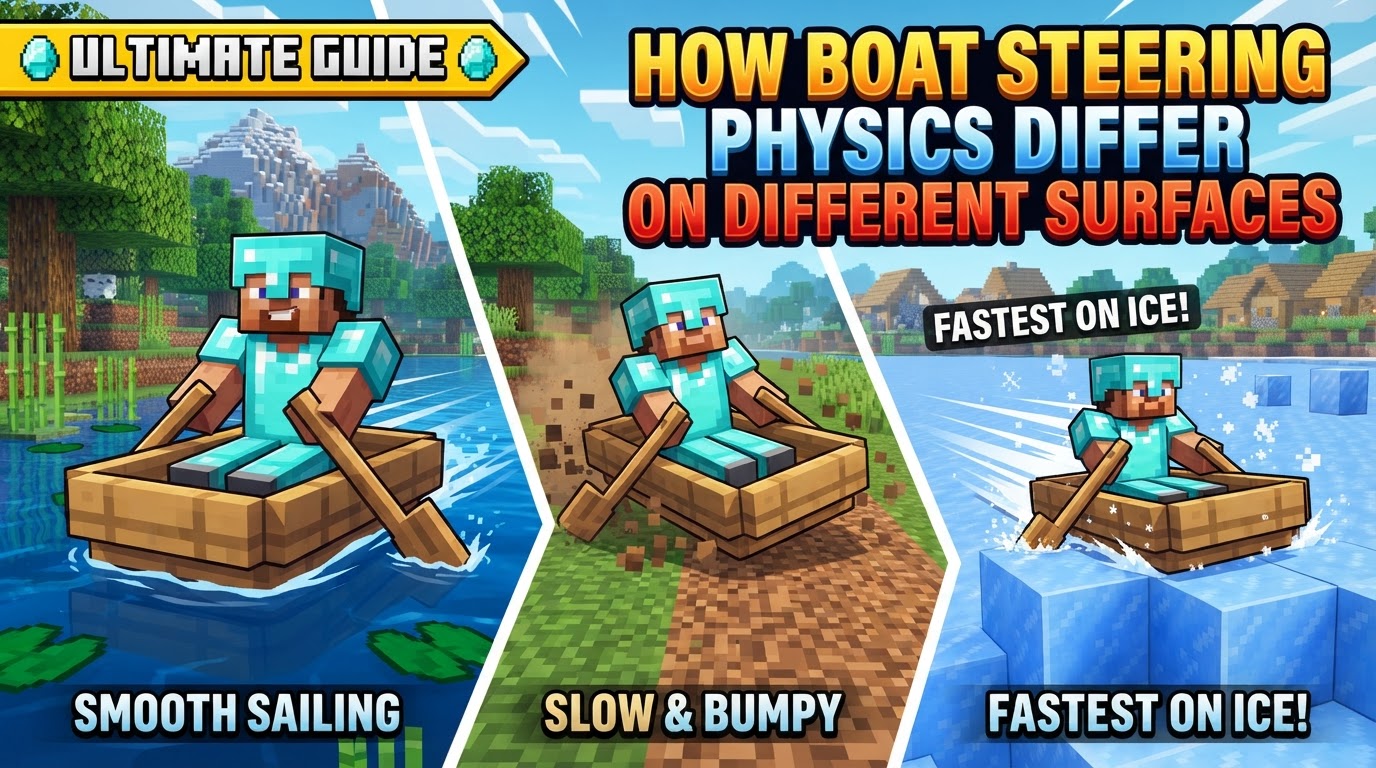
The most immediately noticeable difference in boat steering physics across various surfaces is undoubtedly speed. A boat’s velocity can range from a sluggish crawl to an exhilarating blur, dictated entirely by the block beneath it.
- On Water: The most common mode of transport, boats move at a moderate but reliable speed of 28.8 km/h on regular water. This is your baseline, offering decent travel for exploration and short-to-medium distance journeys.
- On Ice (Frosted, Packed Ice): Stepping onto ice transforms a boat into a much faster vehicle. On Frosted Ice or Packed Ice, boats achieve a significant speed boost, reaching 144.0 km/h. This makes ice a highly desirable material for constructing long-distance pathways, balancing speed with availability, as Packed Ice will not melt under any light level.
- On Blue Ice: For those seeking the absolute pinnacle of speed, Blue Ice is the answer. Boats travelling on Blue Ice reach an extreme speed of 252.0 km/h, making it the fastest form of player-controlled travel in the game, rivaling even complex minecart systems. Building “ice highways” with Blue Ice is a common strategy for ultra-fast transportation across vast distances.
- On Land: While boats can technically move on land, their performance is severely hampered. They crawl at a mere 7.2 km/h, making them impractical for extended terrestrial travel unless absolutely necessary for short transitions or mob transportation.
Controlling Your Aquatic (and Icy) Vessel
Understanding how to manipulate a boat is crucial, regardless of the surface. Boats are controlled using standard movement keys, typically ‘W’ for acceleration and ‘A’/’D’ for steering on PC. The boat will always adjust its orientation to face the direction it is currently moving, which can sometimes feel counter-intuitive, especially at high speeds or during sharp turns.
Boats are entities that inherently float on water. However, their interaction with vertical water flows is distinct. Bubble columns, in particular, have unique effects: those generated by Magma Blocks will cause a boat to sink and forcefully eject its passengers, while Soul Sand bubble columns will cause the boat to jump upwards, potentially creating interesting vertical transport systems.
Precise adjustments can be challenging due to the default sensitivity of keyboard controls, especially when navigating tight spaces or attempting advanced maneuvers like drifting on ice. In Java Edition, there’s a neat trick for fine control: if you’re not holding an item that activates with the ‘Use’ control (default Right-Click), facing a different direction than the boat is moving and pressing ‘Use’ will point the boat in your crosshair’s direction, offering a more direct way to steer.
Collision Dynamics and Durability
Boats, despite their utility, are fragile entities. They possess a limited amount of durability and will break if they take enough damage from impacts, dropping their constituent wooden planks and sticks. This fragility is a key consideration when navigating.
- Impacts with Blocks: Generally, colliding directly with a solid block will cause the boat to stop abruptly. Repeated or high-speed impacts will lead to its destruction.
- Lily Pads: Uniquely, boats can break lily pads upon contact without sustaining any damage themselves, allowing for unimpeded travel through swamp biomes.
- Sneaking for Safety: A crucial technique for preserving your boat at high speeds is to sneak (‘Shift’ on PC) while in it. Sneaking can prevent the boat from breaking on high-speed impacts, absorbing some of the collision force.
- Soul Sand Docks: Soul sand, when placed at water level, has a slightly lower top surface. This allows boats to glide over it without breaking, making it an excellent material for creating secure docks that prevent crashing.
- Boat-on-Boat Collisions: If your ridden boat collides with another unoccupied boat, your boat will be destroyed, while the other boat will simply be bumped away.
- “Wall Priority”: A peculiar mechanic, especially prevalent at high speeds, is “wall priority.” The game can interpret certain diagonal movements near walls as crashes, even if the boat visually appears not to be touching the wall. This can lead to unexpected boat breakage in seemingly clear passages.
General Boat Operation: A Quick Guide
Getting started with a boat is straightforward, but mastering its nuances requires practice.
- Placement: Simply right-click to place a boat on either water or land.
- Mounting: Use the item (right-click) to mount the boat. To exit, press the sneak key (e.g., ‘Shift’ on PC). In Bedrock Edition, pressing the Jump key can also exit, and there’s often a dedicated “Leave Boat” button or pressing down the right analog stick.
- Movement: Press forward movement keys (e.g., ‘W’ on PC) to accelerate the boat.
- Steering: Use left/right movement keys (e.g., ‘A’/’D’ on PC) to steer your boat. Remember, the boat turns to face its direction of movement.
- Exiting: Press the sneak key (e.g., ‘Shift’ on PC) to dismount.
Advanced Techniques & Best Practices
Harnessing the full potential of boat travel involves more than just basic operation:
- Ice Highways: Constructing pathways entirely of ice, particularly Blue Ice, is the premier method for rapid transit. Packed Ice is a practical alternative as it won’t melt, making it suitable for unlit environments.
- Mob Transportation: Boats are incredibly effective for safely moving passive mobs and villagers. They can be ferried across water and even short land distances, making them invaluable for setting up farms or villager trading halls.
- Hunger Management: One significant advantage of boat travel is that your hunger bar does not deplete while riding in a boat, making it efficient for long, cross-biome journeys.
- Seamless Water-to-Ice Transitions: To smoothly transition a boat from water onto an ice highway, use soul sand. Placing soul sand at the water level creates a slightly raised block that allows the boat to glide up onto the ice without stopping. Ensure high light levels or covering water blocks to prevent ice from melting near your transition points.
- Drifting on Ice: For those interested in advanced navigation, techniques for drifting and executing sharp turns on ice exist, often employed in ice boat racing for competitive advantage.
- Secure Docks: Prevent your boats from drifting away or breaking at docks by using strategic placements of doors or soul sand. Wool blocks can also be used as impact buffers, reducing the chance of a boat breaking upon collision.
Navigational Hazards and Common Missteps
Even experienced players can fall victim to common boat-related blunders:
- Crashing: The most frequent mistake is simply crashing. Boats are fragile and will break easily upon impact with solid blocks or other entities. Always be mindful of your surroundings, especially at high speeds.
- Exiting on Ice/Land (Bedrock Edition): In Bedrock Edition, exiting a boat directly on packed or blue ice can cause it to sink through the ground due to a known bug. It’s best practice to exit on open water or a solid, non-ice block.
- Placing Near Hazards: Placing a boat immediately adjacent to blocks like cactus, or directly over magma blocks or into bubble columns underwater, will instantly destroy it. Always ensure a clear placement area.
- Getting Stuck: Boats can become unmovable if placed on certain blocks that lack a full collision box, such as saplings or item frames. This is particularly problematic in Bedrock Edition.
- Multiplayer Desynchronization: On multiplayer servers, high latency can lead to “desync” issues where the boat’s position on your screen doesn’t match its actual position on the server, causing phantom collisions or unexpected movements.
- Forgetting to Pick Up: Leaving a boat behind after dismounting, especially on an ice highway, can be problematic. If you later attempt to continue at high speed and collide with your abandoned boat, it will act like hitting a wall and destroy your current vessel.
Mastering boat steering physics in Minecraft transforms travel from a mundane necessity into an engaging and often thrilling aspect of the game. Understanding how different surfaces affect speed, control, and collision behavior is key to efficient exploration, resource gathering, and even mob transportation.
Tags:
YOU MAY ALSO LIKE...