How Knockback Distance Gets Calculated Precisely
Many Minecraft players mistakenly believe that knockback always pushes a target directly away from the attacker. While this is often the case, the mechanics governing knockback distance and direction are far more nuanced, allowing for precise control and strategic manipulation in combat scenarios.
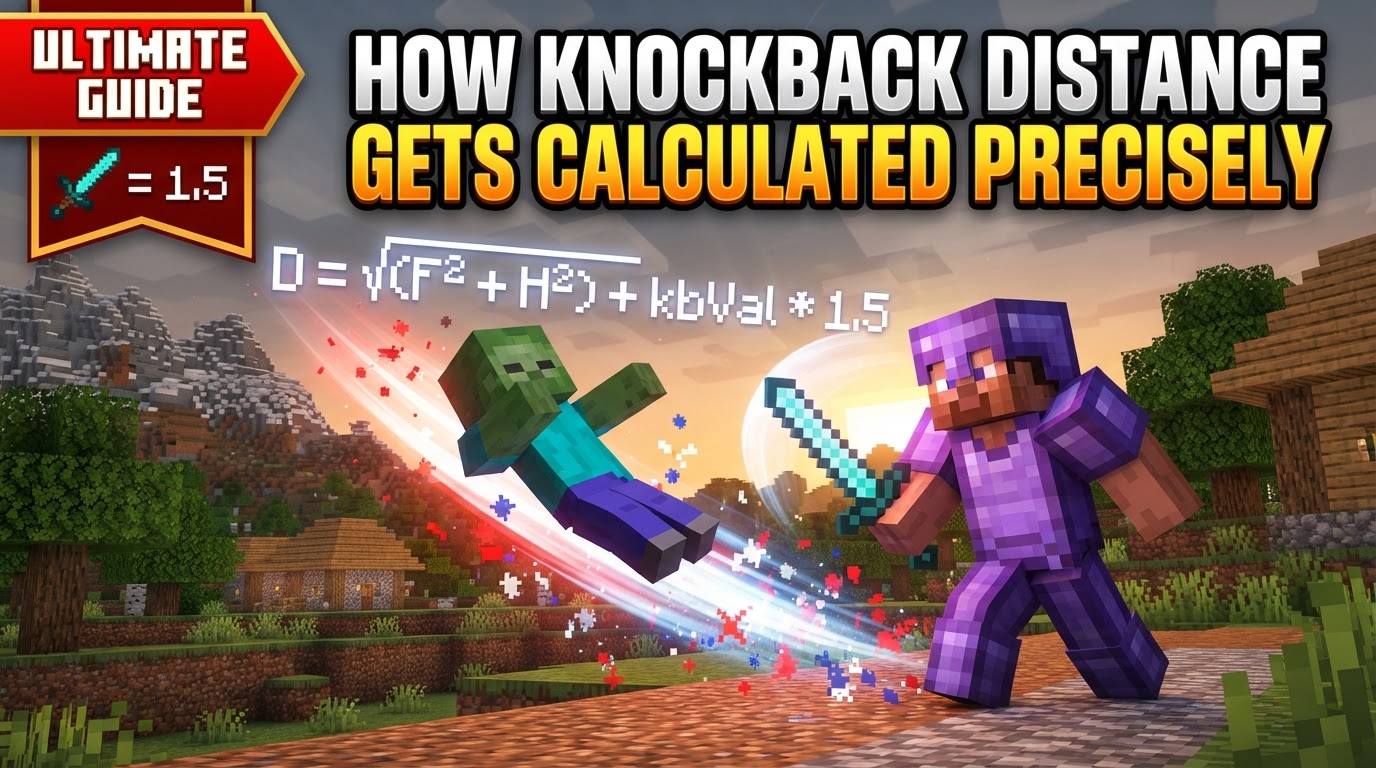
Knockback is a fundamental combat mechanic in Minecraft, dictating how far an entity is propelled after being struck. Far from being a simple push, it’s influenced by a complex interplay of weapon enchantments, attacker actions, and even the target’s inherent attributes. Understanding these factors is crucial for both dealing effective knockback and mitigating its impact on yourself.
The Core Mechanics: Unpacking the Forces at Play
At its heart, knockback in Minecraft is an intricate system built upon several key components. Each element contributes to the final trajectory and distance an entity travels after being hit.
- Base Knockback: The Inherent Push
Every attack in Minecraft inherently applies a base amount of knockback. This foundational force is always present, serving as the default push that sends a target away from the attacker. It’s the starting point for all subsequent calculations, determining the initial momentum. - The Power of Sprint Hits and Critical Blows
Attacker actions play a significant role in augmenting this base force. Performing a sprint hit – attacking while sprinting – substantially increases the knockback dealt to the target. Similarly, critical hits are also noted to deliver an amplified knockback effect, adding another layer of damage and displacement. - The Knockback Enchantment: Extending Your Reach
One of the most direct ways to enhance knockback is through the Knockback enchantment on a weapon. This enchantment explicitly boosts the distance a target is pushed. For instance, each level of the Knockback enchantment can add approximately 3 blocks to the horizontal knockback distance. Furthermore, Knockback II has the unique ability to add one block of vertical displacement, lifting the target slightly off the ground. - Redefining Direction: Attacker’s Gaze and Displacement
Perhaps the most strategic aspect of knockback is its directional control. Under specific circumstances, the knockback direction is not determined by the relative position between the attacker and the target, but rather by the attacker’s look direction at the moment of impact. This crucial mechanism, known as knockback displacement, occurs when the attacker either performs a sprint hit or uses a weapon enchanted with Knockback. This allows experienced players to direct opponents into specific locations, off ledges, or into traps, rather than simply pushing them straight back.
Understanding the Calculation Flow: An Inferred Process
While the exact mathematical formula remains proprietary, the sequence of events that determines knockback can be inferred from its observed behavior. This step-by-step process illustrates how the game likely calculates the final knockback effect.
- Initial Impact and Base Force: When an entity is hit by an attacker, the game first registers the impact and determines the initial base knockback force. This force typically pushes the target away from the attacker based on their relative positions.
- Directional Override Check: The game then checks if conditions for knockback displacement are met. This means evaluating whether the attacker performed a sprint hit or used a weapon enchanted with Knockback.
- Applying Directional Override: If either of those conditions is true, the initial knockback direction is overridden. Instead of pushing away from the attacker, the target is now pushed in the direction the attacker was looking at the precise moment of impact. This is where strategic players gain control over the target’s trajectory.
- Augmenting Force: Additional knockback force is then applied. This includes bonuses from the attack being a sprint hit and any extra force provided by the level of the Knockback enchantment on the weapon. Critical hits also contribute to this amplification.
- The Role of Resistance: When Knockback Fails: Before the final velocity adjustment, the target’s
generic.knockbackResistanceattribute is factored in. This attribute can reduce the final knockback distance, or in some cases, completely negate it. - Final Velocity Adjustment: Finally, the target’s velocity is adjusted according to all these calculated forces and resistances, resulting in the observed knockback. It’s important to note that status effects like Speed and Jump Boost have no impact on knockback calculations.
The Role of Resistance: Not All Foes Are Equal
A critical, often overlooked, aspect of knockback is the target’s inherent resistance. Not every mob responds equally to being struck. Some creatures possess a generic.knockbackResistance attribute, which can significantly alter or even nullify the knockback effect.
- Complete Resistance: Mobs like the Warden, Shulker, and Iron Golem possess complete knockback resistance. This means they are entirely unaffected by knockback from most sources, standing firm against even the most powerful blows.
- Partial Resistance: Other mobs, such as Hoglins and Ravagers, have partial resistance. While they can still be pushed, the effect is significantly reduced compared to creatures without this attribute.
Ignoring these resistances can lead to ineffective combat strategies, as attempts to control or push these mobs will prove futile.
Mastering Knockback: Advanced Techniques and Counterplays
Understanding the underlying mechanics allows players to not only inflict more effective knockback but also to defend against it. Skilled players utilize these techniques to gain a significant edge in combat.
- Strategic Knockback Displacement: Precision in Combat
To effectively direct opponents, leverage the knockback displacement mechanic. When using sprint hits or a weapon with the Knockback enchantment, quickly adjust your viewing angle just before impact. This allows you to push enemies into specific traps, environmental hazards, or off ledges, rather than just straight back. This technique transforms knockback from a simple push into a tactical tool. - Mitigating Incoming Knockback: Jump Resetting and W-Tapping
When you are the target of knockback, certain techniques can help you recover faster or reduce the distance you’re pushed.- Jump Resetting: By timing a jump precisely at the moment you are hit, you can significantly reduce the amount of knockback you take. This allows for quicker recovery and the ability to counter-attack more effectively. It’s about timing individual jumps, not simply holding down the jump key.
- W-Tapping: This technique involves briefly releasing and then pressing the ‘W’ key (forward movement). When attacking, it can help you deal more knockback by resetting your sprint, ensuring your hits are often registered as sprint hits. When defending, it can sometimes help you take less knockback by briefly breaking your forward momentum, allowing for better repositioning.
Common Pitfalls to Avoid
Even seasoned players can fall prey to misconceptions or ineffective practices regarding knockback. Being aware of these common mistakes can elevate your combat prowess.
- The Directional Deception: Many players mistakenly believe knockback always pushes a target directly away from them. This overlooks the critical mechanic of knockback displacement. Failing to understand that sprint hits and Knockback enchanted weapons allow you to manipulate the direction based on your gaze means missing out on powerful strategic options.
- Underestimating Mob Fortitude: Ignoring a mob’s inherent knockback resistance is a common oversight. Attempting to push a Warden or Iron Golem with a Knockback II sword will yield no results, wasting valuable combat time and resources. Always consider your opponent’s attributes.
- The Art of the Timed Jump: Simply holding down the space bar in hopes of reducing knockback is generally less effective than precisely timing individual jumps. The true benefit of jump resetting comes from the precise execution of a jump immediately after being struck, allowing the game to recalculate your momentum more favorably.
Mastering knockback in Minecraft is about more than just hitting harder; it’s about understanding the subtle forces at play, predicting outcomes, and manipulating the battlefield to your advantage. By internalizing these mechanics, you can transform your combat encounters, whether you’re pushing a foe into a lava pit or recovering swiftly from a devastating blow.
Tags:
YOU MAY ALSO LIKE...