Bouncing Safely Using a Slime Block (Step by Step)
Mastering the Slime Block: Your Comprehensive Guide to Safe Bouncing in Minecraft
The slime block is a unique and incredibly versatile utility block in Minecraft, renowned for its bouncy properties and its ability to negate fall damage. Understanding its mechanics is crucial for both survival and creative endeavors, from building elaborate contraptions to simply surviving a perilous drop. This guide will delve into the intricacies of using slime blocks to ensure safe and effective bouncing, covering key mechanics, step-by-step processes, essential tips, and common pitfalls to avoid.
Understanding Key Slime Block Mechanics
At its core, the slime block possesses several distinct properties that set it apart from other blocks. Its primary function, and often its most life-saving, is its ability to completely negate fall damage. When a player or most mobs land on the top surface of a slime block, any fall damage they would have incurred is entirely nullified. This makes it an indispensable tool for safe landings, especially when exploring high altitudes or designing complex builds.
Beyond fall damage negation, slime blocks are famous for their bouncing effect. Falling onto a slime block causes entities to bounce, with the initial bounce height directly proportional to the velocity of the fall. The harder you hit it, the higher you’ll initially go. However, it’s important to note that subsequent bounces rapidly decrease in height. You won’t keep bouncing to the same height indefinitely; the energy dissipates quickly. The absolute maximum height an entity can bounce from a slime block is approximately 57.625 blocks, regardless of how high the initial fall was.
Slime blocks also have a few subtle physical properties. They are slightly slippery, meaning movement on their surface is less controlled than on solid blocks. Additionally, standing on a slime block will slightly slow down your movement speed, which can be a factor in precision platforming or escape routes.
Interaction with Other Blocks
The behavior of slime blocks can be influenced by other blocks placed on top of them. Fortunately, many common blocks can be placed on a slime block without interfering with its primary functions. These include:
- Carpets
- Rails
- Trapdoors
- Redstone repeaters
- Comparators
- Pressure plates
When these items are placed on top of a slime block, they do not prevent its fall damage negation or its bouncing effect. This allows for creative designs where slime blocks are hidden or integrated into redstone contraptions without losing their core utility.
However, there are critical exceptions to be aware of. Placing half-blocks on top of a slime block will completely nullify its bouncing and fall damage negation properties. This includes:
- Slabs (any type)
- Cakes
If you fall onto a slime block covered by a slab or cake, you will take full fall damage as if landing on any other solid block. This is a common mistake that can lead to unexpected and fatal outcomes.
Side Impacts and Piston Interactions
Another crucial detail is how slime blocks interact with entities from the side. If you hit the side of a stationary slime block, it will not cause you to bounce. This means that if you fall alongside a tower of slime blocks and hit one from the side, you will still take fall damage if the fall was significant. The bouncing effect is exclusively triggered by landing on its top surface.
The only exception to this side-impact rule is when the slime block itself is in motion due to a piston. If a slime block is pushed or pulled by a piston and an entity collides with its side during this movement, the entity can be propelled or bounced. This mechanic is fundamental to many advanced redstone contraptions.
Speaking of pistons, slime blocks have a unique interaction with them. They can move most adjacent blocks when pushed by pistons, effectively “sticking” to them and dragging them along. This sticky property is what makes slime blocks so powerful for creating moving contraptions and flying machines. However, certain blocks are immune to this stickiness and will not be moved by slime blocks. These exceptions include:
- Obsidian
- Glazed terracotta
- Furnaces
- Hoppers
- Chests
- Beacons
- Bedrock
Understanding these exceptions is vital when designing piston-based mechanisms to avoid unintended behavior or blockages.
Step-by-Step Process for Safe Bouncing
Utilizing a slime block for safe bouncing is a straightforward process, but knowing the nuances can enhance your experience and safety.
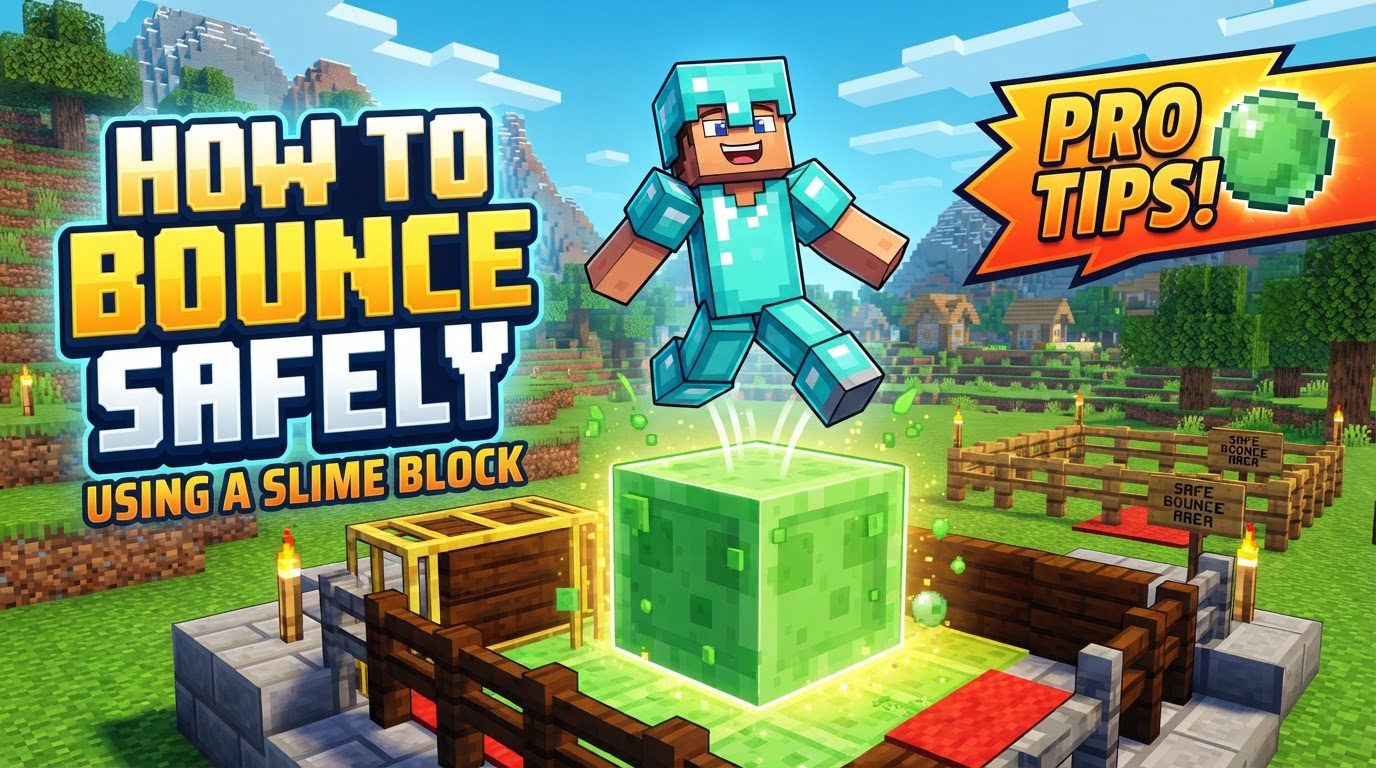
- Placement: Begin by placing one or more slime blocks on a solid surface at your desired landing spot. For general use, a single block is sufficient, but larger pads offer more forgiveness for off-target landings.
- Landing: Simply fall onto the top surface of the slime block(s). Ensure you are aiming for the top and not the sides. As soon as you make contact, fall damage will be negated, and you will begin to bounce.
- Controlled Bounce (Optional):
- To reduce your bounce height: If you wish to minimize the height of your bounce and perhaps perform a normal jump upon impact, hold down the jump key (spacebar) just as you land. This allows for a softer landing and more control over your subsequent movement.
- To completely stop bouncing and remain on the block: While it might seem counter-intuitive, if you hold the sneak key (shift) before impact, you will not bounce. However, it is crucial to understand that doing so will result in taking full fall damage. This is generally considered a common mistake to avoid if your goal is fall damage negation.
Important Tips for Effective Slime Block Use
Beyond basic bouncing, slime blocks offer several advanced applications and considerations:
- Piston Launchers: Consider using pistons in conjunction with slime blocks to create powerful launchers. By pushing a slime block upwards while you are standing on it, you can achieve controlled propulsion, launching yourself or other entities significant distances. This is a cornerstone of many transportation systems and mini-games.
- Larger Landing Pads: When falling from extreme heights, or when accuracy might be compromised, constructing a larger landing pad of multiple slime blocks can significantly increase safety. A wider target area reduces the risk of missing the block and taking fatal fall damage.
- Elytra Users: For players utilizing Elytra, colliding with slime blocks at high speeds can result in incredibly significant bounces. This can be used to regain altitude, change direction rapidly, or create thrilling aerial maneuvers. Experiment with different approach angles and speeds to master this technique.
Common Mistakes to Avoid
While slime blocks are incredibly useful, misusing them can lead to unexpected and often fatal consequences. Be mindful of these common mistakes:
- Crouching (sneaking) while falling: As mentioned, holding the sneak key (shift) when falling onto a slime block will prevent you from bouncing. More critically, it will also result in you taking full fall damage. Always avoid sneaking if your intention is to negate fall damage.
- Hitting the side of a stationary slime block: If you fall and collide with the side of a slime block that is not moving, it will not cause you to bounce. Instead, you will experience the full impact of the fall and take fall damage if the height was sufficient. Always aim for the top surface.
- Placing half-blocks on top: Never place slabs or cakes directly on top of slime blocks if your goal is safe bouncing. These blocks nullify the slime block’s effect, causing you to take fall damage as if landing on any other solid block.
- Expecting a full return bounce: Slime blocks will not bounce you back to the exact height you fell from. The bounce height is always reduced with each subsequent bounce. Plan your falls and contraptions with this energy loss in mind.
- Breaking the block mid-fall: If the slime block you are aiming for is broken before you land on it, you will, of course, still take full fall damage. Ensure your landing pad is secure and undisturbed.
- Incorrect piston contraptions: When designing complex mechanisms involving pistons and slime blocks, be mindful of the blocks that do not stick. Placing obsidian, glazed terracotta, furnaces, hoppers, chests, beacons, or bedrock adjacent to a slime block in a piston contraption can lead to unintended behavior, blockages, or broken machines.
By understanding these mechanics and adhering to these guidelines, you can safely and effectively harness the power of slime blocks in all your Minecraft adventures, transforming dangerous falls into exhilarating bounces and opening up new possibilities for construction and movement.
Tags:
YOU MAY ALSO LIKE...