

Building a Hidden Base Using Camouflage Blocks, Explained
65
views ❘
July 6, 2026
Key Mechanics of Camouflage Bases
The foundation of any successful hidden base lies in mastering several core mechanics that allow for seamless integration with the environment and discreet access.
- Redstone Integration: At the heart of many hidden bases is redstone circuitry. This powerful mechanic allows players to create sophisticated, hidden doors and passages using sticky pistons. Sticky pistons can push and pull blocks, making them ideal for concealing entrances that blend perfectly with their surroundings. These hidden mechanisms are typically activated by discreet switches such as levers, buttons, or pressure plates, which themselves must be hidden or camouflaged effectively. The redstone wiring itself must also be meticulously concealed to prevent detection.
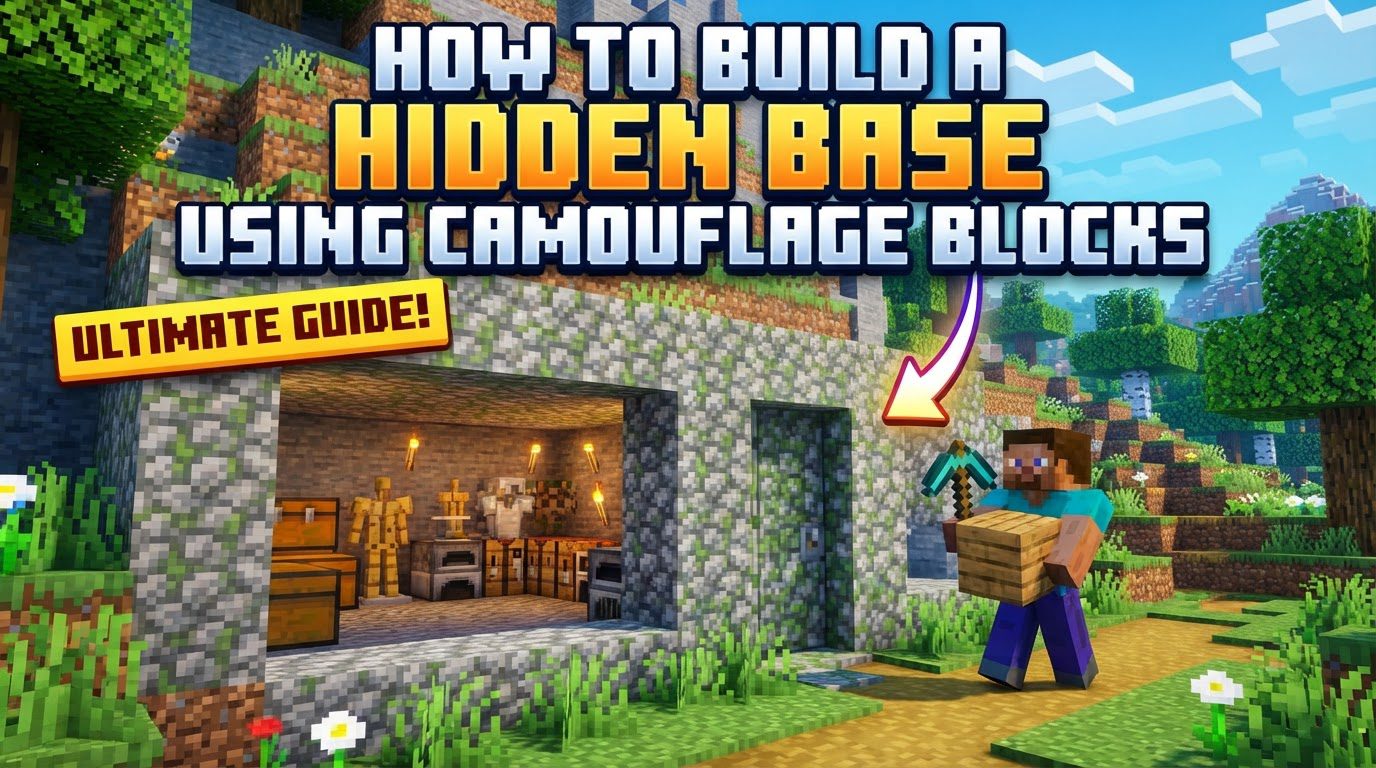
- Natural Camouflage: The most fundamental aspect of a hidden base is its ability to disappear into the natural world. This involves employing blocks that are indigenous to the chosen biome. For instance, in a forest, dirt, grass, and wood are essential. In a desert, sand and sandstone are key. Stone is versatile and can be used in mountainous or underground biomes. Snow is perfect for icy landscapes. By using these naturally occurring blocks, the entrance to your base can seamlessly mimic the surrounding terrain, making it incredibly difficult to spot.
- Environmental Features: Rather than building from scratch in an open field, leveraging existing natural terrain provides an immediate advantage. Mountainsides offer natural cover for entrances that can be carved directly into the rock. Dense trees can hide structures within their foliage or underneath their roots. Waterfalls provide excellent visual and auditory concealment, masking the sounds of pistons or the sight of an opening. Underwater areas offer a unique challenge and a high degree of secrecy, as many players do not extensively explore the depths. Incorporating these features into your design makes your base appear as a natural part of the landscape.
- Game Exploits/Glitches: Advanced hidden base builders often utilize specific game mechanics or subtle “exploits” to create highly discreet entryways. Shulker boxes, for example, can be placed in ways that create walkable gaps or conceal mechanisms. Powdered snow, when carefully placed, can allow players to pass through what appears to be a solid block, offering a unique form of concealment. Even certain trapdoor configurations can be used to create unconventional and discreet passages that are not immediately obvious to an observer. These methods often require a deeper understanding of game physics.
- Water/Lava Flow: Entrances that incorporate water or lava flows add another layer of security and concealment. By strategically placing signs or other specific blocks, it’s possible to create safe passages through what appears to be a hazardous or impassable liquid barrier. Water can be used to hide a drop-down entrance, while lava can deter most players, making a hidden path through it an unexpected surprise. The challenge lies in making the passage safe for the owner while remaining hidden from others.
Step-by-step Process: Practical Examples
Understanding the core mechanics is the first step; applying them in practical builds demonstrates their effectiveness.
- Hidden Tree Base: This classic hidden base design leverages the natural camouflage of a tree.
- Begin by scouting for a suitable tree. Ideally, look for one that has a one-block gap between its trunk and a nearby grass or dirt wall. This natural indentation is perfect for concealing an entrance.
- Once the tree is selected, carefully dig a hidden chamber directly underneath it. This will be the main access point and potentially the start of your base.
- Next, place a lever or another activation mechanism in an extremely discreet location. This could be under a tilled block of soil, making it appear as a regular farm plot, or subtly placed behind the tree, nestled amongst its roots or leaves. The key is that it should not be immediately visible.
- Connect this discreet lever to redstone circuitry. This circuitry will lead to sticky pistons that are positioned to move camouflage blocks – typically dirt or grass blocks – which form part of the natural wall. When the lever is activated, the pistons retract these blocks, revealing the entrance to your hidden chamber.
- Finally, ensure all exposed redstone wiring and pistons are thoroughly covered with natural blocks. This step is crucial for maintaining the illusion of an untouched environment and preventing the mechanism from being discovered.
- Lectern Door: This ingenious design utilizes the often-overlooked redstone properties of a lectern.
- First, place a lectern in a seemingly innocuous location within your base’s outer structure or a decoy building. Place a book on the lectern.
- Behind the lectern, position a redstone comparator. Ensure the comparator is facing away from the lectern. A comparator outputs a redstone signal strength based on the page number the book on the lectern is currently open to.
- Connect the output of the comparator to a series of redstone repeaters, if necessary, to extend the signal. These repeaters will then power sticky pistons that form your hidden door. For instance, setting the book to a specific page number could trigger the comparator to output a strong enough signal to activate the pistons, opening the door.
- When the book is at the correct page, the door opens. When it’s not, the door remains closed and camouflaged. This method provides a subtle and interactive way to conceal an entrance, as simply interacting with a book might not raise suspicion.
Important Tips for Success
Beyond the mechanics, strategic planning and attention to detail are vital for an impenetrable hidden base.
- Strategic Location: The choice of location is paramount. Opt for less frequented areas of the map or naturally defensible spots. Remote mountains, deep within dense forests, or far underwater are excellent choices. These locations naturally offer more concealment and are less likely to be stumbled upon by other players.
- Terraforming: True camouflage often requires modifying the surrounding terrain. If your entrance creates sharp edges or unnatural angles, it will stand out. Take the time to terraform the area around your base, smoothing out any unnatural shapes, adding subtle hills, or planting trees to make the entrance blend in seamlessly with the natural environment.
- Resource Management: Building a hidden base, especially one with complex redstone, is resource-intensive. Gather ample building materials, redstone components, and tools before you begin construction. Running out of materials mid-build can force you to leave visible signs of construction or, worse, abandon the project entirely, potentially exposing your efforts.
- Lighting: While crucial for preventing hostile mob spawns, lighting must be handled subtly. Use light sources that can be covered or are naturally dim, such as glowstone or sea lanterns flush with the ceiling, or strategically placed torches covered by carpets or trapdoors. Avoid bright, exposed torches near the entrance or outside, as they can draw unwanted attention.
- Decoy Structures: A clever tactic is to build a visible, less important structure nearby. This “decoy” can serve as a distraction, drawing attention away from your actual hidden base. Players might investigate the decoy, assuming it’s your main hideout, while your true base remains undiscovered.
- Consider Server Settings: If playing on a multiplayer server, be mindful of server settings, particularly chunk loading and rendering distances. On servers with high rendering distances, elements that are hidden from a close perspective might become visible from afar, potentially revealing your base. Always test your base’s visibility from various distances and angles.
Common Mistakes to Avoid
Even experienced builders can make errors that compromise the secrecy of their hidden base. Awareness of these pitfalls is key.
- Obvious Entrances: The most common mistake is using clearly visible levers, buttons, or pressure plates that stand out against the natural backdrop. Any exposed activation mechanism immediately gives away the presence of a hidden structure. Ensure all activators are either completely hidden or perfectly camouflaged.
- Unnatural Terrain: Creating perfectly flat or angular areas around your base in an otherwise natural, organic environment is a dead giveaway. Nature is rarely perfectly geometric. Such unnatural formations will immediately draw suspicion and investigation. Always strive for organic, natural-looking terraforming.
- Insufficient Materials: As mentioned, running out of blocks or redstone components mid-build can be disastrous. It can leave unfinished sections, exposed mechanisms, or force you to abandon the project, leaving behind tell-tale signs of construction that can lead others to your intended hidden spot.
- No Plan: Attempting to build a complex hidden base without at least a rough design or plan can lead to significant inefficiencies, wasted resources, and easily discoverable flaws in your concealment. Plan your redstone, entrance, and internal layout beforehand.
- Lack of Internal Lighting: Failing to adequately light the interior of your underground or hidden base will result in hostile mob spawns. Mobs can make noise, wander out of hidden entrances, or simply be a nuisance, potentially drawing attention to your base through their presence or sounds.
- Exposed Redstone: While redstone is crucial, leaving any part of the circuitry visible from the outside, even a tiny wire or repeater, will immediately reveal the hidden mechanism. All redstone must be fully encapsulated within the natural blocks used for camouflage.
- Using Rare/Out-of-Place Blocks: Incorporating decorative or rare blocks into your camouflage that do not match the natural surroundings is a significant mistake. A diamond block or a highly polished stone brick in a dirt wall will instantly draw attention, signaling that something unnatural is present. Stick to blocks that are indigenous to the biome.
By adhering to these principles and learning from common mistakes, you can construct a truly undetectable sanctuary in Minecraft, ensuring your treasures and privacy remain safeguarded from even the most determined explorers.
Click to rate this post!
[Total: 0 Average: 0]
Tags:
YOU MAY ALSO LIKE...

Finding the Best Building Seeds for Mountains
49
views
Finding the Best Building Seeds for Mountains in Minecraft Minecraft's endlessly generated worlds offer an…

Finding the Best Minecraft Seeds for 2026 (Step by Step)
58
views
Finding the perfect Minecraft seed can dramatically enhance your gameplay experience, offering a unique foundation…

Finding the Best Survival Seeds with Resources Near Spawn — A Quick Guide
53
views
Understanding Minecraft Seed Mechanics To effectively search for ideal seeds, it's essential to understand how…

How to Find the Bounce Music Disc in Minecraft
11
views
The "Bounce" music disc, introduced in the enigmatic Minecraft 26.2 Chaos Cubed update, stands out…

Finding the Changelog for a Specific Game Drop
43
views
Minecraft, a game renowned for its continuous evolution, has embraced a new paradigm for content…

Finding the Dappled Forest Biome — A Quick Guide
87
views
The world of Minecraft is ever-expanding, and with the upcoming 26.3 update, arriving in the…

Finding the End Portal Room in a Stronghold
63
views
The journey to defeat the Ender Dragon, Minecraft's ultimate boss, begins with locating the End…

How to Find the Stronghold in Minecraft Fast Using the Triangulation Method
134
views
Introduction Finding the Stronghold in Minecraft is a critical milestone for any player aiming to…

Finding Your Minecraft Crafting Calculator Online (Step by Step)
25
views
Understanding and Utilizing Your Minecraft Crafting Calculator Online Minecraft, a world of endless creativity and…