Crafting an Ender IO Soul Binder, Explained
Understanding the Soul Binder’s Core Functionality
At its heart, the Soul Binder is designed to convert specific item types by combining them with the essence of a mob, captured within a filled Soul Vial. This process is not instantaneous or free; it demands both a consistent supply of Redstone Flux (RF) power and a significant investment of experience levels (EXP) to complete any operation.
The experience required can be provided in two primary forms: as liquid experience, which can be piped directly into the machine, or by drawing experience from an Experience Rod. The Soul Binder is an indispensable tool for crafting a variety of specialized items, including:
- Enticing Crystals: Used for mob attraction.
- Flight Control Units: Essential components for advanced flight mechanics.
- Ender Crystals: Powerful items with various applications.
- Frank’N’Zombies: Unique constructs.
- Sentient Ender: A crucial material for advanced crafting.
- Ender Rails: Specialized rail segments.
- Changing the type of a Broken Spawner: Allowing players to customize mob spawners to their needs.
An important aspect to consider for efficiency is the capacitor used within the machine. The higher the tier of the capacitor installed, the more rapidly the Soul Binder will process its tasks, significantly reducing waiting times for complex recipes.
Crafting the Soul Binder
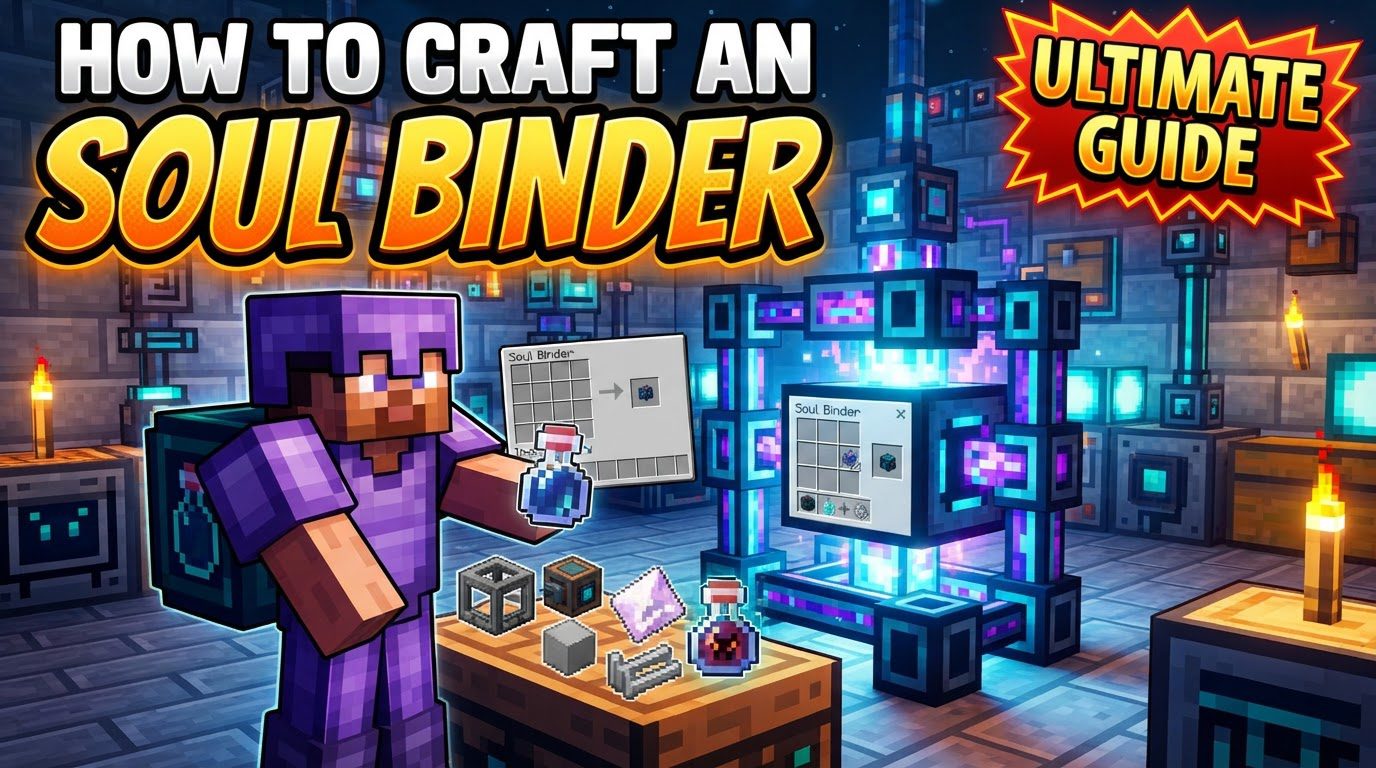
To begin your journey with the Soul Binder, you must first construct the machine itself. The crafting recipe is specific and requires a combination of common and unique Ender IO components, alongside various mob heads. Gather the following materials:
- 4x Soularium: A core Ender IO alloy.
- 1x Enderman Head (EnderIO): A specific variant of the Enderman head from the Ender IO mod.
- 1x Creeper Head: Obtained from a Creeper explosion or rare mob drops.
- 1x Machine Chassis (EnderIO): The foundational component for many Ender IO machines.
- 1x Zombie Head: Obtained from a Zombie explosion or rare mob drops.
- 1x Skeleton Skull: Obtained from a Skeleton explosion or rare mob drops.
Arrange these components in a crafting grid according to the recipe to yield your very own Soul Binder.
Operating the Soul Binder: A Step-by-Step Guide
Once crafted, using the Soul Binder effectively requires adherence to a specific operational sequence:
- Placement and Power: Begin by placing the Soul Binder in your desired location. It is crucial to immediately supply it with Redstone Flux (RF) power. Without adequate power, the machine will not initiate or complete any processing tasks.
- Input Item Insertion: Next, insert the primary item required for your desired recipe into the designated input slot. For instance, if you intend to change a spawner’s type, this is where a Broken Spawner would be placed.
- Soul Vial Placement: Locate the specific slot for the Soul Vial and insert a filled Soul Vial containing the soul of the mob necessary for your recipe. This is the essence that will transform your input item.
- Experience Provision: The Soul Binder requires a certain amount of experience levels (EXP) for each operation. This can be supplied in several ways:
- Player XP: You can directly provide your own experience levels to the machine.
- Liquid XP: Liquid experience can be piped into the Soul Binder using fluid conduits.
- Experience Obelisk: Placing an Ender IO Experience Obelisk next to the Soul Binder and configuring it to push XP is an efficient method.
- Processing and Output: Once all prerequisites-RF power, input item, filled Soul Vial, and sufficient EXP-are met, the machine will commence processing. It will consume the power, experience, and ingredients, ultimately producing your desired output item.
Important Tips for Optimal Performance
To get the most out of your Ender IO Soul Binder, consider these valuable tips:
- Efficient XP Input with Experience Obelisk: For seamless and automated experience provision, place the Soul Binder directly adjacent to an Ender IO Experience Obelisk. Crucially, ensure the Obelisk is configured to actively push XP into the Soul Binder, rather than passively waiting for the Soul Binder to pull it. This setup ensures a constant and reliable supply of experience.
- Liquid XP Management: If you prefer using liquid experience, it can be efficiently piped into the Soul Binder using fluid conduits. Alternatively, an Ender IO tank placed directly on top of the Soul Binder can be configured to push liquid XP downwards, providing a compact and effective solution.
- Utilizing Higher-Tier Capacitors: To significantly boost the processing speed of your Soul Binder, always aim to use the highest-tier capacitors available. Upgrading the capacitor will dramatically reduce the time it takes for recipes to complete, making your operations far more efficient, especially for large-scale production.
- Advanced Automation with Conduits: When integrating the Soul Binder into a fully automated system, standard item conduits with basic filters might not always suffice. Due to varying NBT data on different filled Soul Vials, you might encounter issues with items being incorrectly routed or stuck. To circumvent this, employ more advanced item conduits equipped with sophisticated filters, or utilize level emitters to precisely manage the flow of specific items and Soul Vials, ensuring smooth and error-free automation.
Common Mistakes to Avoid
Even experienced players can encounter issues with the Soul Binder. Being aware of these common mistakes can save you time and resources:
- Insufficient XP: One of the most frequent problems is not providing enough experience. Each recipe has a specific XP cost, and if the Soul Binder only receives a fraction of the required XP, it will not complete the task. It’s vital to remember that higher experience levels require progressively more cumulative XP, so always ensure your XP source has ample total experience available for the operation.
- Incorrect XP Input Configuration: The Soul Binder does not passively pull all available liquid XP from connected pipes or tanks. It only takes what it needs for the current operation. If your XP source (such as an XP Obelisk or a tank) is not explicitly configured to push XP to the Soul Binder, the machine will remain idle, even if a large amount of liquid experience is technically connected. Always double-check your push/pull settings.
- Power Issues: A fundamental requirement for the Soul Binder is a consistent supply of RF power. A lack of adequate power can manifest in various ways: recipes failing to start, operations pausing mid-process, or the machine simply appearing unresponsive. Always verify that your power grid is robust enough to supply the Soul Binder and that the machine is indeed receiving power.
- Server-Side Glitches: In certain multiplayer server environments, players might experience an unusual glitch where the Soul Binder accepts XP but then enters an indefinite pause, failing to complete the process. While not always fixable by the player, sometimes simple actions like relogging, replacing the block, or, if possible, testing the setup in a single-player world might offer a temporary resolution or help diagnose if it’s a server-specific issue.
- Incorrect Ingredients: It’s easy to overlook minor details, especially when dealing with items from multiple mod packs. Always meticulously double-check that both the primary input item and, critically, the type of filled Soul Vial are precisely correct for your intended recipe. Using an incorrect mob soul or a variant of an item can lead to failed operations and wasted resources.
By understanding these mechanics and following the advice provided, you will be well-equipped to integrate the Ender IO Soul Binder seamlessly into your Minecraft infrastructure, unlocking new possibilities for advanced crafting and automation.
Tags:
YOU MAY ALSO LIKE...