Calculating Hunger and Saturation Depletion Rates — A Quick Guide
Understanding how hunger and saturation deplete in Minecraft is fundamental to efficient resource management and survival, particularly during demanding activities like mining, exploring, or combat. While the visible hunger bar gives a basic indication of your character’s nutritional state, a hidden mechanic called saturation plays an even more critical role in determining how long you can sustain actions before needing to eat again. By grasping these interconnected systems, players can optimize their food choices and activity patterns to maximize their time and minimize food consumption.
The Core Mechanics of Hunger and Saturation
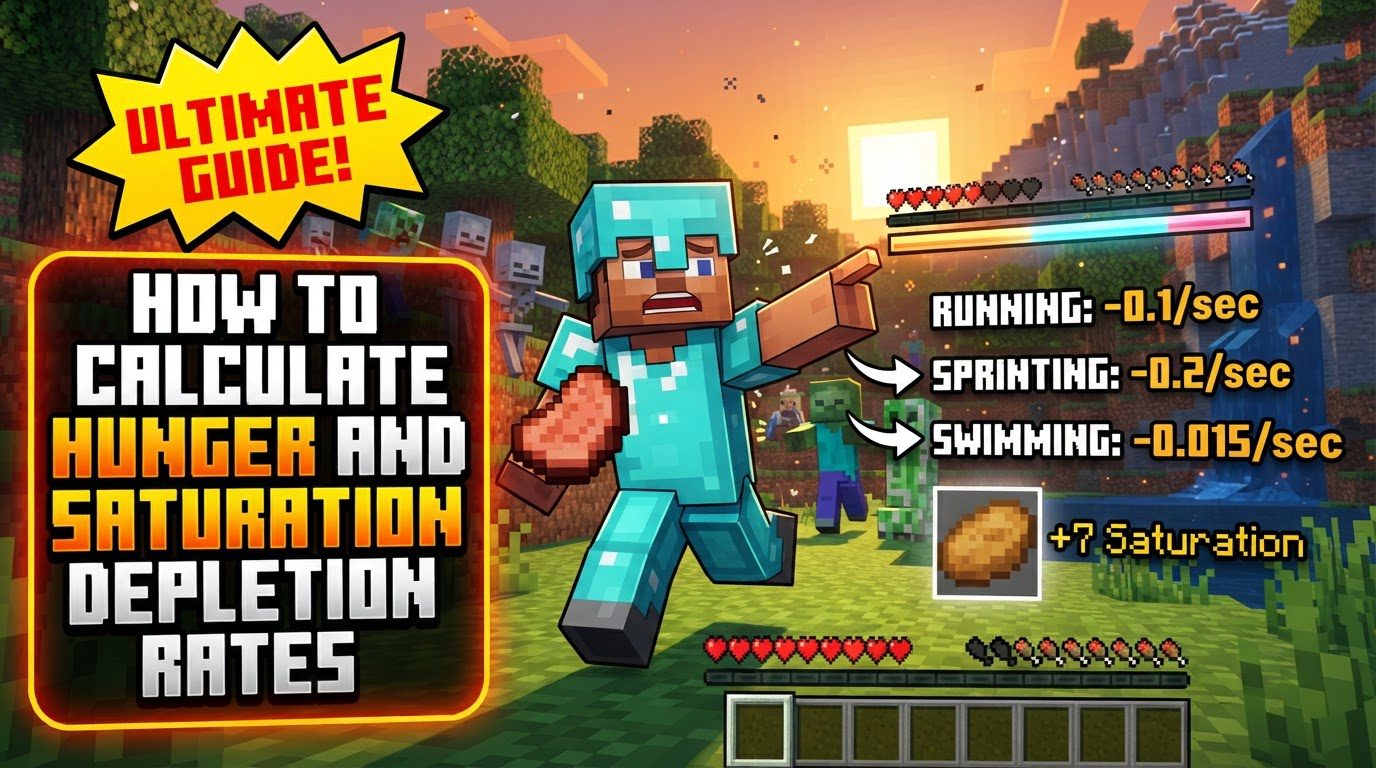
At its most basic, your visible hunger bar consists of 20 hunger points, represented by 10 drumsticks. Each full drumstick represents 2 hunger points. This bar dictates many aspects of your character’s well-being and capabilities.
- Saturation: The Hidden Layer: Saturation is a crucial, hidden, secondary form of hunger. It depletes before your visible hunger bar even begins to decrease. Think of it as a buffer that keeps your visible hunger bar full even as you perform actions.
- Food’s Role: When you consume food, it replenishes both your visible hunger points and your hidden saturation level. The amount restored varies significantly between different food items.
- Saturation Cap: An important rule to remember is that your saturation level can never exceed your current hunger level. If your hunger bar is at 18 points (9 drumsticks), your saturation cannot go above 18, even if the food you eat would normally provide more.
- Exhaustion: The Depletion Engine: Exhaustion is another hidden variable that accumulates as you perform various player actions. It acts as the primary driver for the depletion of both saturation and, eventually, visible hunger.
- Hunger Levels and Abilities: Your current hunger level directly impacts several player abilities:
- Natural Health Regeneration: Your character will naturally regenerate health when your hunger level is at 18 hunger points (9 drumsticks) or higher. This passive healing consumes hunger and saturation.
- Inability to Sprint: If your hunger level drops below 6 hunger points (3 drumsticks), you will be unable to sprint, severely limiting your mobility.
- Starvation Damage: At 0 hunger points (empty hunger bar), your character will begin to take starvation damage. This damage will continue until you eat, or, depending on the difficulty setting, until your health reaches a certain threshold (stops at 10 health on Easy, 1 health on Normal). Starvation damage does not occur on Peaceful difficulty.
The Depletion Process: How Exhaustion Works
The core of understanding hunger and saturation depletion lies in the accumulation and effect of exhaustion. This is a step-by-step process that constantly runs in the background as you play.
- Accumulating Exhaustion: Player activities are the primary source of exhaustion. Actions such as sprinting, jumping, attacking mobs, taking damage, and even naturally regenerating health (when hunger is high) all contribute to increasing your hidden “exhaustion” value. More strenuous or frequent actions accumulate exhaustion faster.
- Saturation Depletion Threshold: When your accumulated exhaustion level reaches 4.0, a specific event occurs:
- One point of saturation is depleted.
- Your exhaustion level immediately resets to 0.
This means that every 4.0 exhaustion points you accumulate, you lose 1 point of that hidden saturation buffer.
- Visible Hunger Depletion: If your saturation level is already at 0 (meaning your hidden buffer is empty), the same 4.0 exhaustion threshold will instead cause your visible hunger bar to deplete:
- One point of visible hunger is depleted.
- Your exhaustion level immediately resets to 0.
This is why you often won’t see your visible hunger bar move until you’ve been active for a while after eating; the saturation is being depleted first.
- The Food Tick Timer: Beyond direct exhaustion, a “foodTickTimer” also plays a role. This timer contributes to health regeneration when your hunger is sufficiently high, consuming hunger and saturation in the process. Conversely, it’s also linked to health depletion when your hunger is at zero, causing starvation damage.
Effective Strategies for Managing Hunger and Saturation
Understanding the mechanics allows for informed decisions that can significantly improve your survival and efficiency.
- Prioritize Avoiding Damage: Healing consumes a significant amount of hunger and saturation, as natural regeneration builds exhaustion rapidly. Minimizing damage taken, whether from mobs, falls, or environmental hazards, is one of the most effective ways to conserve your food supply.
- Golden Carrots for Efficiency: For most general purposes, Golden Carrots offer the best saturation-to-hunger ratio among stackable food items. This makes them incredibly efficient for sustained activity, as they provide a large amount of hidden saturation, keeping your visible hunger bar full for longer.
- Cooked Porkchops and Steak: Cooked porkchops and steak provide an excellent balance of both hunger restoration and saturation. While their saturation-to-hunger ratio might not be as high as Golden Carrots, their ease of farming (especially from passive mobs) and good overall stats make them a staple for many players.
- Optimal Eating Timing: Consume food when your hunger bar first shows empty drumsticks (i.e., when your visible hunger drops below its maximum). Eating when your hunger bar is completely full leads to wasted saturation, as any saturation gained beyond your current hunger level is immediately lost due to the saturation cap.
- Suspicious Stew for Boosts: Certain suspicious stews can provide powerful, albeit temporary, boosts. Specifically, suspicious stew made with a blue orchid or a dandelion provides a large boost to saturation. The blue orchid version is particularly notable for potentially granting the rare active saturation effect, which can be incredibly useful.
Common Mistakes to Avoid
Even experienced players can fall into habits that lead to inefficient hunger management. Being aware of these pitfalls can save you valuable resources.
- Eating When Fully Fed: A common mistake is to eat food when your hunger bar is already completely full. As mentioned, any additional saturation provided by the food beyond your current hunger level is wasted. This is particularly inefficient with high-saturation foods.
- Relying on Low Saturation Foods: For demanding activities like extensive mining, combat, or exploration, avoid relying on foods with low saturation values. Examples include raw fish, cookies, and dried kelp. While they might restore some hunger points, they provide very little saturation, meaning your visible hunger will deplete quickly, requiring more frequent eating.
- Consuming “Hunger” Status Effect Foods: Foods that apply the “Hunger” status effect, such as rotten flesh, raw chicken, or pufferfish, should be avoided unless absolutely necessary. The Hunger effect rapidly accelerates the depletion of both your visible hunger and your hidden saturation, making you lose food faster and become hungry much sooner.
- Excessive Sprinting and Sprint-Jumping: While useful for covering ground quickly, excessive sprinting and especially sprint-jumping rapidly increase your exhaustion level. This, in turn, causes your saturation and visible hunger to deplete at a much faster rate. Use these actions judiciously, particularly when food resources are scarce.
- Underestimating Saturation’s Importance: Many players focus solely on the visible hunger bar. However, underestimating the importance of the hidden saturation mechanic is a significant mistake. Saturation is the primary buffer that determines how long you remain “full” and can perform actions without your visible hunger bar dropping. A high saturation level is key to sustained activity and efficient food usage.
By internalizing these mechanics and strategies, you can become a more efficient and self-sufficient player in the world of Minecraft, ensuring your adventures are limited only by your ambition, not your hunger.
Tags:
YOU MAY ALSO LIKE...