Calculating Looting Enchantment Drop Bonus Per Level, Explained
The Looting enchantment is a cornerstone for any Minecraft player looking to maximize their gains from mob hunting. Primarily designed for swords and spears, this powerful enchantment significantly enhances the drops obtained from hostile creatures. Understanding how Looting works, particularly in calculating its bonus drops per level, is crucial for efficient resource gathering and securing rare items.
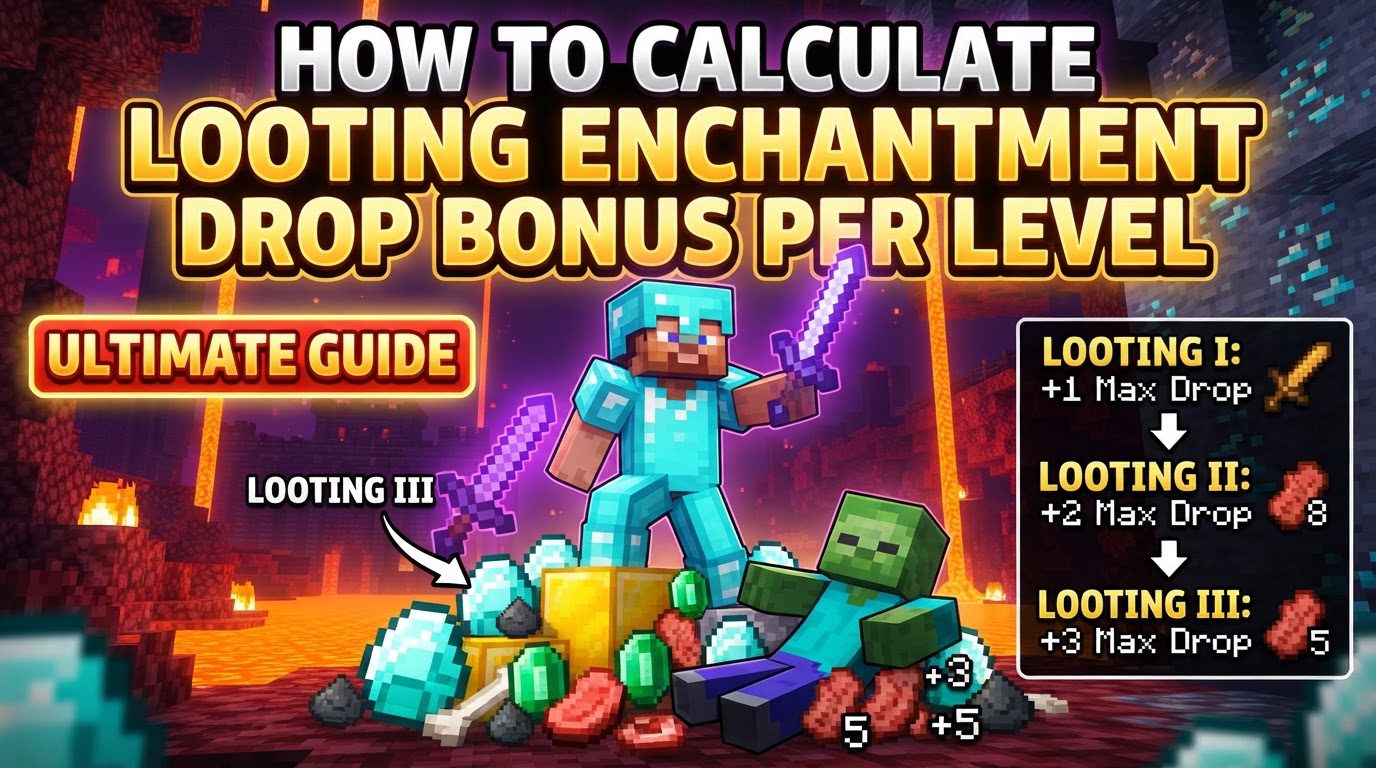
At its core, Looting serves two main purposes: it increases the quantity of common item drops and boosts the likelihood of obtaining rare item drops. The enchantment can reach a maximum level of III, with each level providing incremental benefits. For the enchantment to take effect, the weapon enchanted with Looting must be held in the player’s main hand at the exact moment a mob is defeated. It’s important to note that Looting specifically influences “spawned on death” drops, such as rotten flesh from zombies, but it does not affect items a mob might have been “carrying” when it spawned, like a zombie appearing with a shovel. Furthermore, Looting has no impact on the amount of experience dropped by mobs.
While Looting is incredibly versatile, certain mobs and items are unaffected by its power. These include bats, bees, endermites, Withers, iron golems, cats, snow golems, most fish drops from fish mobs, bamboo from pandas, wool from sheep, sponges, tide armor trims, and totems of undying. However, it’s worth highlighting that guardians and elder guardians are exceptions to this list and their drops are indeed affected by Looting.
Applying the Looting Enchantment
To begin benefiting from Looting, players must first acquire a suitable weapon. Swords and spears are the primary candidates for this enchantment. Once a weapon is obtained, the Looting enchantment can be applied through several methods:
- Using an enchanting table: Place the weapon in the enchanting table’s slot and choose one of the available enchantments, hoping Looting appears as an option.
- Using an anvil with an enchanted book: Combine the weapon with a Looting enchanted book on an anvil. This method allows for precise application of the desired enchantment.
- Utilizing game commands: For those with access to commands, Looting can be directly applied to a weapon using specific console commands.
After the enchantment is successfully applied, the final step is straightforward: hold the enchanted weapon in your main hand when engaging and defeating mobs. This ensures that the bonuses from Looting are active and applied to your loot.
Calculating Common Drop Bonuses Per Level
One of the most immediate and tangible benefits of the Looting enchantment is its effect on common item drops. For items that drop in varying quantities, Looting directly increases the maximum possible number of items obtained. The calculation is simple and consistent across all levels:
- Looting I: Increases the maximum number of items by 1.
- Looting II: Increases the maximum number of items by 2.
- Looting III: Increases the maximum number of items by 3.
For example, if a mob typically drops 0-2 items of a certain type, with Looting I, it would drop 0-3 items. With Looting II, it would drop 0-4 items, and with Looting III, it would drop 0-5 items. This consistent increase per level makes Looting I, II, and III progressively more effective for farming common resources like rotten flesh, bones, or string.
Calculating Rare Drop Bonuses Per Level
The calculation for rare drop bonuses is more nuanced, as Looting enhances the chances of rare items appearing in two distinct ways. This dual approach makes Looting incredibly powerful for hunting down elusive drops.
Method 1: Second Attempt Probability
If the initial attempt to drop a rare item fails, Looting provides a second chance. The success rate of this second attempt is determined by a specific formula:
level / (level + 1)
Let’s break this down by Looting level:
- Looting I: The chance for a second attempt to succeed is
1 / (1 + 1), which equals1/2or 50%. This means if the first roll fails, there’s a 50% chance for a second roll. - Looting II: The chance for a second attempt to succeed is
2 / (2 + 1), which equals2/3or approximately 66.7%. A higher chance for that crucial second opportunity. - Looting III: The chance for a second attempt to succeed is
3 / (3 + 1), which equals3/4or 75%. This significantly boosts the odds of rare drops appearing, as the majority of failed initial rolls get a strong second chance.
This mechanism is particularly effective because it directly addresses the inherent rarity of certain drops, providing a substantial boost to the overall probability of acquisition.
Method 2: Direct Percentage Point Increase
In addition to the second attempt mechanism, Looting also directly increases the base percentage chance of a rare drop by 1 percentage point per level. This is a straightforward additive bonus to the item’s existing drop rate.
- Looting I: Adds 1 percentage point to the base chance.
- Looting II: Adds 2 percentage points to the base chance.
- Looting III: Adds 3 percentage points to the base chance.
Consider an example: if a rare item has a base drop chance of 2.5%:
- With Looting I, the base chance becomes 2.5% + 1% = 3.5%.
- With Looting II, the base chance becomes 2.5% + 2% = 4.5%.
- With Looting III, the base chance becomes 2.5% + 3% = 5.5%.
This direct increase, when combined with the second attempt probability, creates a powerful synergy that dramatically improves the chances of obtaining valuable rare items. This same 1 percentage point increase per Looting level also applies to equipment drops from mobs, making it easier to acquire mob-worn armor or tools.
Strategic Use and Important Tips
To maximize the benefits of Looting, players can employ several strategies:
- Projectile Kills: If you are using a bow, crossbow, or trident for ranged combat, you can still benefit from Looting. The key is to switch to your Looting-enchanted melee weapon before the projectile makes contact and kills the target. In Java Edition, players have an additional advantage as they can hold the Looting weapon in their main hand while shooting a bow from their off-hand, allowing for simultaneous ranged combat and Looting benefits. In Bedrock Edition, this technique of switching weapons for projectile kills is generally more challenging to execute successfully.
- Farming Rare Items: Looting is exceptionally beneficial for farming some of the most sought-after and rare items in Minecraft. This includes crucial resources like Wither Skulls (from Wither Skeletons), Ender Pearls (from Endermen), and Tridents (from Drowned). The enhanced drop rates make these notoriously difficult items much more accessible.
Common Mistakes to Avoid
While Looting is powerful, understanding its limitations is as important as knowing its strengths:
- Players are Immune: Do not expect Looting to increase drops when defeating other players. Its effects are strictly for hostile and certain neutral mobs.
- Irrelevant Mobs: Avoid wasting durability or time using Looting on mobs that do not have “spawned on death” drops or are specifically exempt from its effects. Always confirm if a mob’s drops are affected.
- No Direct Bow/Crossbow Enchantment: Looting cannot be directly applied to bows or crossbows. Its primary application is on melee weapons, necessitating the weapon-switching technique for ranged combat benefits.
- Bedrock Edition Nuances: Be aware that the technique for applying Looting to projectile kills can be more difficult to execute reliably in Bedrock Edition compared to Java Edition. Practice is often required to master this timing.
In conclusion, the Looting enchantment is an indispensable tool for any Minecraft adventurer. By understanding its mechanics – from the straightforward increase in common item quantities to the sophisticated dual-pronged boost for rare drops – players can significantly enhance their resource collection efficiency. Whether you’re hunting for a specific rare artifact or simply want more raw materials, a Looting III sword or spear is your best companion in the perilous world of Minecraft.
Tags:
YOU MAY ALSO LIKE...