Connecting Kinetic Power Using an Encased Chain Drive (Step by Step)
Understanding Encased Chain Drives: A Foundation for Kinetic Power
Encased Chain Drives are an indispensable component for any player looking to efficiently manage and distribute kinetic power within their Minecraft builds. These versatile blocks serve a very specific and crucial role: transmitting rotational power over distances while maintaining a consistent direction. Unlike more complex power transfer systems, Encased Chain Drives are designed for straightforward, linear power distribution, making them a go-to choice for many engineering challenges.
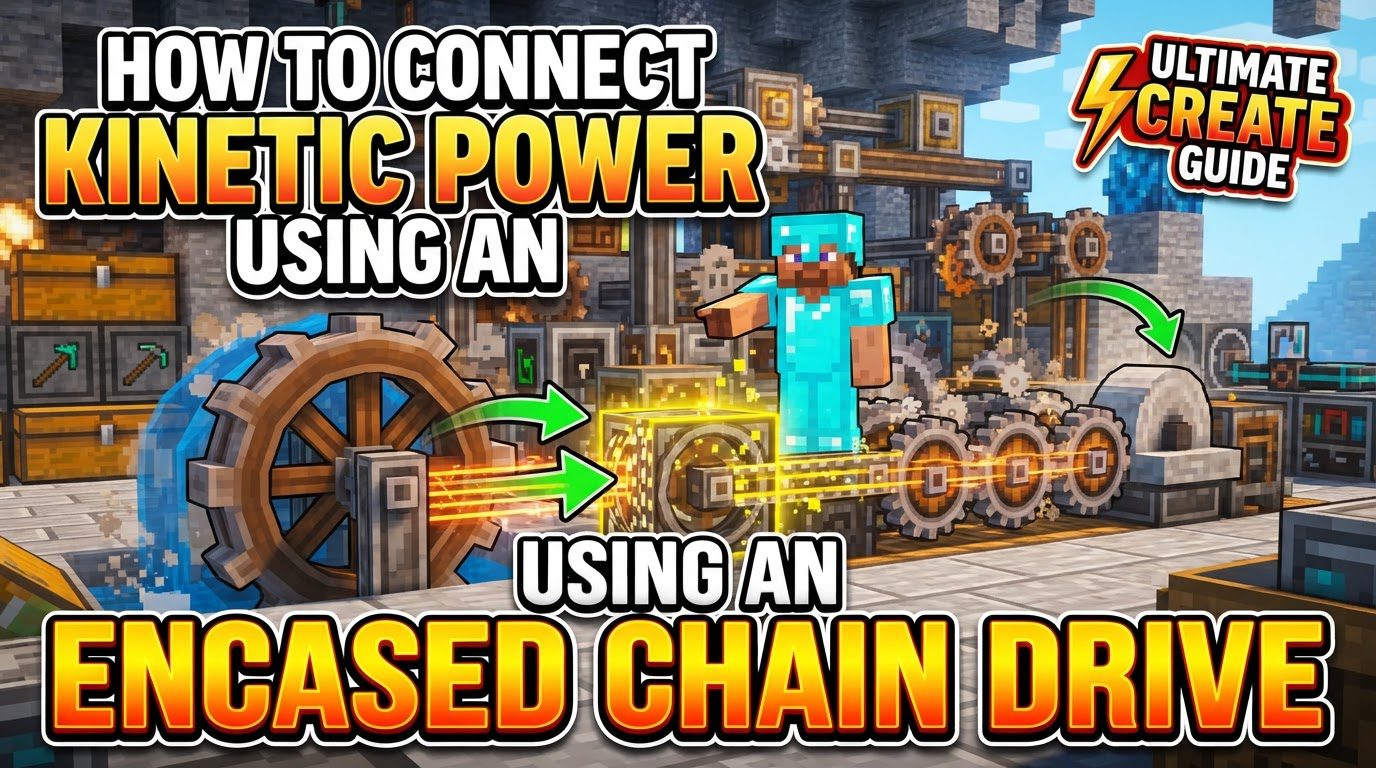
The fundamental principle behind an Encased Chain Drive is its ability to relay kinetic energy in a direct, unvarying path. When placed in a series, these drives form a continuous chain that carries rotational force from one end to the other. A key distinction that sets them apart from other rotational components, such as gearboxes, is their unwavering commitment to maintaining the same rotation direction across the entire length of the power chain. This means if the initial power source rotates clockwise, every subsequent Encased Chain Drive in the chain will also rotate clockwise, without any reversal or alteration in direction. This characteristic simplifies design considerations for many contraptions where consistent directional rotation is critical.
Core Mechanics of Encencased Chain Drives
To effectively utilize Encased Chain Drives, it is essential to grasp their core operational mechanics:
- Straight-Line Power Transfer: The primary function of Encased Chain Drives is to transfer rotational power in a perfectly straight line. This linear transmission ensures that kinetic energy is conveyed directly from its source to its intended destination without deviation.
- Consistent Rotation Direction: Throughout the entire chain of connected Encased Chain Drives, the rotation direction remains identical to that of the initial power input. This contrasts sharply with components like gearboxes, which are often used to intentionally reverse or change rotational direction.
- Side-by-Side Placement for Chain Formation: To form a continuous and functional power chain, Encased Chain Drives must be placed adjacent to one another. This placement can be either vertically or horizontally, allowing for flexible integration into various build designs.
- Requirement for Side Contact: For the power chain to be extended and maintained, it is imperative that the blocks physically touch on their sides. This direct side-to-side contact is the mechanism through which rotational energy is passed from one drive to the next, ensuring an unbroken flow of kinetic power.
- Power Through Rotating Axis: While the primary method of extending the chain involves side-by-side contact, rotational power can also be transmitted through the rotating axis of an Encased Chain Drive. However, it is crucial to understand that utilizing the axis for power output does not contribute to extending the main, linear chain of drives. This axial power output is typically used for connecting individual machines or components directly, rather than extending the long-distance transmission line.
- Optimized Server Performance: A significant advantage of Encased Chain Drives, particularly in multiplayer environments or large-scale contraptions, is their reduced performance impact on servers. Unlike Mechanical Belts, which possess inventories and constantly check for dropped items, Encased Chain Drives are simpler entities. This lack of inventory management and item checking results in a lighter load on server resources, making them a more efficient choice for extensive power networks.
- Integration with Adjustable Chain Gearshifts: For advanced kinetic power setups, Encased Chain Drives can be seamlessly integrated with Adjustable Chain Gearshifts. When placed in line with a series of Encased Chain Drives, these gearshifts offer the capability to modify the speed of rotation. This modification is controlled by redstone input, allowing for dynamic and automated adjustments to the rotational velocity within the chain.
Step-by-Step Guide to Connecting Kinetic Power
Connecting kinetic power using Encased Chain Drives is a straightforward process, provided you follow these steps:
-
Initiate Power Transfer: Begin by placing your first Encased Chain Drive directly adjacent to a kinetic power source. This could be a Water Wheel, Windmill, or any other component generating rotational force. Ensure that the drive is positioned correctly to receive the initial rotational input.
-
Extend the Power Chain: Once the initial drive is connected, continue placing additional Encased Chain Drives in a straight line. The critical aspect here is to ensure that the sides of each subsequent drive are touching the previous one. This side-to-side contact is what allows the rotational power to be continuously transferred along the chain, effectively extending your power transmission line over the desired distance.
-
Executing Turns and Directional Changes: While Encased Chain Drives transmit power in a straight line, you are not limited to perfectly linear paths. To introduce turns or change the orientation of your power chain (e.g., for a 90-degree corner), you can rotate individual Encased Chain Drives as you place them. Instead of trying to connect them at an angle, simply place the next drive in the desired new straight direction and rotate it accordingly. The power will still transfer in a straight line through each individual block, but the overall path of your chain can bend and turn as needed, maintaining its consistent rotational direction throughout the entire system.
Important Tips for Optimal Usage
To maximize the effectiveness and aesthetic appeal of your Encased Chain Drive systems, consider these important tips:
- Long-Distance Power Transmission: Encased Chain Drives excel at transmitting power over considerable distances. Their design ensures that rotational direction remains constant, making them an ideal solution for moving kinetic energy across large areas of your base without complex direction-altering mechanisms. This reliability over distance makes them a cornerstone for sprawling industrial setups.
- Clean and Compact Integration: One of the significant advantages of Encased Chain Drives is their visually clean and compact design. They can be seamlessly integrated into various builds, including being hidden within walls or underneath flooring. This allows for aesthetically pleasing contraptions where the power transmission system is either discreetly concealed or contributes to a sleek, industrial look. Their ability to fit into tight spaces without compromising function is a major benefit for intricate designs.
- High-Speed Rotational Setups with Adjustable Chain Gearshifts: For scenarios requiring precise control over rotational speed or the creation of compact, high-speed machinery, combining Encased Chain Drives with Adjustable Chain Gearshifts is highly effective. By inserting Adjustable Chain Gearshifts into the chain, you can dynamically alter the rotational speed based on redstone signals. This allows for sophisticated automation and fine-tuning of your kinetic power systems, enabling complex interactions and efficient resource processing in a minimal footprint.
Common Mistakes to Avoid
Understanding potential pitfalls can save you time and resources when working with Encased Chain Drives:
- Incorrect Angle Connection: A common error is attempting to connect Encased Chain Drives directly at a 90-degree angle. This will not work. Remember, power transfer occurs in a straight line, and the chain extends through side-to-side contact. To achieve a turn, you must place subsequent blocks in a new straight line and rotate them individually to change the overall direction of the chain’s path. Direct angular connections will simply break the power flow.
- Expecting Direction Reversal: Unlike certain gearboxes or other rotational components, Encased Chain Drives do not possess the ability to reverse rotation direction. If you require a change in rotational direction, you will need to incorporate a different component designed for that purpose, such as a gearbox, into your power transmission line. Relying on Encased Chain Drives for direction reversal will lead to frustration and non-functional systems.
- Improper Axis Contact: Be careful not to place Encased Chain Drives so that their rotating axes touch the sides of other chain drives. While power can exit through an axis, the continuous chain extension relies solely on direct side-to-side contact between the blocks. If axes are touching sides instead of sides touching sides, the primary power chain will not extend as intended, interrupting the flow of kinetic energy.
- Issues with Rotating Structures: Exercise caution when rotating entire structures that contain Encased Chain Drives. There is a known potential for their internal direction data to not update correctly during such rotations. This can lead to unintended consequences, such as the rotational direction of the drives being altered from their original input. For example, a fan previously configured to pull items might suddenly begin pushing them due to an erroneous direction change. It is advisable to test and verify the functionality of Encased Chain Drives after any structural rotations to prevent unexpected behavior in your contraptions.
Tags:
YOU MAY ALSO LIKE...