How to Create Bases Resistant to Creeper Explosions
A single, silent green stalker can undo hours of meticulous building in less than two seconds. Creepers, the iconic explosive mob of Minecraft, are notorious for their ability to turn perfectly good structures into Swiss cheese. Building a base that can withstand their explosive wrath is not just about piling up strong blocks; it requires a deep understanding of their mechanics, strategic material choices, and smart base design. This comprehensive guide will equip you with the knowledge to construct a fortress impervious to even the most determined Creeper.
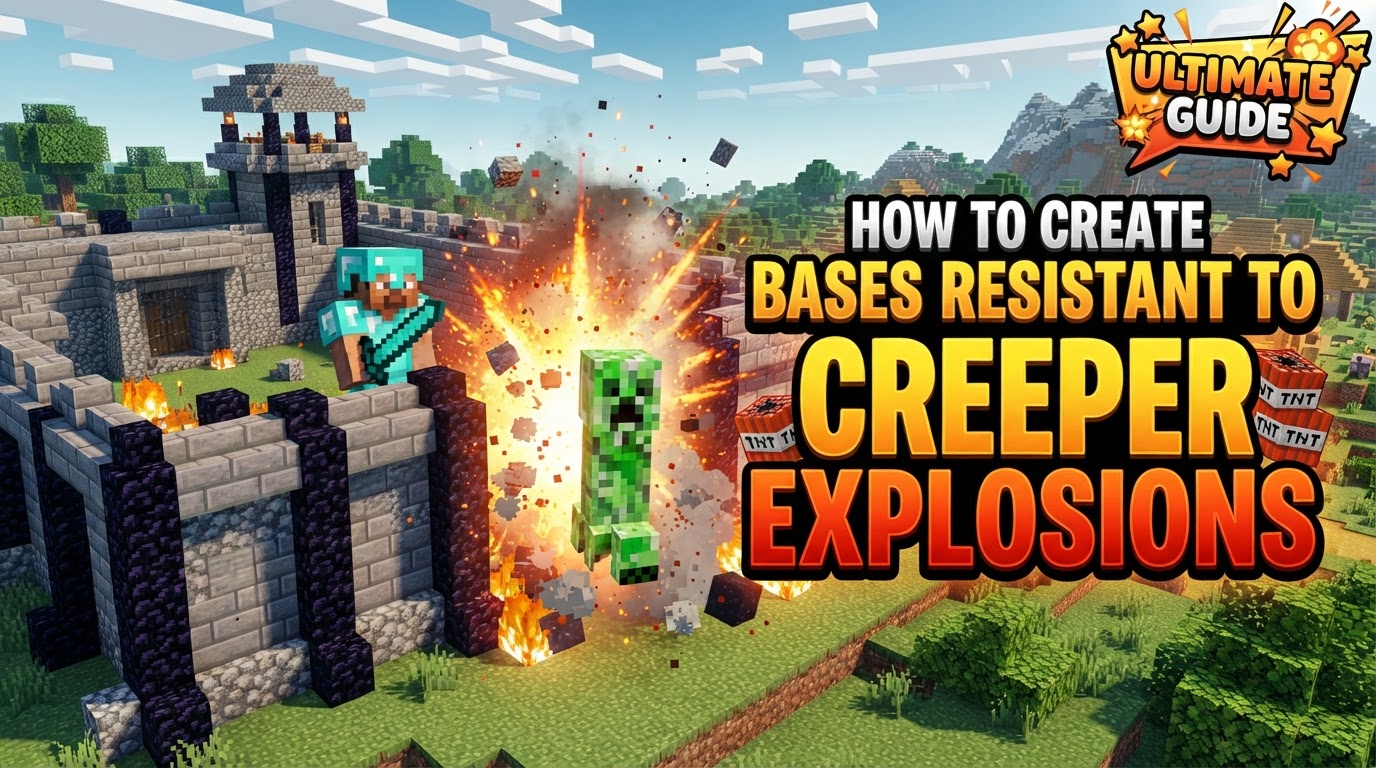
Understanding the Green Menace: Creeper Mechanics
Before you can defend against Creepers, you must understand how they operate. Creepers are stealthy and dangerous, but they follow predictable patterns. They will initiate their explosive countdown when a player is within three blocks of them. This fuse lasts for a mere 1.5 seconds, and detonation only occurs if they maintain an uninterrupted line of sight with the player. Crucially, if you manage to move seven blocks away or break their line of sight during this brief window, the fuse will cancel, and the Creeper will return to its passive state, until it re-engages. Their explosions cause significant damage to both players and the surrounding environment, creating craters and launching players skyward.
The destructive power of a Creeper explosion is not uniform. While the maximum blast radius is approximately 5.2 blocks, the actual number of blocks destroyed is non-deterministic and heavily influenced by the explosion’s exact location relative to the blocks. A particularly devastating variant is the Charged Creeper, which occurs when a regular Creeper is struck by lightning. These super-charged versions possess a significantly larger blast radius and much greater destructive strength, making them a threat to even moderately reinforced structures. Interestingly, explosions are measured from the block a player is standing on, so quickly placing a block at your feet before a detonation can marginally reduce the damage you take.
One of the most powerful, yet often overlooked, Creeper-proofing mechanics is the interaction with water. Water completely cancels explosion damage. This means that any base built underwater or any area covered by a layer of water is inherently Creeper-proof. This fundamental principle can be leveraged in various defensive strategies.
Fortifying Your Foundations: Blast-Resistant Materials
The first line of defense against any explosion is the material your base is constructed from. Choosing the right blocks is paramount. While no material in Minecraft is truly indestructible in all scenarios (especially against a Charged Creeper or multiple explosions), some offer near-absolute protection against standard Creepers.
- Completely Resistant (Survival Obtainable): For the ultimate protection, blocks like Obsidian, Crying Obsidian, Ancient Debris, and Netherite Blocks are 100% blast resistant to standard Creeper explosions. These materials are incredibly tough to break, making them ideal for critical areas of your base. Furthermore, water and stationary lava are also completely impervious to explosions, offering a natural and free form of blast protection.
- Highly Resistant: While not entirely impervious, several materials offer substantial protection. Deepslate (including all its variants like polished deepslate, deepslate bricks, etc.), Cobblestone, and blocks of Diamond, Raw Copper, and Andesite all boast a high blast resistance value (specifically, a value of six). A two-block thick wall made of cobblestone, for instance, can reliably withstand most single Creeper explosions, making it an excellent and readily available option for early to mid-game bases. Even a single layer of these blocks will offer significantly more protection than common materials like dirt, wood, or even stone.
The Unbreachable Perimeter: Exterior Defenses
Preventing Creepers from ever reaching your base is often the best defense. A well-designed perimeter can deter or eliminate threats before they become an issue.
- Illumination is Key: Creepers, like most hostile mobs, require a light level of zero to spawn. Therefore, ensuring all areas around your base – within and without – have a light level of one or higher is critical. Torches, lanterns, glowstone, and sea lanterns should be strategically placed to blanket your perimeter in light, effectively creating a mob-free zone.
- Trenches and Moats: A simple, yet highly effective, defense is to dig a trench around your base. A trench at least two blocks deep will stop most mobs, including Creepers, from simply walking up to your walls. For added security, a four-block deep trench will ensure that even if a Creeper detonates at the bottom, its blast radius will not reach your base walls. These moats can be filled with water to completely nullify explosion damage, or with lava to provide an additional layer of damage and deterrence for any mob that falls in.
- Walls with Overhangs: Building sturdy perimeter walls is a given, but adding an overhang (a lip of blocks extending outwards from the top of the wall) provides an extra layer of security. This prevents spiders from climbing over, maintaining the integrity of your secure zone.
- Feline Guardians: Creepers have a unique aversion to cats and ocelots. If a Creeper detects a cat within a six-block radius, it will immediately flee. Taming and strategically placing cats around your base, particularly near entrances and vulnerable points, acts as a natural, living deterrent, causing Creepers to run away rather than explode.
Intelligent Base Design: Interior and Structural Considerations
Beyond the perimeter, the internal structure and layout of your base can also contribute significantly to its Creeper resistance.
- Multiple Exits are a Must: Never rely on a single entrance or exit. Always design your base with at least two, preferably on different sides. This prevents you from being trapped by a surprise Creeper encounter at your primary doorway, giving you an escape route.
- Elevated Bases: Building your base high off the ground, perhaps on stilts or on a natural cliff, can prevent most ground-level mobs, including Creepers, from ever reaching your main living areas. Access can be controlled via ladders, staircases, or water elevators.
- Slabs and Stairs for Safety: A clever trick to prevent indoor mob spawns is to utilize bottom-half slabs and stairs for floors, roofs, and catwalks. Mobs, including Creepers, cannot spawn on these blocks, eliminating the risk of a surprise indoor explosion.
- Strategic Water Layers: Incorporating water into the exterior design of your base, even as a decorative feature, can be a powerful defense. A thin layer of water running down an exterior wall or covering a roof can absorb explosion damage, preserving the underlying structure.
Handling the Threat: Combat and Evasion
Even with the best defenses, you might still encounter a Creeper. Knowing how to react is crucial for survival and base preservation.
- The “Hit and Retreat” Tactic: When a Creeper starts to fuse, a quick sprint-attack will knock it back. This action, if timed correctly, will often reset its approach and give you enough distance for its fuse to cancel, allowing you to back off safely.
- Shields are Your Best Friend: A raised shield completely blocks all damage from a Creeper explosion, both to you and, crucially, to the blocks directly behind you. Always carry a shield when exploring or returning to your base.
- Bows for Distance: The safest way to deal with Creepers is from afar. A bow and arrows allow you to eliminate them before they can even get within their detection range, preventing any risk to your structures.
- Forceful Detonation: If you find a Creeper in an area where its explosion wouldn’t harm your base (e.g., in an open field, or near other hostile mobs), a flint and steel can be used directly on it to force an immediate detonation. This can be a useful way to clear out other mobs or simply dispose of the Creeper without taking damage yourself.
Pitfalls to Avoid: Common Mistakes
Even experienced players can fall victim to Creeper attacks due to simple oversights. Avoiding these common mistakes will significantly increase your base’s resilience:
- Insufficient Lighting: This is arguably the most common and easily preventable mistake. Failing to adequately light up both the interior and exterior of your base is an open invitation for Creepers to spawn and surprise you. Dark corners are Creeper breeding grounds.
- Using Weak Materials: Building your base’s exterior walls out of easily destroyed blocks like dirt, wood planks, or even basic stone without reinforcement leaves your base highly vulnerable. Always prioritize blast-resistant materials for critical structural components.
- Lack of Perimeter: Without a secure perimeter, Creepers can simply wander up to your base unimpeded, making every return home a potential risk. Invest time in setting up defenses like trenches or well-lit walls.
- Underestimating Creeper Range: Don’t assume a low wall, fence, or even a small gap will protect you. Creepers can detect players and initiate their fuse even with minor obstructions, and their blast radius can extend over or through small barriers. Always maintain a safe distance.
- Ignoring Game Rules (on private servers): On private Minecraft servers or single-player worlds where you control the settings, enabling the
/gamerule mobGriefing falsecommand will completely prevent Creepers (and other mobs like Ghasts or Endermen) from destroying blocks. While some consider this “cheating,” it offers absolute protection and can save countless hours of repair work.
By understanding Creeper behavior, utilizing blast-resistant materials, implementing robust perimeter defenses, and designing your base smartly, you can transform your vulnerable dwelling into an unyielding fortress. No longer will you dread the hiss; instead, you’ll build with confidence, knowing your creations are safe from the green menace.
Tags:
YOU MAY ALSO LIKE...