Debugging NullPointerExceptions in Forge Mod Development — A Quick Guide
Understanding NullPointerExceptions in Forge Mod Development
A NullPointerException (NPE) is one of the most common and frustrating errors encountered during Java development, and Forge modding is no exception. It signifies a critical issue where your program attempts to use an object reference that currently holds no value, meaning it is null. This situation is akin to trying to use a tool that isn’t actually in your hand – it simply isn’t there. When an NPE occurs, it’s a runtime exception, which means it happens while your mod is actively running, leading directly to a game crash. Understanding how to effectively debug and prevent these errors is crucial for any aspiring or experienced Forge mod developer.
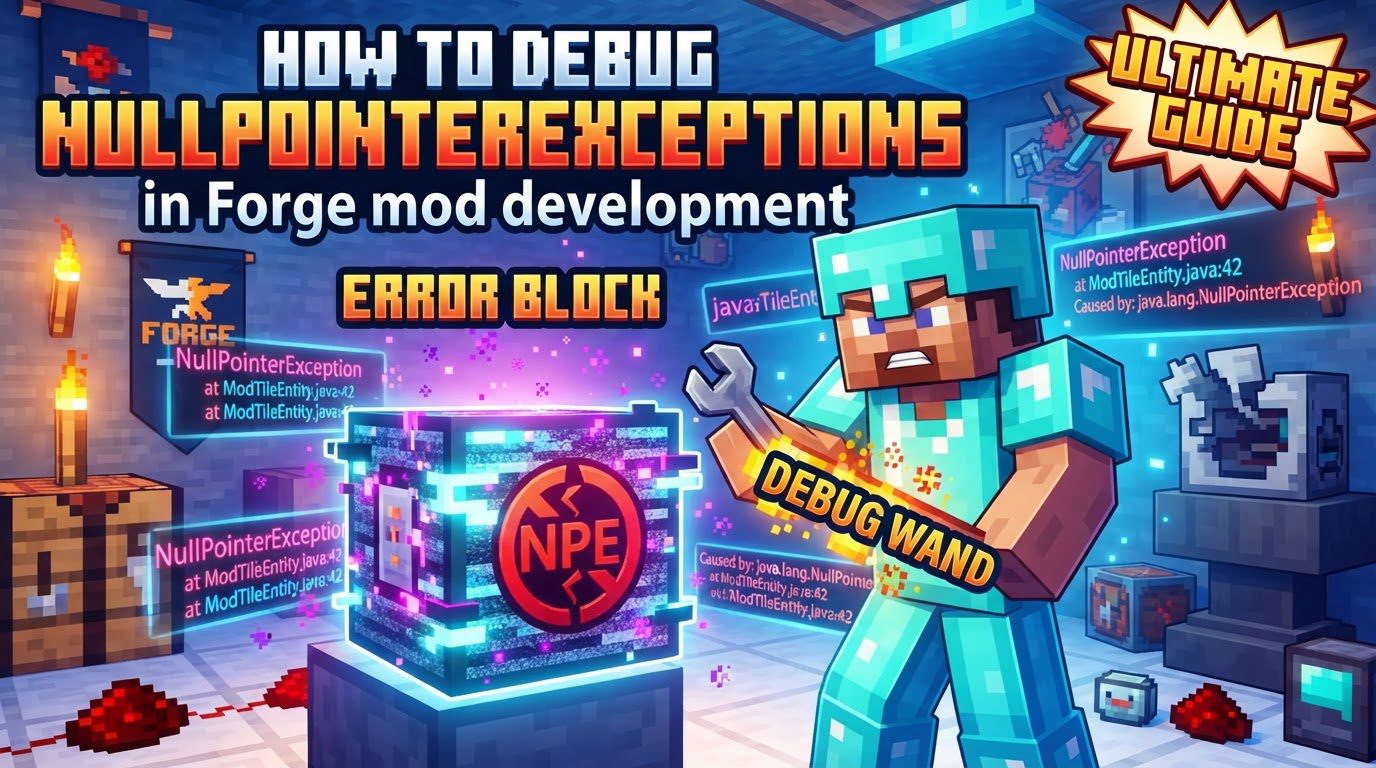
The immediate aftermath of an NPE is typically a crash report or an entry in the game’s log files. These vital resources provide what is known as a “stack trace.” A stack trace is a detailed sequence of method calls that led up to the point of the error. Crucially, it pinpoints the exact file and line number within your code where the NullPointerException originated. This piece of information is the cornerstone of your debugging efforts, guiding you directly to the source of the problem.
Step-by-Step Debugging Process
When faced with a crashing mod due to an NPE, a systematic approach is key to resolution:
-
Locate the error: Your first action should always be to find the stack trace. This is typically found in the
latest.logfile within your Minecraft installation directory (e.g.,.minecraft/logs/latest.log) or within the crash report itself, which is usually generated in the.minecraft/crash-reports/folder. Carefully examine the stack trace, looking for lines that reference your mod’s packages and classes. The topmost line within your mod’s code will indicate the precise file and line number where the NPE occurred. -
Identify the null variable: Once you have the exact line number, navigate to that line in your Integrated Development Environment (IDE), such as IntelliJ IDEA or Eclipse. Analyze the code on that line. An NPE means that one of the variables or object references being used on that line is
null. Your task is to determine which specific variable has this uninitialized state. For example, if you havemyObject.doSomething(), thenmyObjectis likelynull. -
Trace back initialization: With the suspected
nullvariable identified, you need to work backward through your code. Follow the variable’s path from its declaration to the problematic line. Your goal is to find where this variable is supposed to be initialized or assigned a value. Is it passed into a method? Is it instantiated within a constructor? Is it set by another method call? Understanding its intended initialization path is critical. - Use a debugger: This is arguably the most powerful tool at your disposal. Set a breakpoint directly on the problematic line of code, or, even better, a few lines *before* it. Then, run your Minecraft instance in debug mode from your IDE. When the program execution reaches your breakpoint, it will pause, allowing you to inspect the program’s state at that precise moment.
-
Inspect variables: While execution is paused at the breakpoint, use your IDE’s debugger interface to examine the state of all relevant variables. Pay particular attention to the variable you’ve identified as potentially
null. The debugger will clearly show its current value. This allows you to confirm if it is indeednulland to see the values of other related variables, providing context for why the initialization might have failed. You can also “step over” or “step into” subsequent lines to observe how variable states change. -
Verify conditions: As you trace back and inspect variables, consider any conditional logic that might be in play. Look for
ifstatements,fororwhileloops, or other control flow structures that could prevent the variable from being initialized or, conversely, explicitly set it tonullunder certain conditions. Sometimes, an unexpected game state or an edge case can lead to a condition where initialization is skipped. - Isolate the issue (if mod-related): If your mod is part of a larger modpack or interacts with many other mods, and you suspect a conflict, try to isolate the problem. Systematically remove other mods from your development environment or test instance. If the NPE disappears, you’ve narrowed down that the issue is caused by an interaction with one of the removed mods, making it easier to pinpoint the specific conflict.
Important Tips for Prevention and Resolution
Beyond the immediate debugging steps, adopting good practices can significantly reduce the occurrence of NPEs:
-
Defensive programming: Cultivate a mindset where you always assume an object could potentially be
null, especially when dealing with external inputs, method return values, or objects that rely on the game’s complex lifecycle. This proactive approach helps you anticipate and handle situations where an object might not be available. -
Null checks: The most straightforward way to prevent an NPE is to perform explicit null checks. Before attempting to call a method or access a field on an object, always use an
if (myObject != null)statement. This ensures that the code block that relies on the object only executes if the object reference is valid, thereby preventing crashes. - Use your IDE’s debugger: Master your IDE’s debugging features. Learning to effectively set breakpoints, step through code (using “step into” to go into method calls and “step over” to execute a line without entering its methods), and inspect variables will dramatically speed up your debugging process. It provides real-time insight into your program’s execution flow and state.
-
Logging: Strategically place logging statements in your code. Using
System.out.println()can be a quick way to print variable values at critical points, but for more robust debugging, leverage a proper logging framework like Log4j (which Forge uses). Logging allows you to track variable states and execution paths without needing to constantly stop execution with a debugger. - Understand Forge lifecycle: Forge mods operate within a specific lifecycle, meaning certain objects and game components are only initialized and available at particular stages. Accessing objects too early in the mod loading process or during an inappropriate event can easily lead to an NPE because the object simply hasn’t been created yet. Familiarize yourself with Forge’s event bus and common event phases.
- Read Forge documentation: The official Forge documentation and numerous examples provided by the community are invaluable resources. They detail the proper initialization, registration, and usage of Forge-specific APIs and game objects. Consulting these resources can clarify how to correctly interact with the game environment, thereby avoiding common pitfalls that lead to NPEs.
Common Mistakes to Avoid
Many NPEs stem from common patterns of error that can be prevented with awareness:
-
Forgetting to initialize objects: This is arguably the most frequent cause of NPEs. A variable is declared (e.g.,
MyClass myObject;), but it is never assigned an actual instance of an object (e.g.,myObject = new MyClass();) before it is used. Always ensure your objects are properly instantiated. -
Not handling method return values: Many methods, especially in complex APIs or those dealing with external data, can legitimately return
nullunder certain conditions (e.g., a method that searches for an item might returnnullif the item isn’t found). If you immediately try to use the result of such a method without a null check, you’re inviting an NPE. -
Improper event registration/handling: Forge relies heavily on an event system. If an event listener isn’t correctly registered, or if you expect an object to be populated by an event that either wasn’t fired or was handled incorrectly, you might find the object remains
nullwhen you try to use it later. -
Client-side vs. Server-side logic confusion: Minecraft environments have distinct client and server logical sides. Objects like
Minecraft.getInstance()are client-only. Attempting to access such objects on the logical server, or server-specific objects on the client without proper side checks (e.g.,world.isClient()orLogicalSide.CLIENT), will inevitably result in an NPE on the incorrect side. -
Mod conflicts: In complex modded environments, interactions between different mods can lead to unexpected behavior. One mod’s actions might inadvertently interfere with another mod’s expected object initialization or state, causing an object that should be present to become
null. This often requires careful isolation as described in the debugging process. - Ignoring the stack trace: The stack trace is your most valuable diagnostic tool. Developers sometimes glance at it, see “NullPointerException,” and then immediately jump to conclusions. Always thoroughly analyze the entire call path presented in the stack trace. It tells you not just *where* the error happened, but *how* the program arrived at that point, which is crucial for understanding the context.
Tags:
YOU MAY ALSO LIKE...