Using a Gearbox to Turn Rotation 90 Degrees — A Quick Guide
In the expansive and intricate world of Minecraft’s Create mod, mastering rotational power is fundamental to constructing elaborate automated systems. Among the myriad components available, the Gearbox stands out as an indispensable tool for manipulating the flow and direction of this power. Specifically, it excels at the crucial task of turning rotational power by 90 degrees, enabling compact and efficient mechanical designs. This guide will delve into the mechanics, usage, and advanced considerations for effectively employing gearboxes to achieve precise 90-degree rotational shifts in your contraptions.
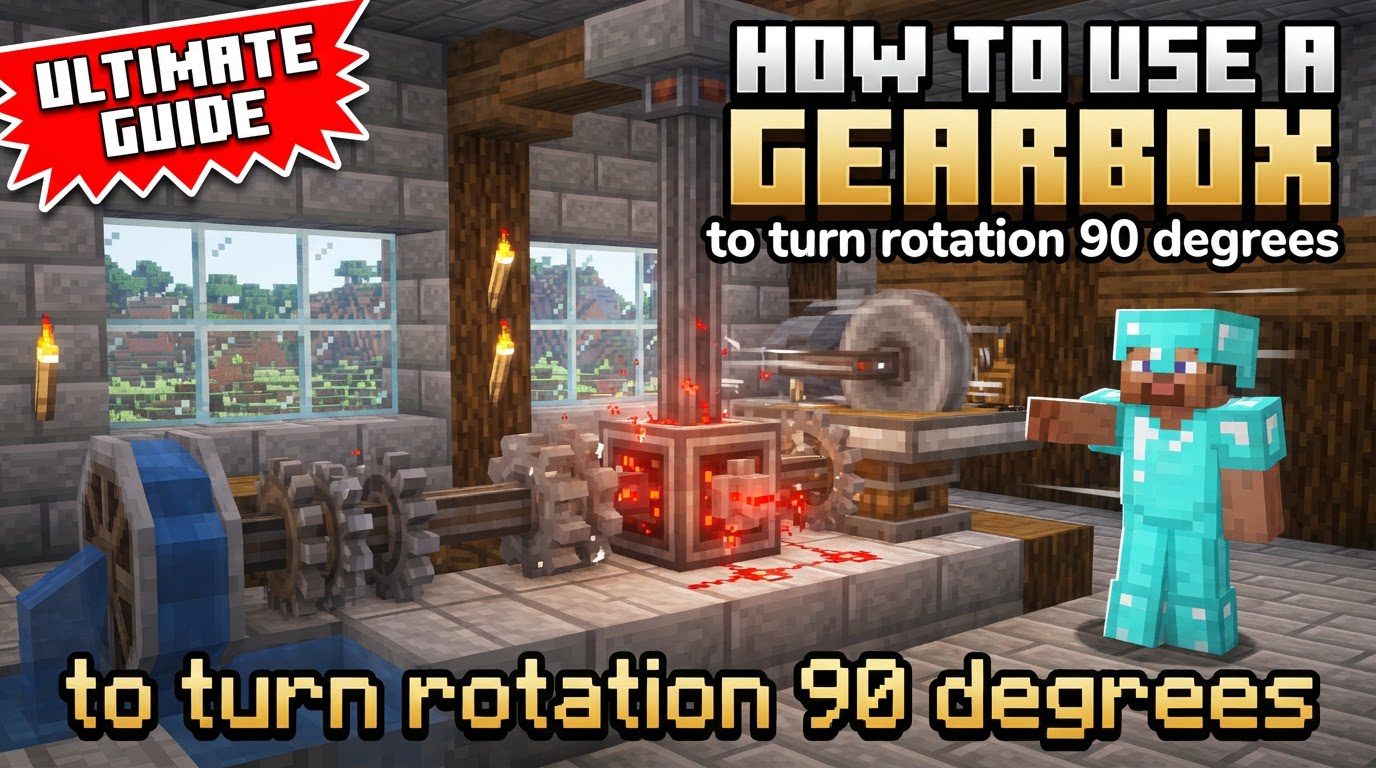
Understanding Gearbox Mechanics
Gearboxes in the Create mod are engineered devices designed to transfer and redirect rotational power. Their core functionality revolves around their ability to change the orientation of rotational force, making them perfect for navigating tight spaces or reorienting power lines within your builds. A key characteristic of a standard Gearbox is its capacity to transfer rotational power in four distinct directions: front, back, left, and right, relative to its placement. This versatility allows for significant flexibility in how you route power throughout your mechanical systems.
It is crucial to understand that a Gearbox inherently alters the rotational direction of the output spin. Specifically, the output rotation will always be reversed relative to the input rotation. If your input shaft spins clockwise, any output shaft connected to the Gearbox will spin counter-clockwise. This directional reversal is a fundamental aspect of Gearbox operation and must be accounted for in your designs to prevent unintended consequences.
The Create mod offers two primary types of gearboxes, each tailored for different directional changes:
- Standard Gearbox: This variant is used for horizontal directional changes. If you have a power source running along the X-axis and need to redirect it along the Z-axis, or vice-versa, the standard Gearbox is your go-to component.
- Vertical Gearbox: As its name suggests, this specialized Gearbox is designed for vertical directional changes. It allows you to take rotational power from a horizontal shaft and direct it upwards or downwards, or to take vertical power and redirect it horizontally.
At its heart, a Gearbox in Create functions much like a real-life 4-way bevel gearbox. This mechanical analogy helps in visualizing how power is split and redirected within the block, allowing for multiple outputs from a single input point.
Step-by-Step Guide to 90-Degree Rotation
Implementing a Gearbox to achieve a 90-degree turn in your rotational power system is a straightforward process, provided you understand its basic operation. Follow these steps to correctly integrate a Gearbox into your contraptions:
- Crafting the Gearbox: Your journey begins with crafting the Gearbox itself. This essential component is fashioned using a combination of Cogwheels and Andesite Casing. Ensure you have these materials readily available in your inventory.
- Strategic Placement: Once crafted, place the Gearbox precisely at the point where you intend to alter the direction of your rotational power. Consider the orientation of the Gearbox carefully, as this will dictate the available output directions. For instance, if you want to turn power from one horizontal direction to another horizontal direction, place a standard Gearbox. If you need to turn horizontal power into vertical power, a Vertical Gearbox is necessary.
- Connecting the Rotational Power Source: Connect your source of rotational power to one of the faces of the Gearbox. This input can come from various components, such as a shaft extending from a water wheel, a hand crank, or another mechanical component generating rotation. The Gearbox will accept power from any of its four faces, effectively becoming the entry point for your rotational energy.
- Understanding Output and Spin Reversal: Once the input is connected and the Gearbox is receiving power, it will begin to output rotational power from its other three available faces. Remember the critical rule: the spin direction of this output power will always be reversed compared to the input. For example, if your input shaft is spinning clockwise, any shaft connected to the Gearbox’s output faces will spin counter-clockwise. Plan your subsequent machinery accordingly to account for this inherent spin reversal.
- Vertical Redirection with a Vertical Gearbox: Should your design require a vertical change in rotational power direction, the process is identical, but you will use a Vertical Gearbox instead of the standard one. The Vertical Gearbox specifically facilitates turning horizontal power into vertical power, or vice-versa, allowing for multi-layered mechanical systems.
Important Tips for Advanced Rotational Power Management
While the basic function of a Gearbox is simple, understanding its nuances and alternative components can significantly enhance your engineering capabilities in the Create mod.
- Unleashing Flexibility: Gearboxes offer unparalleled flexibility in both rotational direction and machine placement. Their ability to redirect power in multiple axes means you can design more compact and aesthetically pleasing contraptions, fitting complex machinery into tighter spaces.
- Enabling Vertical Systems: Vertical gearboxes are crucial for developing vertically oriented mechanical systems. They allow you to stack layers of machinery, transferring power efficiently between different elevations without needing elaborate and space-consuming horizontal power lines.
- Large Cogwheels as an Alternative: For a 90-degree turn, large cogwheels can also serve as an alternative. When two large cogwheels are meshed at a 90-degree angle, they can effectively transfer power while changing its direction. However, this method typically requires more space than a compact Gearbox, so consider your available build area when choosing between the two.
- Encased Chain Drives for Efficiency and Speed: Encased Chain Drives provide another versatile method for achieving 90-degree power rotation. Beyond simple redirection, they offer unique advantages. When combined with an adjustable chain gear shift and activated by a redstone signal, an encased chain drive can even double rotational speed, offering a powerful option for optimizing your rotational power output.
- Intentional Spin Reversal with a Powered Gearshift: If the inherent spin reversal of a Gearbox is undesirable or if you need to intentionally reverse rotation at any point in your system, a powered gearshift can be used in conjunction with a gearbox. This component allows for dynamic control over spin direction, adding another layer of sophistication to your designs.
- Precise Rotations with a Sequenced Gearshift: For highly specific and controlled rotational movements, such as turning exactly 90 degrees and then returning to the original position, a Sequenced Gearshift is the appropriate tool. This advanced component allows for programmed, partial rotations, enabling complex automation sequences.
Common Mistakes to Avoid
Even experienced builders can fall prey to common pitfalls when working with gearboxes and rotational power. Being aware of these mistakes can save you time and resources.
- Forgetting Spin Reversal: This is arguably the most common mistake. Gearboxes inherently reverse the spin direction of the rotational power. Failing to account for this can lead to machinery operating in the opposite direction than intended, potentially breaking production lines or causing system failures. Always double-check your spin directions.
- Over-reliance on Vertical Gearboxes: While vertical gearboxes are excellent, using multiple ones when a more compact or aesthetically pleasing solution exists is inefficient. Consider alternatives like an encased chain drive, which can often achieve the same vertical redirection with fewer components or a more streamlined appearance.
- Exceeding Rotational Speed Limits: Attempting to feed power into the “half-speed shaft” of certain connected gearboxes can inadvertently lead to exceeding rotational speed limits. This can cause components to break or systems to become unstable. Always monitor your rotational speeds and understand the limits of your components.
- Overlooking Alternative Components: Focusing solely on gearboxes for 90-degree turns can limit your design possibilities. Overlooking alternative components like large cogwheels or encased chain drives means missing out on solutions that might be more efficient, require less space, or simply fit better into specific build designs. Always evaluate all available options.
- Insufficient Torque: Connecting machinery to a rotational power source that lacks sufficient torque is a recipe for disaster. An overstressed system will fail, either by components breaking or by simply not functioning. Always ensure your power source generates enough stress units to drive all connected machinery, especially when adding redirection components like gearboxes, which themselves have a stress cost.
By understanding these principles and common pitfalls, you can effectively utilize gearboxes to manipulate rotational power, creating robust and efficient mechanical contraptions in your Minecraft Create mod worlds.
Tags:
YOU MAY ALSO LIKE...