

How Water Flows Through Different Block Types
Water, a seemingly simple element in Minecraft, often defies real-world logic, flowing in ways that can surprise even seasoned players. Understanding its unique physics is not just a matter of curiosity; it’s a fundamental skill that underpins everything from basic farming and trap construction to elaborate automatic sorting systems and efficient travel. Unlike real-world fluids, water in Minecraft adheres to a predictable, grid-based system, yet its interactions with the myriad of blocks can create complex and sometimes counter-intuitive behaviors. Mastering how water interacts with different block types is crucial for any player looking to harness its power for construction, defense, or resource management. This guide will delve into the core mechanics, practical applications, and common peculiarities of water flow, offering a comprehensive understanding of this essential game element.
The Dual Nature of Water Blocks
In Minecraft, not all water is created equal. There are two distinct types of water blocks, each with its own characteristics and behaviors:
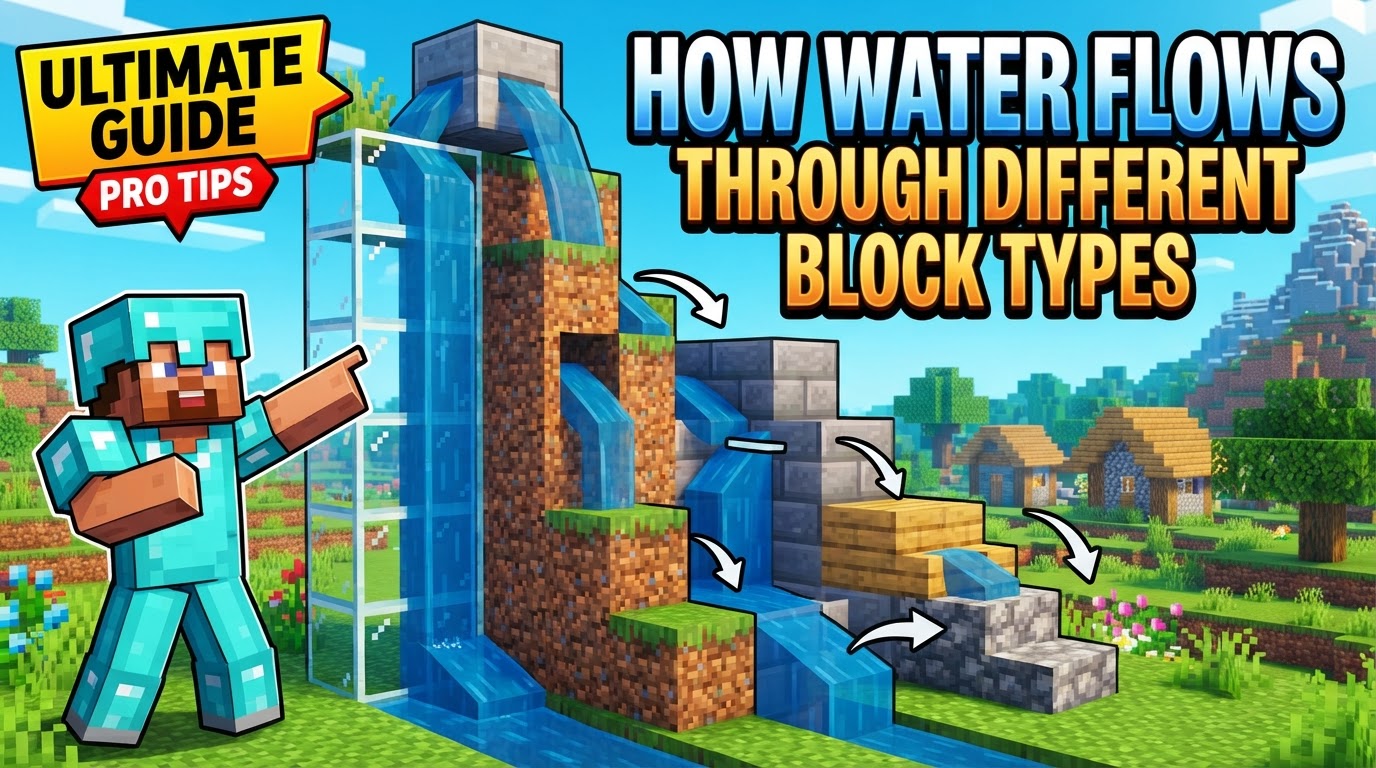
- Source Blocks: These are the origin points of all water flow. A source block is a still, full block of water that does not move unless acted upon by external forces (like being picked up by a bucket). Naturally occurring bodies of water, such as oceans, lakes, and rivers, are composed primarily of these source blocks. Players can create new source blocks by placing water from a bucket into an empty space.
- Flowing Water Blocks: These blocks originate from source blocks and are characterized by their dynamic, moving appearance. Flowing water spreads out from a source block, gradually decreasing in visual “level” or intensity as it moves further away. Unlike source blocks, flowing water cannot be picked up with a bucket; attempting to do so will only yield an empty bucket. Its primary function is to extend the reach of a source block and interact with the environment.
Fundamental Principles of Water Movement
The movement of water in Minecraft is governed by a set of rules that prioritize certain directions and interactions:
- Spread Distance: On a perfectly flat surface, water will spread horizontally up to 7 blocks away from its source block. This means a single source block can influence a 15×15 area (7 blocks in each cardinal direction from the center source). The water’s visual appearance will show it receding over these 7 blocks, indicating its “strength” or level.
- Downward Preference: Water exhibits a strong preference for moving downwards. If there is an empty block directly below a source block or flowing water, the water will flow into that space first, before attempting to spread horizontally. This gravity-like behavior allows water to fill chasms and flow down slopes.
- Vertical Dynamics: Water can flow downwards indefinitely, continuing its descent until it encounters a solid block that obstructs its path. However, flowing upwards naturally is not possible unless specific mechanics are employed. The primary method for vertical upward water flow is through bubble columns, which are created by placing soul sand directly beneath a water source block. Conversely, magma blocks create downward-pulling bubble columns.
- Infinite Water Sources: One of the most useful applications of water physics is the creation of infinite water sources. By placing two source blocks one block apart, the flowing water between them will convert into a new source block. A common and efficient method is to dig a 2×2 hole, one block deep, and place water in opposite corners. This will instantly fill the entire 2×2 area with four source blocks, providing an endless supply of water that can be scooped up without depleting the source.
- Interaction with Game Entities: Flowing water generates a current that exerts force on items and mobs. Any item dropped into flowing water will be pushed in the direction of the current, making it an excellent tool for item transportation. Similarly, mobs caught in a water current will be pushed along, which is useful for mob farms, traps, or simply clearing an area.
Deconstructing the Flow Process
Understanding the sequence of how water flows can help predict its behavior:
- Source Placement: The process begins when a water source block is introduced into the world, either through natural generation (e.g., a lake) or by a player using a bucket.
- Downward Flow Priority: The very first action water takes is to check for an empty block directly beneath it. If such a path exists, the water will immediately flow downwards, creating a column of water until it hits a solid block.
- Horizontal Spread: Once the downward path is obstructed or if no downward path was initially available, the water will then begin to spread horizontally from the source block. This spread extends up to 7 blocks in any cardinal direction, gradually decreasing in visual “level” with each block.
- Prioritization of Drops: A crucial aspect of water flow is its tendency to flow towards the closest available drop or hole. This means that if there’s a nearby vertical drop-off, the water might not spread out equally in all directions horizontally. Instead, it will prioritize filling that downward path, potentially creating an uneven flow pattern that can be counter-intuitive to new players.
Player Control and Manipulation
Harnessing water’s properties requires specific tools and an understanding of block interactions:
- The Indispensable Bucket: The bucket is the player’s primary interface with water. It allows you to pick up source blocks and place them in desired locations, making it essential for creating infinite water sources, filling moats, or setting up complex water-based mechanisms.
- Barriers and Containment:
- Solid Blocks: Any solid, full block will completely stop water flow. This is the most straightforward way to contain or redirect water.
- Non-Solid Blocks: Many blocks that do not fully occupy a block space, such as signs, fences, iron bars, and stairs, can contain water. Water will not flow through these blocks into adjacent empty spaces, effectively acting as barriers while allowing players or items to pass through (in some cases).
- Waterlogging: Introduced in later versions, waterlogging allows many blocks (like stairs, slabs, chests, and even leaves) to occupy the same space as a water source block or flowing water. This is incredibly versatile for aesthetics, creating hidden water flows, or even making underwater bases with breathable pockets.
- Surface Interactions: Water flows seamlessly over ice blocks. This interaction is particularly useful because items and entities traveling on water streams above ice, packed ice, or blue ice will move significantly faster, making it an excellent method for long-distance item transportation.
- Vertical Transportation: Bubble Columns:
- Soul Sand: Placing soul sand directly beneath a water source block (or a column of water sources) will create an upward-flowing bubble column. This powerful current can lift players, mobs, and items rapidly, making it the basis for water elevators.
- Magma Blocks: Conversely, placing a magma block beneath a water source or column creates a downward-pulling bubble column, drawing entities towards the bottom. This is useful for mob traps or quick descents.
Advanced Applications and Strategic Uses
Beyond basic containment, understanding water flow opens up a world of possibilities:
- Efficient Item Transportation: By creating long, shallow channels of flowing water, especially when combined with ice blocks underneath, players can transport items across vast distances quickly and automatically. This is a cornerstone of many automated farms and storage systems.
- Fall Damage Negation: A simple yet life-saving application: falling into even a single block of water, regardless of the height of the fall, completely negates all fall damage. This makes water buckets an invaluable tool for exploration and dangerous ventures.
- Farming and Irrigation: Water is essential for hydrating farmland, allowing crops to grow faster. Understanding its 7-block spread helps in designing efficient crop fields.
- Mob Traps and Defense: Water currents can be used to funnel mobs into specific areas, activate pressure plates, or push them off cliffs into damage traps.
Navigating Water’s Quirks and Peculiarities
Despite its predictability, water in Minecraft has some behaviors that can trip up even experienced players:
- Counter-Intuitive Flow Directions: As mentioned, water prioritizes drops. This can lead to situations where water flows in a single, narrow stream towards a nearby hole rather than spreading out evenly in all cardinal directions as one might expect. Always observe the terrain carefully before placing water.
- “Unrealistic” Physics: Minecraft’s water physics are a simplification. It’s a grid-based system designed for performance and predictability, not fluid dynamics realism. Water flows in square patterns, has fixed “levels” of intensity, and doesn’t behave like a continuous, amorphous liquid. This is by design and ensures consistent gameplay.
- Placement Restrictions: You cannot directly place a water source block on top of another water source block in an open space. A solid block must be present underneath to support the new source. However, you can create a column of source blocks by placing them from the top down into a shaft.
- Nether Evaporation: The Nether dimension is an intensely hot, arid environment. Any water placed directly in the Nether will instantly evaporate, turning into steam particles. The sole exception to this rule is water placed inside a cauldron, which remains intact. This fundamental difference in physics makes the Nether a challenging environment for water-based builds.
Understanding how water flows through different block types is more than just a niche fact; it’s a foundational element of Minecraft gameplay. From creating basic farms and infinite water sources to designing complex mob grinders and automated item transport systems, the ability to predict and manipulate water’s behavior is a hallmark of an advanced player. Embrace its quirks, learn its rules, and you’ll unlock a new dimension of creative and functional building possibilities in your blocky world.
Tags:
YOU MAY ALSO LIKE...


