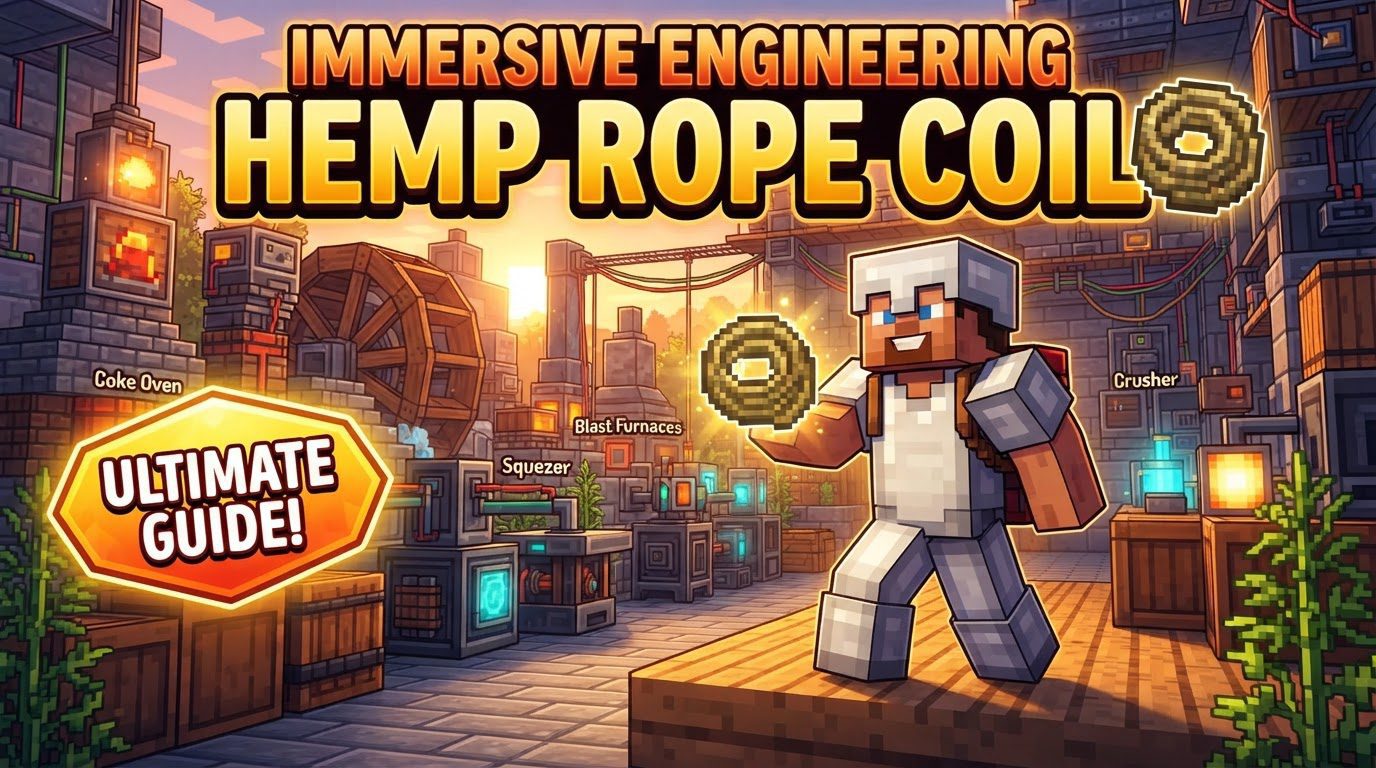
Immersive Engineering Hemp Rope Coil
A common misconception surrounding Immersive Engineering’s various cables is that all of them transmit power. While the mod is renowned for its intricate power generation and distribution systems, not every cable is designed for electrical flow. The Immersive Engineering Hemp Rope Coil stands as a prime example, carving out a unique niche within the mod as a versatile structural element and a dynamic transportation utility rather than a conduit for energy. Understanding its specific capabilities and limitations is key to harnessing its full potential in your Minecraft builds, whether for industrial aesthetics or practical traversal.
The True Nature of the Hemp Rope Coil
At its core, the Hemp Rope Coil functions primarily as a decorative structural cable. Unlike its electrical counterparts such as LV, MV, or HV wires, this particular coil is explicitly designed without any power transmission capabilities. This distinction is crucial for players who might mistakenly try to integrate it into their power grids, only to find their machinery remains dormant. Instead, its strength lies in its visual appeal and its ability to connect points across distances, adding a touch of industrial realism or rustic charm to any structure.
One of its most defining characteristics is its impressive reach. A single Hemp Rope Coil can stretch for a maximum length of 32 blocks. This considerable distance allows for flexible architectural designs and extensive zip-line routes. Furthermore, these ropes are remarkably adaptable to their environment; they possess the unique ability to pass through blocks and even liquids without breaking connection or suffering any ill effects. This means you can run them through walls, under water, or over tricky terrain, offering unparalleled freedom in placement.
However, it’s important to embrace the coil’s natural behavior: it will always bend. The physics within Immersive Engineering dictate that these cables will exhibit a natural sag or curve, especially over longer distances. There is no in-game configuration or trick to force a perfectly straight line. This natural bend contributes to its realistic aesthetic, mimicking real-world suspended cables, but it’s a detail to keep in mind for those aiming for pristine, rigid constructions.
Establishing Connections: A Step-by-Step Guide
Deploying a Hemp Rope Coil is a straightforward process, requiring only a few simple steps. The key components are the coils themselves and Structural Cable Connectors, which act as anchors for your rope lines.
- Anchor Your Start Point: Begin by placing a Structural Cable Connector at your desired starting location. This block will serve as the initial attachment point for your rope.
- Anchor Your End Point: Next, place another Structural Cable Connector at your intended destination. Remember the 32-block length limit when positioning this second connector to ensure a successful connection.
- Initiate the Connection: With the Hemp Rope Coil item in your hand, right-click on the first Structural Cable Connector you placed. This action prepares the coil for deployment.
- Complete the Link: Immediately after, right-click on the second Structural Cable Connector. If the distance is within the 32-block limit and both connectors are properly placed, a Hemp Rope Coil will visually stretch between the two points, forming your structural cable or zipline.
- Cable Removal: Should you need to adjust or remove a cable, use the Engineer’s Wire Cutters. Simply right-click on either of the Structural Cable Connectors to which the rope is attached, or even an HV Wire Relay if it’s part of a larger network, and the rope will be cleanly detached.
This simple procedure allows for rapid deployment of multiple rope lines, enabling quick construction of complex networks or efficient transportation systems.
Beyond Aesthetics: The Functional Zipline
While its decorative potential is significant, the Hemp Rope Coil truly shines when paired with the Engineer’s Skyhook. This combination transforms the static rope into a dynamic method of rapid vertical and horizontal traversal. By connecting two points with a Hemp Rope Coil, you create a functional zipline that players can use to quickly move across vast chasms, descend from towering structures, or ascend to high platforms.
The Engineer’s Skyhook is the essential tool for activating this functionality. When a player equips the Skyhook and right-clicks on a deployed Hemp Rope Coil, they will automatically attach and glide along its length. This makes the Hemp Rope Coil an invaluable asset for base navigation, resource gathering in mountainous biomes, or even as an escape route in precarious situations. Planning your zipline routes carefully, considering both the 32-block limit and the natural bend, can lead to highly efficient and enjoyable transportation networks.
Strategic Implementation: Tips for Optimal Use
To get the most out of your Hemp Rope Coils, consider these strategic tips:
- Embrace the Aesthetic: While they don’t carry power, their realistic appearance makes them perfect for adding detail to industrial builds, factories, or even rustic settlements. Use them to simulate support cables for bridges, overhead lines for non-electrical purposes, or even decorative elements for large machinery.
- Master Zipline Placement: When designing ziplines, always keep the 32-block length constraint in mind. For longer distances, you’ll need to strategically place intermediate Structural Cable Connectors to create a series of shorter zipline segments. This also allows for changes in direction or elevation.
- Consider Terrain: The ability for ropes to pass through blocks and liquids simplifies placement significantly. Don’t be afraid to run them through mountains or across rivers to create direct, efficient routes.
- Plan for Sag: Account for the natural bend when planning your builds. If you need a rope to clear a certain obstacle, start it slightly higher than you might initially think to compensate for the sag, especially over longer spans.
Common Pitfalls to Avoid
Even experienced players can sometimes fall into common traps when using the Hemp Rope Coil. Being aware of these can save you time and resources:
- The Power Misconception: The most frequent error is expecting the Hemp Rope Coil to transmit power. It is crucial to remember that these coils are purely decorative or for ziplines; they do not carry energy. For power transmission, you’ll need to use Immersive Engineering’s dedicated electrical wires (LV, MV, HV).
- Fighting the Bend: Do not attempt to force the rope into a perfectly straight line. The game’s physics dictate a natural bend, which is more pronounced over longer distances. Trying to achieve perfect straightness will only lead to frustration. Instead, integrate this natural curve into your designs, perhaps even using it to your advantage for more organic-looking structures.
- Ignoring the Length Limit: Attempting to span more than 32 blocks with a single Hemp Rope Coil will result in a failed connection. Always measure or estimate your distances before placing connectors to avoid having to re-do your setup.
Conclusion: A Versatile Tool for Creative Engineers
The Immersive Engineering Hemp Rope Coil, while seemingly simple, is a remarkably versatile and valuable component within the mod. Its role as a non-power-transmitting structural cable, capable of stretching up to 32 blocks through various terrains, opens up a world of possibilities for both aesthetic detailing and practical transportation. By understanding its unique mechanics, mastering its deployment, and embracing its natural characteristics, Minecraft engineers can integrate these coils into their builds to create visually compelling structures and highly efficient zipline networks. Whether you’re aiming for industrial realism or swift traversal, the Hemp Rope Coil offers a unique solution that adds depth and functionality to your Immersive Engineering experience.
Tags:
YOU MAY ALSO LIKE...