

Immersive Engineering HV Wire
A single Immersive Engineering HV Wire segment can continuously transfer an astounding 32,768 Redstone Flux (RF) per tick, making it the bedrock of high-power energy infrastructure in your Minecraft world. This elite tier of power transmission is indispensable for powering the most demanding machinery and ensuring your industrial operations run without a hitch. However, with great power comes unique challenges and specific handling requirements that distinguish it from its lower-voltage counterparts.
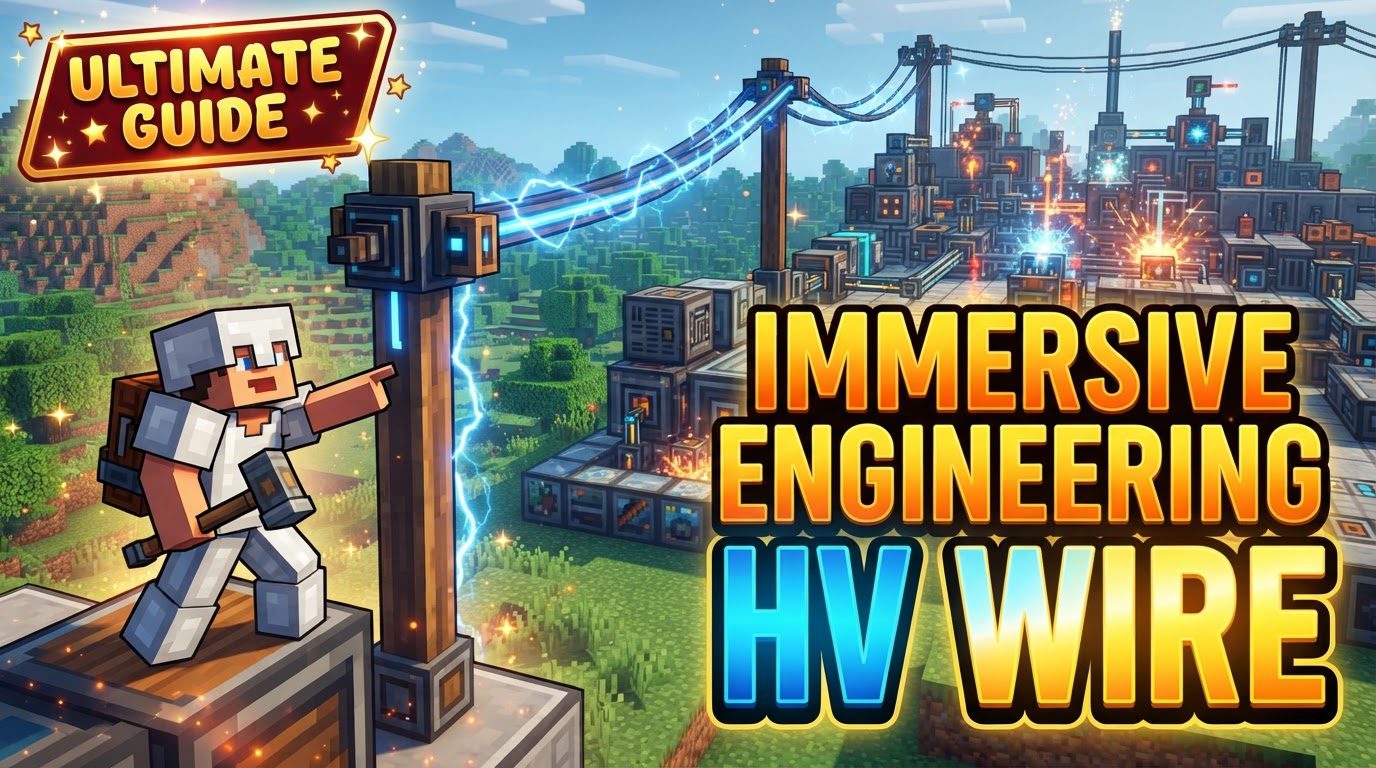
Understanding HV Wire Fundamentals
The HV Wire, or High Voltage Wire, represents the pinnacle of Immersive Engineering’s power conduit system. It is specifically engineered for situations where massive amounts of RF need to be moved efficiently over moderate distances. Its primary role is to link high-output generators, such as Diesel Generators or Advanced Generators from other mods, to high-consumption machines or large battery banks, known as Capacitors in Immersive Engineering.
- Maximum Throughput: HV Wire boasts an impressive continuous transfer rate of 32,768 RF per tick. Exceeding this critical threshold will cause the wire to overheat and burn up, leading to a catastrophic power outage in your network.
- Segment Length: Each individual HV Wire segment has a maximum allowable length of 32 blocks. Beyond this, a direct connection cannot be established, necessitating the use of HV Wire Relays to extend the network.
- Energy Loss: While highly efficient, HV Wire is not entirely lossless. It incurs a minimal energy loss of 0.078% RF per block. At its maximum segment length of 32 blocks, this accumulates to a total loss of 2.5%, which is a factor to consider for extremely long-distance or high-efficiency setups.
- Uninsulated Danger: Unlike the LV and MV wires, HV Wires are inherently uninsulated. This means that any player or mob coming into direct contact with a powered HV Wire will sustain damage. This characteristic demands careful planning for placement and enclosure to prevent accidental harm.
Constructing Your High-Voltage Network
Establishing an HV power grid requires specific components and a precise connection method. The primary tools you’ll need are HV Wire Connectors and the HV Wire Coil.
- Place HV Wire Connectors: Begin by placing two HV Wire Connectors on the blocks where you wish to initiate and terminate your wire segment. These connectors act as the endpoints for your power line. Ensure these are HV-tier connectors, as mixing voltage tiers is not possible.
- Use the HV Wire Coil: With the HV Wire Coil in your hand, right-click the first HV Wire Connector. This action “loads” the coil with the intent to draw a wire from that point.
- Complete the Connection: Next, right-click the second HV Wire Connector. If the distance is within the 32-block limit and there are no obstructions, an HV Wire will visually appear, connecting the two points and completing the circuit.
For more complex networks or to extend the reach beyond 32 blocks, HV Wire Relays become essential. These specialized blocks allow multiple HV Wires to connect to them, facilitating branching and extending your power lines without acting as power input or output points themselves. They simply relay the connection.
Should you need to modify or dismantle a wire, the Engineer’s Wire Cutters are your tool of choice. Simply right-click on an HV Wire Connector with the cutters to remove any wires connected to it.
Optimizing HV Wire Deployment and Best Practices
To fully leverage the power of HV Wires and avoid common pitfalls, consider these strategic tips:
- Prioritize High-Power Applications: Reserve HV wiring for scenarios involving significant power generation or consumption. This includes connecting large-scale power sources like multiple Diesel Generators or powering energy-intensive machines. Using HV for lower power needs is generally overkill and less cost-effective.
- Minimize Energy Loss on Long Runs: While 2.5% loss over 32 blocks is small, for extremely long power lines, this can add up. Strategically placed HV Wire Relays can help break up segments, but the loss per block remains. Consider direct connections where possible and minimize overall network length for maximum efficiency.
- Ensure Voltage Tier Consistency: A crucial rule in Immersive Engineering is that voltage tiers cannot be mixed directly. All components in an HV network-connectors, relays, and connected machines-must be of the HV tier. Attempting to connect an HV Wire to an LV or MV connector will simply not work and will prevent any power transfer.
- Utilize Capacitors for Stepping Down Voltage: If you need to power MV or LV machines from an HV source, dedicated transformers are an option. However, Capacitors can act as a more versatile and often cheaper alternative. They not only store energy but can also output power at lower voltage tiers, effectively stepping down your HV power to MV or LV as needed. This provides both storage and voltage conversion in one block.
- Safety First: Enclose Uninsulated Wires: Due to their uninsulated nature and the damage they inflict on contact, always enclose your HV Wires within walls, floors, or ceilings. This prevents accidental player damage and protects any wandering mobs from meeting an untimely, electrified end.
Common Mistakes and Troubleshooting HV Networks
Even seasoned engineers can encounter issues with HV wiring. Being aware of common problems can save you considerable time and resources:
- Overloading the Wire: This is perhaps the most critical mistake. Attempting to transfer more than 32,768 RF/tick through a single HV Wire will cause it to burn up immediately. Always monitor your power generation and consumption rates to ensure they stay within this limit. Utilize multiple HV lines or higher-capacity conduits from other mods if your power needs exceed this.
- Incorrect Voltage Connections: As mentioned, connecting HV Wire to lower-voltage connectors (LV or MV) will result in a non-functional connection. Double-check all your connectors and ensure they are HV-tier. Power will simply not flow across mismatched tiers.
- Forgetting About Uninsulated Wires: The danger of uninsulated HV Wires is often overlooked until a player or mob accidentally touches a powered line. Always design your base with safety in mind, ensuring these wires are safely enclosed and out of reach.
- Server Restarts and World Reloads: A particularly frustrating issue reported by players is the unreliability of HV Wire Connectors after server restarts or world reloads. Connectors may lose functionality, change position, or appear to be connected visually but fail to transmit power. If your HV network suddenly stops working after such an event, the first step should be to inspect and potentially re-establish the connections using the Engineer’s Wire Cutters and HV Wire Coil. This often resolves the “ghost wire” problem where power isn’t flowing despite a visual connection.
Mastering Immersive Engineering’s HV Wire system is a cornerstone of advanced industrial automation in Minecraft. By understanding its capabilities, limitations, and how to properly implement and maintain it, you can build incredibly powerful and efficient energy networks that will sustain even the most ambitious projects. Remember to build safely, monitor your power loads, and be prepared to troubleshoot occasional connectivity quirks, especially after server events.
Tags:
YOU MAY ALSO LIKE...


