

Stop Wasting Time On Manual Farming
Many Minecraft players fall into the trap of endless manual labor, painstakingly gathering resources one stack at a time. This cycle of chopping trees, mining stone, and harvesting crops can consume hundreds of in-game hours that could be spent on grander builds, exploration, or intricate Redstone contraptions. The key to unlocking your true creative potential and efficiency in Minecraft lies in automation. By setting up a variety of specialized farms, you can transform tedious chores into a continuous, self-sustaining stream of materials, freeing you to focus on what truly matters to you in your world.
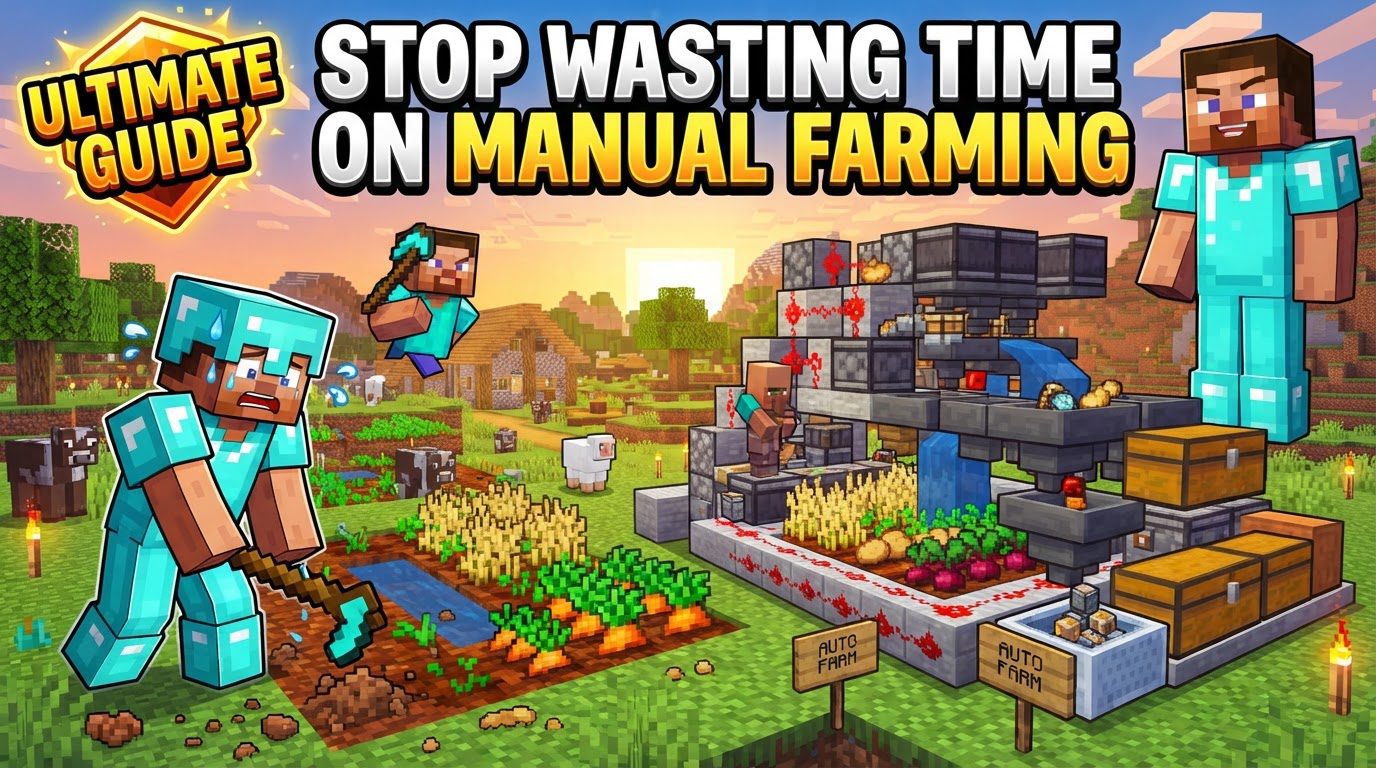
Minecraft offers an incredible array of automation possibilities, from simple Redstone circuits to complex villager interactions and mob-spawning mechanics. These systems are designed to continuously produce specific items, dramatically reducing the need for manual intervention. Here’s a comprehensive look at some of the most effective and popular automated farms that will help you stop wasting time on manual farming.
The Industrious Villager Crop Field
One of the most fundamental and rewarding automated farms is the villager crop farm. This ingenious design leverages the natural behavior of farmer villagers to manage your essential food and renewable resources. A farmer villager, given a suitable plot of farmland, will diligently plant, harvest, and replant crops such as wheat, carrots, potatoes, and beetroot. The harvested items, instead of being kept by the villager, are collected by a series of hoppers strategically placed beneath the farmland, leading them into a storage chest. This system is highly efficient for generating a consistent food supply and other crop-based resources.
- Pros: Exceptionally efficient for food and renewable resources; relatively straightforward to set up once you understand villager mechanics; villagers handle the entire planting and harvesting process autonomously.
- Cons: Requires securing and transporting a farmer villager; initial setup to ensure the villager has seeds in its inventory and is contained properly can take some effort.
- Stats: Provides a steady, continuous supply of chosen crops once established, making manual food gathering largely obsolete.
Automated Sugarcane and Bamboo Production
For paper, sugar, scaffolding, or fuel, automatic sugarcane and bamboo farms are indispensable. These farms operate on a simple yet effective principle: an observer block detects when a sugarcane or bamboo stalk grows to a specific height. Upon detection, it triggers a piston to break the grown portion of the plant. The harvested items are then washed by water streams into hoppers, which funnel them into a collection chest. This design is easily scalable and can be built with minimal resources.
- Pros: Very simple to build with basic resources; provides an unlimited supply of sugarcane or bamboo, crucial for crafting, fuel, or trading with villagers.
- Cons: Can be somewhat slow in terms of output if not optimized or constructed in large arrays, but its continuous nature compensates for this.
- Stats: Guarantees continuous, albeit sometimes slow, generation of these vital plant resources.
The Bountiful Melon and Pumpkin Patch
Similar to the sugarcane farm, automated melon and pumpkin farms utilize observers and pistons to efficiently harvest these valuable gourds. As a melon or pumpkin block forms on its stem, an observer detects the change and activates a piston to break the block. Hoppers positioned beneath or adjacent to the growing area then collect the dropped items. These farms are excellent for securing a steady supply of food, trading goods, or crafting materials.
- Pros: Provides a completely automated source of melons and pumpkins, useful for food (melon slices), trading (pumpkin pie, carved pumpkins), or crafting (jack o’lanterns).
- Cons: Can be less space-efficient than villager farms for general food production if land is limited; melon and pumpkin blocks often require further processing for consumption or other uses.
- Stats: Ensures a steady output of melon slices or pumpkin blocks without any player intervention.
The Indomitable Iron Golem Foundry
Iron is one of Minecraft’s most critical resources, used for tools, armor, blocks, and various Redstone components. An automatic iron golem farm is arguably one of the most impactful automation projects you can undertake. These farms are built around the mechanic of scaring villagers, which causes iron golems to continuously spawn. The spawned golems are then funneled into a killing chamber, often using fall damage or a lava blade, to collect their drops: iron ingots and poppies. While complex to build, the reward is an unparalleled supply of iron.
- Pros: An excellent and virtually unlimited source of iron, a crucial resource for almost every aspect of gameplay.
- Cons: Can be complex and resource-intensive to build, requiring significant planning and materials; may cause localized lag in the game due to the constant mob spawning and entity processing.
- Stats: Provides a constant and high-volume supply of iron ingots, making it one of the most useful automatic farms for long-term survival.
Self-Fueling Dried Kelp and XP Farm
Kelp, often overlooked, can be the backbone of a highly efficient fuel and experience point (XP) farm. This system involves automatically harvesting kelp, which is then transported to smokers or furnaces to be dried. Dried kelp can be crafted into dried kelp blocks, which are incredibly efficient as fuel. The genius of this farm lies in its XP generation: when dried kelp is removed from a furnace that has processed many items, the accumulated experience can be collected by the player without breaking the furnace. This creates a self-sustaining cycle where dried kelp fuels more drying, and XP is generated.
- Pros: Self-fueling, as dried kelp blocks can power the smokers; generates large amounts of dried kelp (an excellent fuel source and tradable item); provides a renewable source of XP, useful for enchanting and repairing.
- Cons: Requires an initial supply of kelp to kickstart the system; can be somewhat slower for XP generation compared to dedicated mob grinders, but offers a consistent, passive income.
- Stats: Offers a unique self-sustaining fuel cycle alongside reliable XP generation.
The Colorful Automatic Wool Harvester
Wool is essential for beds, banners, carpets, and various decorative blocks. An automatic wool farm elegantly solves the problem of manual sheep shearing. It utilizes an observer to detect when a sheep eats a grass block. This triggers a dispenser, loaded with shears, to shear the sheep automatically. The dropped wool is then collected by hoppers into a chest. By housing different colored sheep, you can automate the collection of a full spectrum of wool.
- Pros: Automates the collection of wool in various colors, making it invaluable for building, crafting, or trading.
- Cons: Requires grass blocks for sheep to graze, which can be depleted over time and need a period to regrow, potentially slowing down output if not managed correctly.
- Stats: Each sheep provides 1-3 wool per shearing, with shearing occurring after grazing, leading to a continuous supply from a well-designed farm.
The Compact Automatic Chicken Farm
For a steady supply of food and feathers, the automatic chicken farm is a compact and highly efficient solution. In this design, adult chickens lay eggs into a hopper. These eggs are then dispensed, often by a Redstone clock, hatching new baby chickens. Once these chickens grow into adults, they are funneled into a killing chamber, typically involving a lava blade or suffocation, which cooks the chicken and drops feathers. The cooked chicken and feathers are then collected by hoppers.
- Pros: Provides an automated, compact, and efficient source of cooked chicken (a superior food item) and feathers.
- Cons: Can become quite noisy due to the large number of chickens often contained within a small space.
- Stats: Delivers a constant supply of cooked chicken and feathers, making it an excellent early-game food source.
The Simple Automatic Cactus Farm
Cactus is a versatile plant, useful for green dye, smelting, and even some niche XP farm designs. An automatic cactus farm is one of the simplest to build. It relies on the mechanic that when a cactus grows to its next segment, any block directly adjacent to its side will cause the top segment to break off. By placing a block next to where the cactus grows and using water streams and hoppers, the broken cactus pieces are easily collected. While the output per plant is low, these farms are highly scalable.
- Pros: Extremely simple to build and maintain, requiring minimal Redstone or complex mechanics; cactus is useful for green dye, as a smelting fuel, and can be integrated into XP farms.
- Cons: The output is relatively slow per individual plant, meaning significant yields typically require building large arrays of cactus plants.
- Stats: Offers a low output per plant, but scales exceptionally well with the size of the farm, providing a reliable resource over time.
The Endless Cobblestone Generator
Cobblestone is the backbone of many builds and crafting recipes. A basic automatic cobblestone generator is a fundamental utility in any Minecraft world. It works by bringing a stream of lava and a stream of water into contact, which continuously generates cobblestone. While fully automated versions that mine the cobblestone automatically (often using advanced, dangerous methods like a Wither) are complex, simpler versions allow players to stand and mine an infinite supply, with hoppers collecting the drops.
- Pros: Provides an infinite source of cobblestone, a fundamental and constantly needed building material.
- Cons: Fully automated versions (e.g., using a Wither to break blocks) are incredibly complex and dangerous to construct; simpler versions still require player interaction to mine the blocks.
- Stats: Guarantees infinite cobblestone generation, making it invaluable for large-scale construction.
The Golden Nether Gold Farm
For those seeking vast quantities of gold, XP, and even rotten flesh, a gold farm is an advanced but highly rewarding project. These farms are often constructed on the Nether roof, attracting Zombified Piglins (formerly Zombie Pigmen) to a specific area. Using mechanics like turtle eggs to draw their attention, these mobs are then funneled into a killing chamber, often a large fall or a trap that allows the player to manually kill them for XP. They drop gold nuggets (which convert to ingots), rotten flesh, and sometimes gold tools or armor.
- Pros: An excellent source of gold, invaluable for crafting powered rails, golden apples, and trading; also generates significant XP and rotten flesh for trading or composting.
- Cons: Complex to build, especially when constructing on the Nether roof; can be resource-intensive and potentially laggy due to the high volume of mob spawning.
- Stats: Offers a high yield of gold and XP, making it a powerful late-game automation solution.
The Advanced Wither Rose Cultivator
Wither Roses are a unique and powerful item, useful for mob control and advanced farm designs due to their Wither effect. An automatic Wither Rose farm is an extremely advanced and dangerous undertaking, typically built in the End dimension. It involves summoning a Wither in a controlled environment where it kills Snow Golems. When a mob killed by a Wither drops an item, if that mob was standing on a block that could be replaced by a Wither Rose (like grass or dirt), a Wither Rose will spawn. The Snow Golems are continuously generated and led to their demise by the Wither, producing the roses.
- Pros: Provides Wither Roses, which are incredibly useful for mob control, creating mob-specific traps, and other highly specialized advanced farm designs.
- Cons: Very advanced and exceptionally dangerous to build due to the presence of a Wither; requires a steady and automated supply of Snow Golems, adding to the complexity.
- Stats: Produces Wither Roses for specialized, high-level applications, making it a niche but powerful farm.
By investing your time into building these automated systems, you’ll find that your Minecraft experience becomes far more enjoyable and productive. No longer will you spend hours mindlessly punching trees or tilling dirt; instead, you’ll have a constant stream of resources flowing into your storage, allowing you to build bigger, explore further, and truly master your blocky world. Start small, learn the mechanics, and gradually expand your automated empire.
Tags:
YOU MAY ALSO LIKE...


