The Complete Physics of Boat Movement on Land
Reaching a blistering 252.0 kilometers per hour on Blue Ice, the seemingly humble Minecraft boat transforms from a leisurely watercraft into a high-speed land vehicle under the right conditions. While often associated with aquatic travel, understanding the unique physics governing boat movement on solid ground unlocks a plethora of overland transportation strategies, from rapid material hauling to efficient mob relocation. This guide delves into every aspect of a boat’s terrestrial behavior, revealing its surprising capabilities and limitations.
The Fundamentals: Boats on Normal Terrain
When placed on most land blocks, such as dirt, stone, or sand, a boat’s performance is notably subdued. It moves at a glacial pace of approximately 7.2 km/h, making it impractical for long-distance travel without modifications. Despite being on land, boats will still display a curious splashing water graphic, a visual quirk that hints at their primary design but doesn’t impact their terrestrial function.
From a game mechanics perspective, boats are treated as entities, much like players or mobs. This means they possess health, typically just over 4 hearts. While modern boats are remarkably resilient to typical collisions with blocks or other entities, they are not indestructible. Explosions, fire, lava, or direct attacks can destroy a boat, causing it to drop as an item. A significant advantage for the player is that riding a boat grants immunity to fall damage, regardless of the height from which the boat descends, though the boat itself may still be at risk.
Boats can accommodate two riders, which can include two players, a player and a mob, or even two mobs. This dual-occupancy feature is crucial for various transport strategies. Additionally, boats can be pushed around slowly on solid blocks, and an interesting side effect of this movement is their ability to clear snow layers in their path.
Unleashing Speed: The Power of Ice
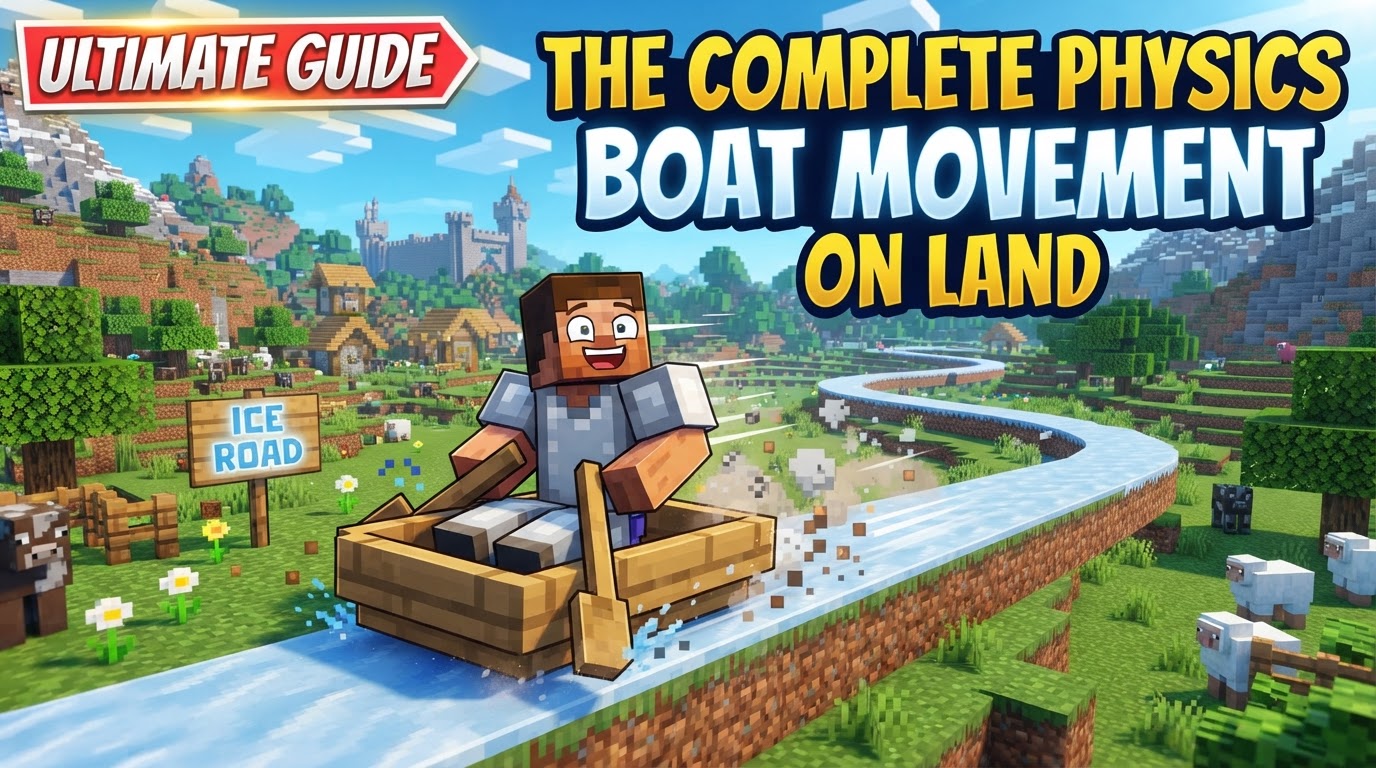
The true potential of overland boat travel emerges when ice blocks are introduced. These slippery surfaces dramatically alter a boat’s physics, transforming it into one of the fastest modes of transportation in the game. On regular Ice and Packed Ice, a boat can achieve speeds of up to 144.0 km/h. However, the ultimate speed demon is Blue Ice, which propels boats to an astonishing 252.0 km/h.
To leverage this, players often construct “ice roads” or “boat highways” using these blocks. Blue Ice, being the fastest, is the preferred material for long-distance, high-speed routes. These ice highways are typically built as long, flat strips, often enclosed to prevent accidental derailing. For temporary bursts of speed or to facilitate smoother movement across short stretches of normal terrain, a single water bucket can be incredibly effective. By placing a water source directly in front of the boat, it will glide across the land more easily. The player can then pick up the water and re-place it as they progress, creating a mobile, temporary glide path.
Conquering Verticals and Obstacles
Moving a boat uphill or over challenging terrain presents its own set of physics puzzles. Several methods can be employed to overcome verticality:
- Water Paths: One classic technique involves creating a two-block-wide upward-flowing water path. The current will naturally propel the boat and its occupants to higher elevations, making for a relatively passive ascent.
- Leads (Minecraft 1.21+): With the advent of Minecraft 1.21, leads gained a powerful new utility for boats. By attaching a lead to a boat, players can effectively pull it uphill, over ledges, and even up sheer cliffs. This method requires active player input, often involving sprinting and jumping while holding the lead, but it offers unparalleled efficiency for both vertical and horizontal maneuvering across difficult landscapes.
- Pistons and Bubble Columns: More complex redstone contraptions can also be used. Pistons, when placed strategically in the ground, can provide a momentary push to elevate a boat. Similarly, upward-flowing bubble columns, created by Soul Sand under water, can lift boats (and their occupants) vertically through a water column, depositing them at a higher level.
Beyond Transport: Utility and Mob Management
The ability of boats to carry two entities extends their utility far beyond just player travel. They are an invaluable tool for transporting mobs across land. To move a mob like a villager, simply push it into a boat. Once the mob is seated, the player can enter the boat and drive it to the desired location. While slow on regular terrain, this method is often the safest and most controlled way to relocate valuable or dangerous mobs without risking their escape or despawn.
Another niche utility for boats on land involves docking. While not strictly “movement,” knowing that boats will run aground on Soul Sand without breaking provides a convenient and safe material for creating dedicated boat parking spots or docks on land, preventing them from sliding away or sustaining damage.
Durability, Vulnerabilities, and Common Misconceptions
Despite their robust collision resistance in modern Minecraft, boats are not invincible. As entities with health, they can be destroyed by specific environmental hazards. Explosions, fire, and direct exposure to lava will quickly obliterate a boat. Similarly, being repeatedly attacked by hostile mobs or players will deplete its health, causing it to break.
A critical point of concern is fall damage. While a player riding a boat is immune to fall damage, the boat itself is not. Boats can break and potentially kill passengers if they fall specific distances, such as 12, 13, or 49 blocks, among other specific thresholds. This means high-speed ice highways should incorporate gentle ramps rather than sudden drops.
One of the most common misconceptions about boats on land stems from outdated game mechanics. In pre-1.9 versions of Minecraft, boats were notoriously fragile, breaking easily upon high-speed collisions with blocks. Modern boats, however, are largely immune to this, allowing for much more aggressive and high-speed overland travel without fear of instant destruction from minor bumps. Another common issue is getting stuck: boats can become immobile if placed on certain non-full blocks or blocks without full collision boxes, such as saplings, carpets, or redstone repeaters. Always ensure your boat path is clear of such obstructions.
Finally, a word of caution regarding lava: attempting to ride a boat placed in lava will result in the player’s instant death and the destruction of the boat. Boats offer no protection against the extreme heat of lava, making it an absolute no-go for terrestrial boat travel.
Advanced Strategies for Overland Travel
Mastering the physics of boats on land involves combining these insights into cohesive strategies. For example, a long-distance overland route might involve a main artery of Blue Ice highway, with off-ramps leading to temporary water bucket paths for navigating local terrain, and lead-assisted ascents for reaching elevated bases. Understanding the nuances of boat durability allows for safer construction of these routes, while knowledge of mob transport makes them versatile tools for base expansion and resource gathering.
The Minecraft boat, often overlooked for its land capabilities, is a surprisingly versatile and powerful tool. From slow, safe mob transport to blistering high-speed travel across custom-built ice highways, its unique physics on land offer a rich layer of complexity and opportunity for creative players. By understanding its strengths, weaknesses, and the environmental factors that influence its movement, players can unlock entirely new dimensions of exploration and logistics in their blocky worlds.
Tags:
YOU MAY ALSO LIKE...