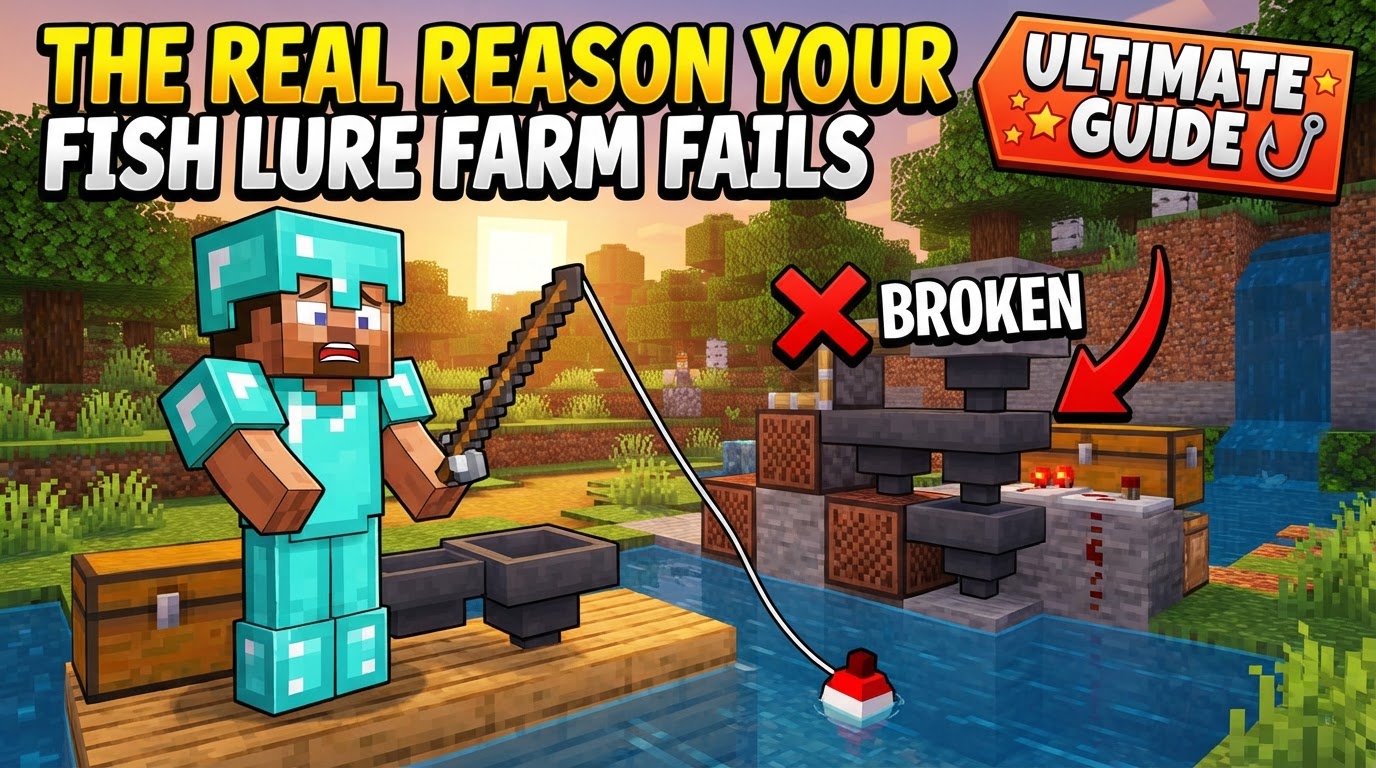
The Real Reason Your Fish Lure Farm Fails
The primary reason your Minecraft fish lure farm isn’t working as expected usually boils down to a fundamental misunderstanding or oversight of critical game mechanics, especially those introduced in recent updates. Many players meticulously follow old tutorials, only to find their efforts yield minimal treasure or cease functioning entirely. This guide will uncover the often-missed details and common pitfalls that lead to a failing AFK fishing setup, ensuring your next build is a resounding success.
The Foundation: Core Mechanics You Can’t Ignore
Understanding the bedrock principles behind AFK fishing is paramount. Without these, even the most elaborate farm design is destined to falter.
- Continuous Input: The Heartbeat of Automation
At its core, an AFK fishing farm relies on your character continuously performing the “use item” action – right-clicking. This input casts the fishing rod and, critically, reels it in when a fish bites. If this input isn’t constant, your farm simply won’t operate. Methods range from software auto-clickers to physically weighting down your mouse button, or even using the F3+T trick (holding right-click while reloading texture packs) to keep the input active. - Treasure Mechanics: The 1.16+ Open Water Rule (Java Edition)
This is perhaps the most significant change that tripped up countless pre-1.16 farm designs. For your farm to catch treasure items – think enchanted books, name tags, or saddles – the water block where your bobber lands must be part of a larger, unblocked water body. Specifically, in Java Edition versions 1.16 and later, this requires a 5x5x4 area of water (5 blocks wide, 5 blocks long, and 4 blocks deep) with no solid blocks obstructing it. Older, compact designs often fail this requirement, leading to only junk and fish catches. - Lure and Mending: The Indispensable Enchantments
Your fishing rod is not just a tool; it’s the engine of your farm.- Lure Enchantment: Lure significantly reduces the waiting time for a bite. Lure III is ideal, dramatically boosting the farm’s efficiency and item yield per hour.
- Mending Enchantment: For any AFK session longer than a few minutes, Mending is non-negotiable. This enchantment uses experience orbs collected (from reeling in fish) to repair the rod, preventing it from breaking. Without Mending, your rod will eventually shatter, bringing your farm to a halt. Some advanced designs might use lava to prevent durability loss, but Mending is the standard, reliable solution.
- The Reel-in Trigger: Your Farm’s Brain
An effective AFK farm needs a mechanism to detect a bite and automatically reel in. This is typically achieved by having the bobber interact with a specific block when an item is caught. Common triggers include note blocks, tripwires, or pressure plates. When the bobber bobs against this block, it generates a redstone pulse, which is then used to simulate a “right-click” input, reeling in your catch. - Loot Collection: The Unsung Hero
A robust collection system is fundamental. Hoppers placed beneath the water block where items land will automatically funnel your catches into chests. An inadequate or full collection system can quickly lead to items despawning, rendering all your fishing efforts moot.
Building for Success: A Step-by-Step Blueprint
With the core mechanics understood, let’s outline the essential elements for constructing a robust and treasure-yielding AFK fishing farm.
- Crafting the Optimal Water Source: If you’re aiming for treasure, create a water body that is at least 5 blocks wide, 5 blocks long, and 4 blocks deep for Java Edition 1.16+. Ensure there are no solid blocks within this volume. This “open water” environment is critical for treasure loot.
- Implementing the Trigger Mechanism: Position a note block, pressure plate, or tripwire hook near the water source. Your character will aim the fishing rod at this block. When a fish bites, the bobber will dip and hit this trigger, sending a redstone signal.
- Setting Up Automated Collection: Place a hopper directly beneath the water block where your caught items will fall. Connect this hopper to a series of chests to create ample storage space for your haul.
- The AFK Stance: Positioning and Input: Stand in a precise location where, when you aim your fishing rod at the trigger mechanism, the bobber consistently lands within your designated 5x5x4 water source. Activate your continuous right-click input (auto-clicker, weighted mouse, F3+T trick) to begin the farming process.
- The Right Rod: Enchantments Matter: Equip a fishing rod enchanted with Lure III and Mending. Ideally, also include Luck of the Sea III to further improve your chances of catching valuable items.
Beyond the Build: Operational Wisdom
Even with a perfectly constructed farm, certain operational aspects can make or break your long-term success.
- Enchantment Synergy: Maxing Your Rod: While Lure III and Mending are essential, adding Luck of the Sea III will significantly increase the quality and quantity of your catches. A fully enchanted rod is an investment that pays dividends.
- Storage Vigilance: Never underestimate the volume of items an efficient AFK farm can generate. Periodically check your collection chests. If they fill up, new items will have nowhere to go and will despawn, wasting your efforts. Expanding your storage or building a sorting system is a smart long-term strategy.
- The Power of Persistence: Long Sessions: AFK fishing is a game of patience and accumulation. For significant gains in experience, enchanted books, or rare items, allow your farm to run for several hours, or even overnight. This is where Mending truly shines.
- Version Awareness: Java vs. Bedrock vs. Updates: Minecraft’s mechanics, especially those related to fishing, can differ between Java and Bedrock Editions, and frequently change with major game updates. Always ensure the farm design you are using is specifically compatible with your game version and edition. A Java design will almost certainly fail on Bedrock, and vice-versa, and an outdated design won’t leverage current mechanics.
Why It Breaks: Common Pitfalls and Solutions
Despite careful planning, many farms still falter. Here are the most common mistakes that lead to failure and how to address them.
- The Silent Farm: Input Failure: If your character isn’t continuously right-clicking, the rod won’t cast or reel automatically. Double-check your auto-clicker settings, ensure your weighted object is secure, or that the F3+T trick is properly engaged.
- Outdated Schematics: The Pre-1.16 Trap: Many widely circulated AFK fishing farm designs predate the 1.16 update. While these might still catch raw fish and junk, they will NOT yield treasure items in Java Edition due to the changed “open water” requirements. Always seek designs explicitly stated to be 1.16+ compatible for treasure.
- Water Woes: The Missing Treasure Dimension: Failing to create the required 5x5x4 unblocked water area (Java Edition post-1.16) is a prime culprit for treasure drought. Verify your water source meets these dimensions and has no hidden blocks within it.
- Misaligned Aim: The Trigger Miss: The bobber must consistently land and interact with the designated trigger block (note block, pressure plate, etc.) for the automatic reeling mechanism to work. Small shifts in player position or aiming can cause the bobber to miss, breaking the automation loop. Adjust your stance and aim until it’s perfectly consistent.
- Overflowing Hoppers: The Despawn Dilemma: If your collection chests become full, newly caught items will have nowhere to go. After five minutes, these items will despawn, negating all farming efforts. Implement a larger storage system or an item sorting and disposal mechanism.
- The Fragile Rod: Mending’s Absence: A fishing rod without Mending will eventually break, stopping your farm dead in its tracks. Always enchant your primary fishing rod with Mending for infinite durability during AFK sessions.
- Lag and Latency: Multiplayer Headaches: On multiplayer servers, high latency or an unstable internet connection can disrupt the precise timing required for automatic reeling. The game might register the bobber hitting the trigger but fail to process the reel-in command in time, causing fish to get away. This is often harder to fix, but optimizing your connection or playing on a less laggy server can help.
- Edition Confusion: Java vs. Bedrock Design Discrepancies: Mechanics, redstone, and fishing rules often differ significantly between Minecraft: Java Edition and Minecraft: Bedrock Edition. Applying a Java design to Bedrock (or vice-versa) will almost certainly lead to unexpected failures. Always verify the design is for your specific game edition.
By carefully addressing these common pitfalls and understanding the underlying mechanics, you can transform a failing fish lure farm into a consistent source of experience, food, and valuable treasure. Happy fishing!
Tags:
YOU MAY ALSO LIKE...