The Science of Block Update Chain Reactions
Many aspiring Redstone engineers often overlook the invisible forces at play in their contraptions, leading to unpredictable results and frustrating failures. This oversight frequently stems from a misunderstanding of one of Minecraft’s most fundamental yet complex mechanics: the block update chain reaction.
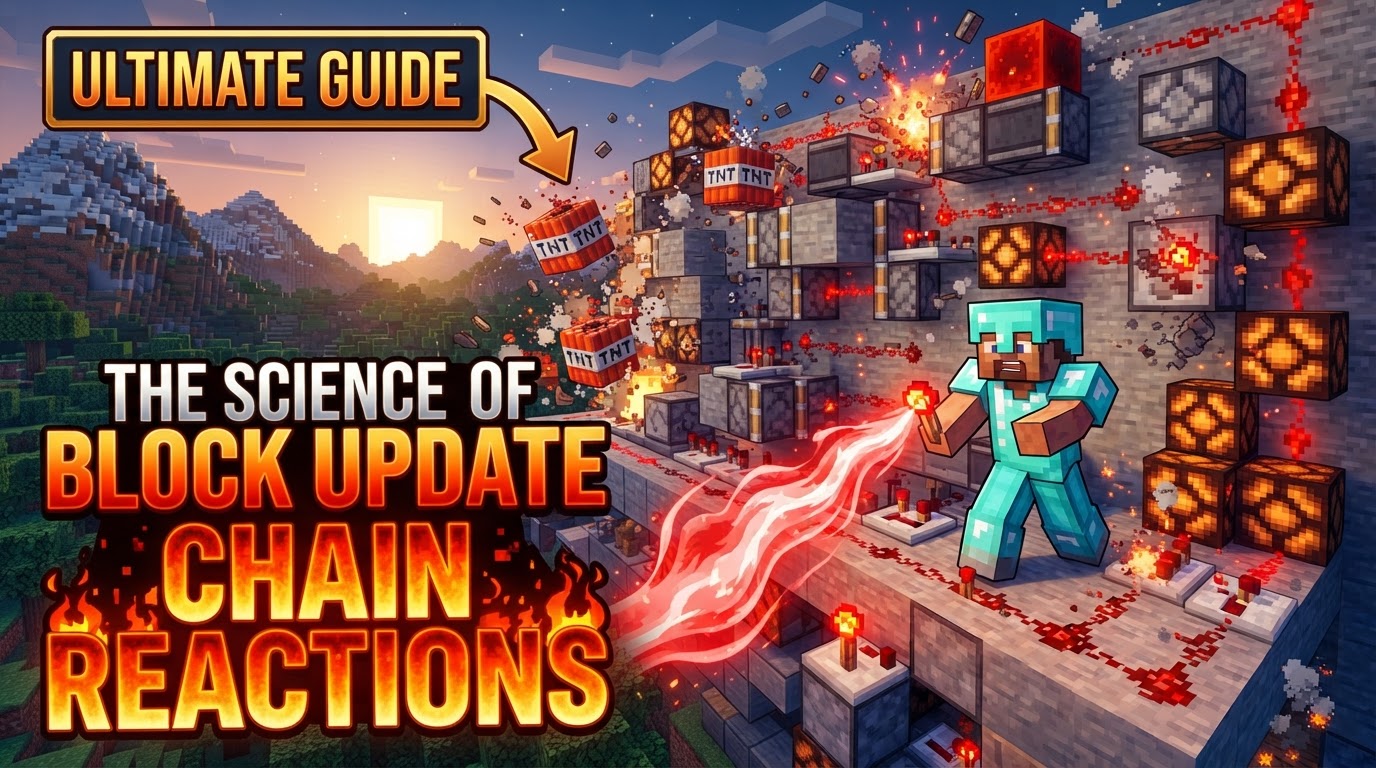
A block update chain reaction is the invisible engine driving complex Redstone machinery and dynamic environmental changes in Minecraft. When a block’s state changes-placed, destroyed, powered, or growing-it notifies adjacent blocks. These ‘block updates’ can then trigger subsequent reactions, propagating a cascading sequence of events across your world. Mastering this intricate dance is crucial for building efficient farms, sophisticated Redstone computers, and understanding in-game phenomena.
The Invisible Language of Blocks: Core Update Mechanics
At its heart, a block update is an internal game mechanism that notifies surrounding blocks when a block is modified. This is essential because the game engine cannot constantly evaluate every single block in the world for changes due to computational limits. Instead, blocks are programmed to ‘listen’ for updates from their neighbors.
- Definition of a Block Update: A block update is an internal game mechanism notifying surrounding blocks when a block’s properties or state change. The game cannot constantly evaluate all blocks due to computational limits, so blocks ‘listen’ for updates. Modifications include placing/breaking, furnace activity, water flow, or Redstone component state changes.
- Triggers: The initial spark for any update sequence comes from various sources. Player actions like placing or breaking blocks are common. Environmental events, such as fire destroying a block, an explosion altering terrain, or crops maturing, also initiate updates. Crucially, Redstone components-like repeaters, comparators, observers, and Redstone dust-are prolific update generators, sending specific types of updates when their states change.
- Propagation and Order: When a block changes, it generally sends updates to its six immediate neighbors (West, East, North, South, Down, Up). This order is hardcoded. While general changes follow this pattern, Redstone components have specific, often prioritized, update orders. For example, comparators may update North, East, South, West, while repeaters often have higher priority. This specific order is crucial for precise Redstone timing, preventing components from activating out of sync.
- Types of Updates: Beyond general notifications for connected blocks (like stairs adapting their shape or torches dropping when their support block is removed), there are specialized updates. Redstone components, in particular, generate various update signals, some of which are “strong” power, “weak” power, or simple block state changes. Understanding these nuances helps predict how different blocks will react.
Deconstructing the Cascade: How Chain Reactions Unfold
Understanding the step-by-step process of a block update chain reaction illuminates its power and complexity:
- Initial Trigger: Every chain reaction begins with a primary event. This could be as simple as a player placing a Redstone block, a piston extending, a crop growing to its final stage, or a furnace finishing smelting an item. This initial change is the first domino to fall.
- First-Wave Updates: The block involved in this primary event immediately sends out update notifications to all its directly adjacent blocks. These are the initial ‘listeners’ in the system, waiting for a signal.
- Neighboring Block Reactions: Upon receiving an update, any of these notified blocks that are specifically designed to react to such a change will then perform their programmed action. For example, a Redstone torch adjacent to a newly powered block might turn off. An observer block, detecting the change in the block it’s monitoring, will emit a Redstone pulse. A piston might extend or retract, or a door might open or close.
- Propagation: The crucial next step is that if a reacting block itself changes its state (e.g., a Redstone torch turning off, a piston extending), it will, in turn, send its own set of update notifications to its adjacent blocks. This is where the ‘chain’ truly begins.
- Chain Formation: This receive-react-send cycle repeats. Each subsequent reaction can trigger further reactions, creating a dynamic, propagating wave of changes throughout the system. The cascade continues until no more blocks react within loaded chunks or a stable state is reached. This propagation makes chain reactions powerful yet challenging.
Harnessing the Power: Tips for Controlling Updates
For those looking to move beyond basic Redstone and build truly advanced contraptions, mastering the control of block update chain reactions is essential:
- Mastering Update Order: For precision engineering, an intimate understanding of specific component update orders is non-negotiable. Knowing that repeaters often process before comparators, or that certain directions are prioritized, allows for the creation of incredibly compact and reliable timing mechanisms. This knowledge prevents race conditions where components activate in an unintended sequence.
- Strategic Observer Use: Observers are the ultimate tools for detecting block state changes and initiating controlled chain reactions. They instantly detect a change in the block they are facing and emit a short, one-tick Redstone pulse from their carved face. They are indispensable for automatic farms (detecting crop growth), complex Redstone logic, and creating responsive systems. Always ensure the observer’s ‘face’ is against the block you want to monitor, and its ‘output’ (the red dot) is pointing in the direction you want the signal to go.
- Block Update Detectors (BUDs): BUDs are ingenious contraptions that exploit the game’s update mechanics to detect changes that wouldn’t normally trigger a direct Redstone signal. Often employing pistons, these devices react to indirect updates (like a block being placed next to a piston, causing it to update and check for power). They are excellent for detecting subtle changes, such as a block being placed or removed a short distance away, and then initiating a controlled Redstone response.
- Exploring Update Suppression: Update suppression is an advanced technique involving intentionally creating an overwhelming number of simultaneous block updates, causing an internal ‘stack overflow’ error. This error, when player-initiated, cancels the update sequence without crashing the game. It can be exploited for unusual block placements, impossible block states, or structures defying normal physics, requiring precise timing. This offers extreme control for expert builders.
Pitfalls and Paradoxes: Avoiding Update-Related Errors
Even seasoned players can fall prey to common mistakes when dealing with the intricacies of block updates:
- Incorrect Observer Orientation: One of the most common and frustrating errors for Redstone builders is misplacing an observer. If the observer’s ‘face’ isn’t directly looking at the block whose state you want to monitor, or if its Redstone output isn’t correctly aligned with the component you want to activate, your system will simply fail to respond. This often requires careful visual inspection and testing.
- Disregarding Update Order: Assuming all block updates occur instantaneously or in a perfectly synchronized manner is a recipe for disaster in complex Redstone. Components activating in the wrong sequence, or ‘race conditions’ where two components try to update simultaneously with an unpredictable winner, can lead to intermittent failures or completely broken contraptions. Understanding the specific timings of Redstone components is vital for reliability.
- Overlooking Quasi-Connectivity: Mainly for Java Edition pistons, quasi-connectivity allows activation by Redstone power two blocks away or diagonally upwards. This means pistons can extend or retract from an indirect Redstone signal, leading to unexpected behavior if not understood. While offering unique Redstone possibilities, it’s a common source of unintended updates.
- Unintended Performance Drain (Lag): While block update chain reactions are powerful, large-scale, uncontrolled cascades, especially those involving many entities or complex calculations, can severely impact game performance. Massive Redstone contraptions, automatic farms with thousands of items, or rapid-fire systems can create significant lag, making the game unplayable for some. Efficiency in design is key to mitigating this.
- Insufficient Testing: The intricate nature of block updates means that even a seemingly perfect Redstone build can have hidden flaws. Not thoroughly testing contraptions under various conditions-repeated activations, different input timings, or even after game updates-can lead to intermittent failures or unexpected interactions that only surface during extended use. Patience and rigorous testing are your best allies.
The science of block update chain reactions is a core pillar of advanced Minecraft mechanics. It’s the invisible engine driving sophisticated creations and subtle environmental phenomena. From a small Redstone pulse to an expansive automated factory, understanding how blocks communicate, react, and propagate changes is key to transforming frustrating messes into flawlessly functioning marvels. Delving into triggers, propagation, and update order grants unparalleled control, making the seemingly random reliably predictable, and pushing the boundaries of the blocky universe.
Tags:
YOU MAY ALSO LIKE...