

Understanding Mob Pathfinding Through Half Blocks
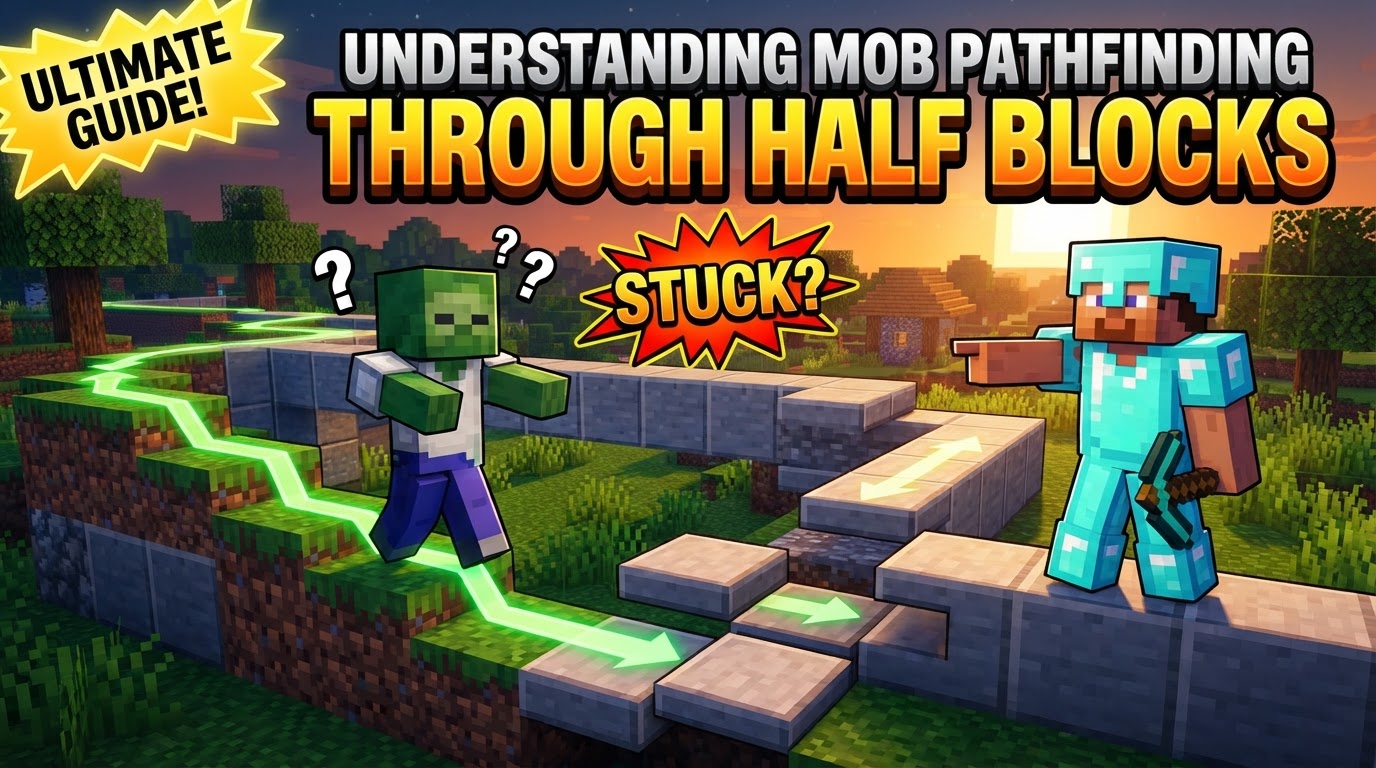
One of the most counter-intuitive aspects of Minecraft mob behavior is their perception of open trapdoors. Despite appearing as a gaping hole, mobs often “see” an open trapdoor as a solid block, confidently stepping onto it only to plummet into a waiting trap. This fascinating quirk is just one example of the complex logic governing mob movement, particularly when it comes to half blocks and other non-standard terrain features.
The Underlying Algorithm: A* and Path Costs
At its core, Minecraft mob pathfinding relies on a modified version of the A* graph search algorithm. This sophisticated system allows mobs to calculate the most efficient route to a target destination by assigning “path costs” to different blocks and movements. Every step a mob takes, every block it needs to navigate around, contributes to this cost, influencing its decision-making process.
Mobs don’t just wander aimlessly; they actively seek out targets. Within a certain radius, typically 32 blocks for general wandering behavior, a mob will randomly cast about for a “full block” to pathfind towards. The more solid blocks available in a particular direction, the more likely the mob is to select a target within that area. This preference for solid ground is a fundamental principle that can be exploited in various builds.
Furthermore, different block types can carry varying “malus” or cost modifiers. For instance, pathfinding next to water generally incurs a higher cost, making mobs less inclined to choose routes that hug watery edges unless absolutely necessary. This subtle detail contributes to the natural-looking, yet predictable, movement patterns observed in the game.
Mob Perception Beyond Solid Blocks
The key to manipulating mob movement lies in understanding how they perceive the world around them, which isn’t always aligned with what a player sees. As mentioned, open trapdoors are a prime example; mobs perceive them as solid walking surfaces. Similarly, rails, despite being low-profile and seemingly traversable, can be identified by mob pathfinding as full barriers, causing mobs to navigate around them rather than over them.
This discrepancy between visual appearance and pathfinding perception extends to other elements. Mobs generally view carpet blocks as air, meaning they will not attempt to cross them, effectively treating them as empty space. This can be incredibly useful for creating hidden pathways or barriers that are invisible to mobs but passable by players. Each mob type also possesses unique navigation abilities: spiders can climb vertical walls, while certain entities can float, fly, or jump depending on their specific navigation components, adding layers of complexity to their pathfinding.
Navigating Half Blocks: Slabs and Stairs
When it comes to half blocks like slabs and stairs, their interaction with mob pathfinding is nuanced and depends heavily on their placement.
- Bottom-Half Slabs: These are particularly interesting. Mobs generally cannot spawn on bottom-half slabs. More importantly, their pathfinding behavior is significantly altered on them. Mobs may not pathfind across bottom-half slabs in the same way they would full blocks, often treating them as obstacles or undesirable routes. This makes bottom-half slabs excellent for creating mob-proof areas or directing flow.
- Top-Half Slabs: In contrast, top-half slabs behave much more like full blocks. Mobs *can* spawn on top-half slabs, provided there is sufficient space above them. They also pathfind across them quite readily, making them less effective for mob-proofing but useful for building traversable, lower-profile structures.
- Stairs: Similar to top-half slabs, mobs can pathfind and spawn on stairs. Their sloped nature allows for smooth transitions in elevation, and mobs navigate them without significant issues, treating them as extensions of the ground.
A crucial limitation to note is that while the pathfinding system often detects slabs as valid blocks to target, mobs generally do not detect collisions as effectively. This disparity is precisely what allows for many common mob farm designs, where mobs attempt to walk over perceived solid ground (like a slab or open trapdoor) but fail to register the physical void, leading to their demise.
Strategic Manipulation for Mob Control
Understanding these pathfinding quirks opens up a world of possibilities for player-built structures, especially mob farms and traps. The core principle is to guide mobs where you want them to go by controlling their perceived valid paths.
- Funneling Mobs: By strategically placing solid blocks only where you desire mobs to travel, and using non-solid blocks like glass, bottom-half slabs, or stairs elsewhere, you can effectively funnel mobs into a specific direction or collection point. Mobs will always prioritize the path they perceive as solid and available.
- Trapdoors for Farms: The open trapdoor trick is a cornerstone of many mob farms. Because mobs perceive open trapdoors as solid, they will attempt to walk over them, inevitably falling into a collection system below. This is incredibly efficient for guiding large numbers of hostile mobs.
- Creating “Monoliths”: Mobs will pathfind to the closest block they can reach within their “follow range,” which is typically 16 blocks for many hostile mobs. By constructing a central “monolith” of solid blocks, mobs on surrounding non-solid surfaces (like bottom-half slabs or trapdoor-lined edges) will attempt to pathfind towards this central structure, often resulting in them falling into a trap surrounding the monolith.
- Using Specific Lures: Certain mobs can be influenced by specific game elements. Creepers are repelled by cats, skeletons by wolves, and zombies by turtle eggs. By strategically placing these entities or blocks, you can create powerful lures that direct these specific mob types towards desired locations in your pathfinding farms, adding another layer of control.
Common Pitfalls and Mob-Specific Quirks
Despite the predictability of mob pathfinding, there are still common mistakes and mob-specific quirks that builders should be aware of:
- Unreachable Targets: A frequent issue arises when mobs attempt to pathfind to blocks they cannot actually reach. This often leads to erratic behavior, mobs getting stuck against walls, or endlessly jumping in place, ultimately hindering the efficiency of a farm or causing unexpected mob accumulations. Careful testing of pathing is crucial.
- Villager Pathfinding: Villagers are notoriously inefficient pathfinders. They often struggle with seemingly simple obstacles like closed doors or fences, even if other mob types can navigate them with ease. Designing efficient villager sorting or trading halls requires a deep understanding of their unique limitations.
- Waterlogged Blocks: In Bedrock Edition, players have observed specific pathfinding issues with waterlogged blocks. Mobs may misinterpret these blocks, leading to unpredictable movements or getting stuck, which can be a significant concern for water-based mob transportation systems.
- Carpet Blocks: As previously noted, mobs generally view carpet blocks as air. While useful for creating hidden passages, it’s a mistake to assume mobs will walk over them. If a path requires mobs to cross a carpet, they will instead try to path around it or get stuck if no other path is available.
Mastering mob pathfinding, particularly through the lens of half blocks, is a fundamental skill for any serious Minecraft builder. By understanding how the A* algorithm works, how mobs perceive various block types, and the specific behaviors associated with slabs and stairs, players can design highly efficient and robust contraptions. This knowledge transforms seemingly complex mob behaviors into predictable mechanics, allowing for creative solutions to resource gathering and mob management.
Tags:
YOU MAY ALSO LIKE...


