Why Certain Structures Generate Partially Underground
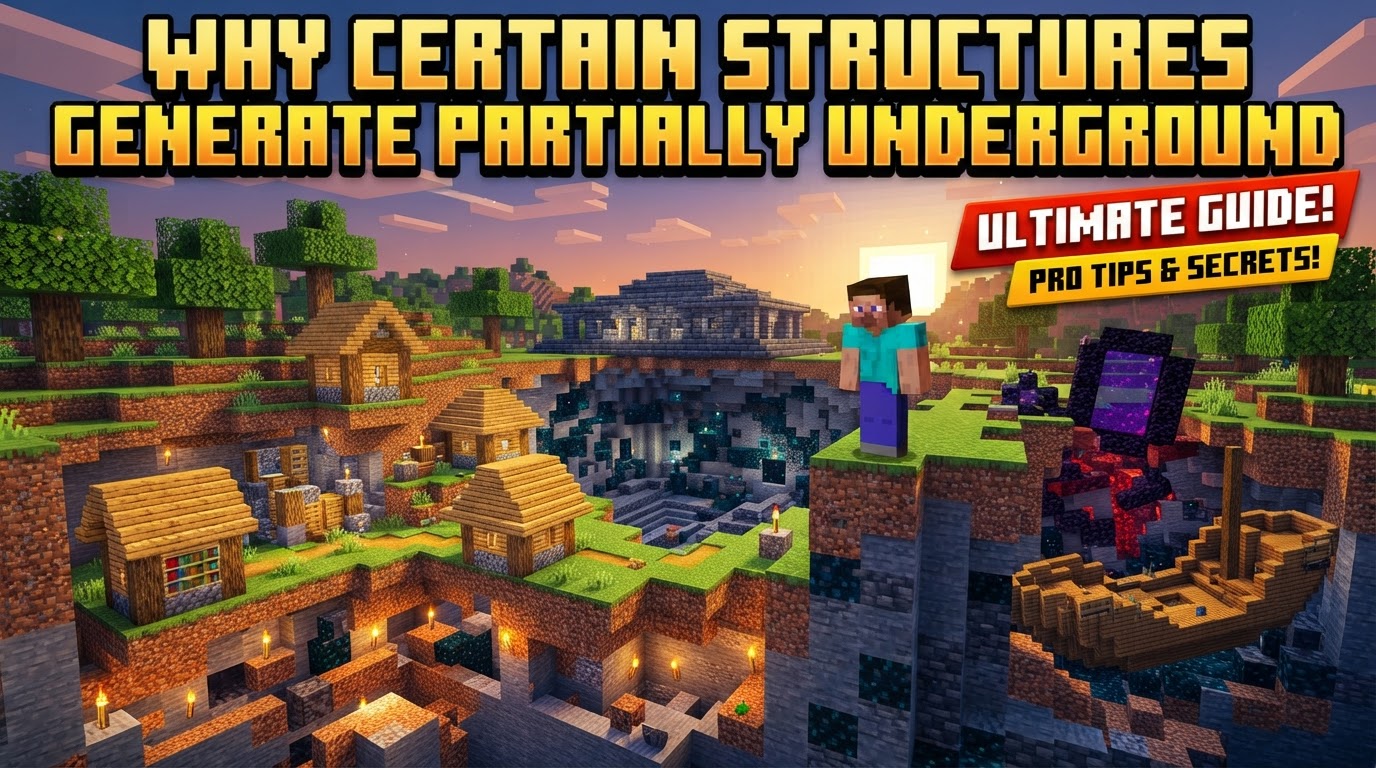
Many adventurers exploring the vast blocky landscapes of Minecraft often encounter a peculiar sight: a village well half-buried in a hill, a desert temple with its entrance submerged in sand, or a shipwreck partially entombed in the ocean floor. This isn’t usually a bug, but rather a fascinating consequence of Minecraft’s intricate world generation mechanics. The game’s sophisticated, multi-pass system and specific structure placement algorithms interact with the procedurally generated terrain in ways that can lead to these intriguing, sometimes awkward, placements.
The Foundations of a Blocky World: Procedural Generation
Minecraft’s infinite worlds are not pre-designed masterpieces but are instead sculpted on the fly through a process known as procedural generation. At its heart is a “seed” – a numeric or alphanumeric value that acts as the initial input for a pseudo-random number generator. This seed dictates every single block placement, every mountain peak, and every valley, ensuring that while each generated world is unique, it is also perfectly replicable. Enter the same seed, and you’ll find the exact same world, down to the smallest detail. This systematic randomness is the bedrock upon which all structures are eventually placed.
A Layered Creation: The Multi-Pass System
The creation of a Minecraft world is not a single, instantaneous event but rather a sophisticated, multi-pass system. Imagine an artist building a sculpture layer by layer. The first pass lays down the foundational terrain – the sweeping plains, jagged mountains, deep valleys, and initial cave systems. Following this, a biome pass defines the environmental characteristics, assigning biomes like forests, deserts, or oceans, and further detailing underground elements. Structures, the focus of our inquiry, are placed in subsequent, later passes. This sequential generation is crucial to understanding why structures might appear partially buried; they are often added to a landscape that has already been significantly shaped, rather than having the terrain perfectly adjusted for them upfront.
Architects of Placement: Structure Generation Algorithms
Each structure in Minecraft, from a humble village house to a sprawling jungle temple, is governed by a distinct set of placement algorithms. These algorithms come with specific rules, dictating where and how a structure can manifest. Key parameters include spacing requirements, ensuring structures aren’t too close together, and crucially, biome conditions. A desert pyramid, for instance, will only ever attempt to generate within a desert biome. For more complex and adaptive structures, such as villages, a clever system utilizing ‘Jigsaw Blocks’ is employed. These blocks allow structures to be built modularly, piece by piece, attempting to adapt to the underlying terrain. However, this adaptation, while ingenious, is not always flawless, leading to the quirky placements we often observe.
The Unfolding Scenario: How Structures End Up Buried
To fully grasp why structures generate partially underground, let’s trace the typical generation sequence:
- Terrain Generation: The game’s engine first sculpts the raw landscape. This involves creating the base elevations, digging out initial cave systems, and forming the fundamental geological features of the world.
- Biome Assignment: Next, biomes are assigned across the landscape. This step considers factors like elevation, temperature, and humidity, and further refines underground features, potentially expanding existing caves or adding new ones.
- Structure Location Selection: After the terrain and biomes are established, an algorithm identifies suitable locations for specific structures. This selection is based on the structure’s predefined rules, such as requiring a certain biome type or ensuring sufficient distance from other generated features.
- Structure Placement: Finally, the structure is placed at the chosen location. This is where the magic, and sometimes the ‘misplacement,’ happens. If the selected spot, or a significant portion of the structure’s intended footprint, falls upon uneven terrain – perhaps a steep hill that wasn’t perfectly accounted for, or within a pre-existing underground feature like a cave or ravine generated in an earlier pass – the structure will inevitably be partially or even largely buried. Villages are prime examples, often generating without fully leveling the ground beneath them, resulting in houses embedded in hillsides or paths dipping into valleys. Similarly, shipwrecks, while designed to be aquatic, can appear partially submerged in the ocean floor if the seafloor elevation is higher than their intended placement.
Intentional Design vs. Quirky Consequence
It’s important to differentiate between structures that are designed to be entirely or partially underground and those that end up partially buried as a side effect of the generation process. Many iconic Minecraft structures are purposefully hidden beneath the surface. Strongholds, the gateways to the End Dimension, are always found deep underground. Dungeons, with their monster spawners and treasure chests, are also inherently subterranean. Mineral veins, geodes, and the newer trial chambers are all intentionally placed underground features. Therefore, encountering these partially or fully buried is their intended behavior.
However, the partial burial of structures like villages, desert temples, jungle temples, or shipwrecks is typically a consequence of the structure placement algorithms interacting with the already-generated, often uneven, terrain. The game prioritizes placing the structure in its designated biome and often at a specific Y-level range, but it doesn’t always perform extensive terraforming to perfectly accommodate the structure’s base. This leads to the charming, if sometimes inconvenient, sight of a village farm half-submerged in a hill or a temple requiring a bit of digging to fully enter.
Navigating and Customizing Generation: Tips for Players and Creators
For players, understanding this multi-layered generation explains why vanilla structures often appear with their unique quirks – a village house perched precariously on a cliff, or a desert well filled with sand. These are not flaws but rather characteristic elements of Minecraft’s procedural charm. Such uneven generation is considered a common and expected aspect of the game.
For custom structure designers and modders, this understanding is vital. When creating custom structures, the “step” property in a structure’s configuration file determines when it generates in the world. Setting this to underground_decoration, for example, explicitly allows a structure to spawn beneath the surface. Furthermore, modifying structure settings in JSON files, particularly parameters like “Terrain Adaption,” offers fine-grained control over how a structure interacts with the ground. To achieve a structure that is mostly underground but with its top exposed, a creator might set its initial placement nearer the surface and allow it to replace grass blocks, effectively embedding itself into the landscape.
It’s also worth noting that conflicts can arise when using multiple mods that introduce new structures. These mods might not be designed to account for each other’s placement rules, leading to structures spawning inside one another, or failing to appear as intended. Careful management of mod lists and understanding their generation principles can mitigate these issues, ensuring your custom worlds generate as smoothly as possible.
Tags:
YOU MAY ALSO LIKE...