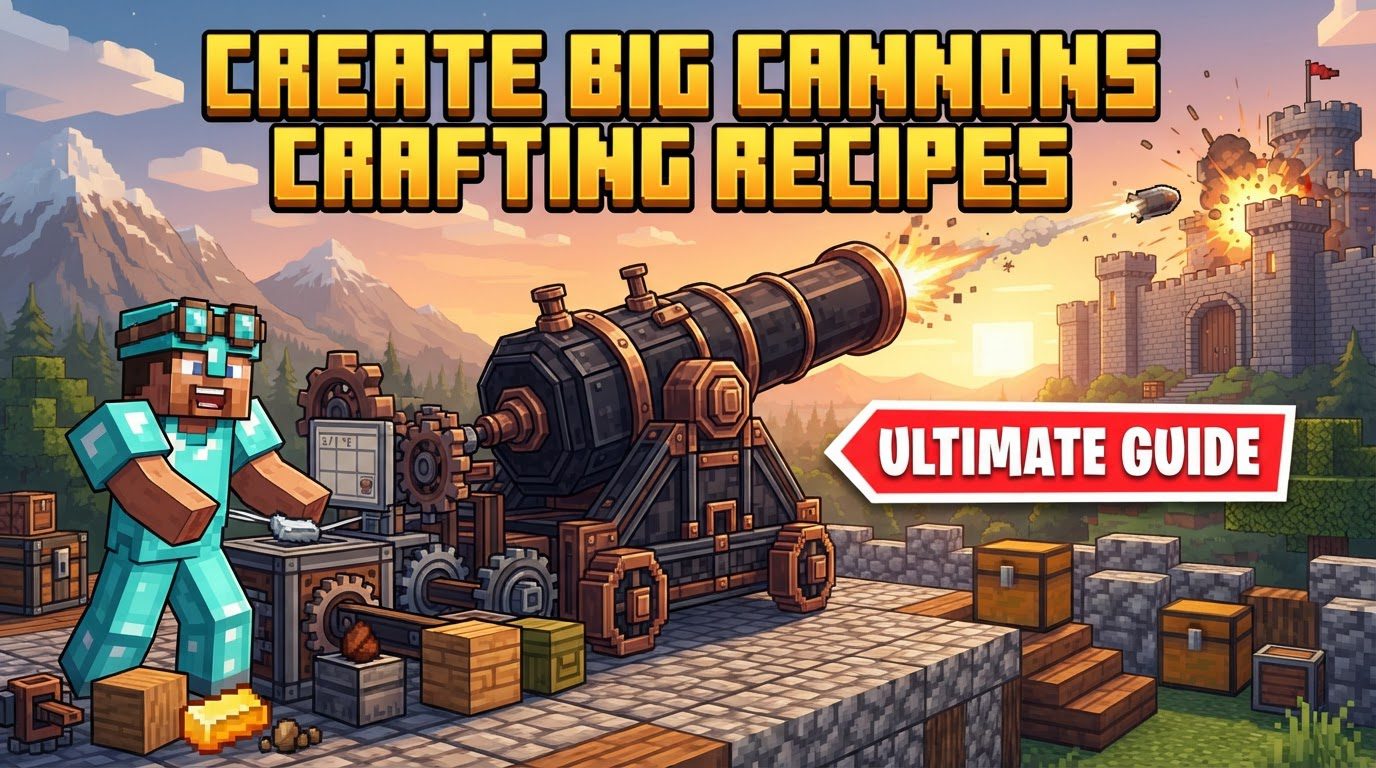
Create Big Cannons Crafting Recipes
One of the most destructive mistakes a budding artillery engineer can make in “Create Big Cannons” is firing an assembled cannon while its chamber or barrel is clipping through another solid object. This common oversight inevitably leads to a catastrophic explosion, often destroying hours of meticulous work and reminding players of the mod’s unforgiving realism. Understanding the intricate crafting recipes and assembly processes is crucial to avoid such fiery fates and harness the true power of these kinetic behemoths.
The “Create Big Cannons” mod significantly expands the engineering possibilities within Minecraft, offering an advanced addon to the popular Create mod. It transforms the concept of artillery into a complex, multi-block engineering challenge, where kinetic energy from the Create mod is not just for automation but for the very construction and operation of massive cannons. This guide will delve into the verified facts of crafting and mechanics, helping you master the art of big cannon construction.
The Foundational Mechanics: Multiblock Structures and Kinetic Power
At its heart, “Create Big Cannons” is about constructing multi-block structures. Unlike simple single-block items, these cannons are intricate assemblies of various cannon blocks, available in different materials and tiers. Whether you’re aiming for a colossal big cannon or a rapid-fire autocannon, the principle remains the same: thoughtful assembly of interconnected components. The mod seamlessly integrates with Create’s kinetic system, leveraging rotational power for every aspect, from the initial crafting stages to the final loading, aiming, and firing mechanisms. Beyond the cannons themselves, the mod also introduces a diverse range of projectiles and fuze items, allowing for tailored destructive effects and precise detonation methods, adding another layer of strategic depth to your arsenal.
Dependencies and Material Acquisition
Before embarking on your journey to build monumental artillery, it’s essential to understand the mod’s prerequisites. “Create Big Cannons” requires both the base Create mod and Ritchie’s Projectile Library to function. Furthermore, to access higher-tier materials like bronze and steel for your cannon components, an additional mod such as IngotCraft is often necessary. These dependencies highlight the mod’s design philosophy: an extension of existing industrial mechanics rather than a standalone system, demanding a comprehensive understanding of its ecosystem.
The Core Crafting Principle: The Casting System
The genesis of every “Create Big Cannons” component lies in its unique multi-block casting system. This is where Create’s kinetic principles truly shine in the crafting process. Unlike traditional crafting table recipes, cannon components are not simply assembled but are forged through a kinetic casting process. This initial stage is fundamental, as it produces the raw, unrefined parts that will later be bored, drilled, and assembled into a functional cannon. Mastering the casting system is the very first step in building any cannon, setting the stage for all subsequent construction.
From Raw Cast to Functional Cannon: Assembly and Refinement
Once components are cast, a series of precise operations transform them into robust cannon parts:
- Boring, Drilling, and Assembly: Cast components, particularly those made from materials like bronze, undergo a process of boring and drilling. These steps are crucial for shaping the internal structure of barrels and chambers, ensuring they can safely contain and direct explosive forces. Following these modifications, the components are then assembled into the larger cannon structure.
- Layering and Blasting: Further processes involve layering and blasting. While the specifics can vary, these steps are typically related to reinforcing the cannon’s structure or shaping its exterior. They contribute to the overall integrity and, in some cases, the aesthetic finish of the cannon.
- Welding for Durability and Integrity: Welding plays a critical role in the assembly of both chambers and barrels. This process not only binds components together but also directly impacts the cannon’s durability. Properly welded sections are stronger and more resilient, capable of withstanding the immense pressures of firing. Conversely, poor or absent welding can lead to structural weaknesses and potential failure.
Ammunition Arsenal: Crafting Projectiles and Propellants
A cannon is useless without its ammunition. “Create Big Cannons” offers a specialized crafting tree for its various munitions, focusing on propellant creation:
- Pinch of Gunpowder: A fundamental component, crafted by compressing 1 gunpowder into 9 Pinch of Gunpowder. This is your basic propellant unit.
- Guncotton: A more potent propellant, created by combining Paper, Gunpowder, Water, and Redstone. This recipe signifies a step up in explosive power and complexity.
- Congealed Nitro: An even more advanced propellant, made by combining Guncotton, a Slimeball, Water, and Redstone. The addition of a Slimeball suggests a more viscous or stable explosive.
- Packed Guncotton: For maximum punch, 3 Guncotton can be compressed into Packed Guncotton, offering a concentrated form of explosive power for larger charges.
Beyond these propellants, players can also craft a range of projectiles and fuzes, each designed for different effects and detonation timings, from explosive shells to armor-piercing rounds.
Smart Cannon Design and Operation: Essential Tips
To maximize your cannon’s effectiveness and longevity, consider these crucial tips:
- Understanding the Squib Ratio: When pondering a gunpowder charge, its “squib ratio” will be revealed. This vital statistic indicates the maximum safe barrel length a single charge can propel a projectile through without causing an explosion, or conversely, the minimum barrel length required to prevent the cannon from exploding due to overpressure. Ignoring this ratio is an invitation for disaster.
- Muzzleloaders vs. Breechloaders: Cannons constructed with “regular” ends, typically from cast iron and forged iron, are designed as muzzleloaders. This means they must be loaded from the front, as these specific ends cannot be opened from the rear. Understanding your cannon’s loading mechanism is key to efficient operation.
- Aesthetics vs. Functionality: The mod offers “thick” and “built-up” barrel versions. While these provide aesthetic variations, they currently do not offer additional utility or structural benefits beyond their appearance. Choose them for style, not for an expected performance boost.
- Automating Your Artillery: While dedicated cannon loaders are available, the mod also supports more creative automation. Projectiles and charges can be efficiently loaded using Create’s gantries, pulleys, and mechanical pistons. This flexibility allows for the construction of compact and highly automated loading systems, increasing your artillery’s rate of fire and operational efficiency.
Avoiding Catastrophe: Common Pitfalls in Cannon Construction and Use
Even with careful planning, mistakes can happen. Being aware of common pitfalls can save you significant time and resources:
- The Danger of Clipping Explosions: As mentioned, firing a cannon while its chamber or barrel is clipping through any other solid object will cause it to explode. Always ensure clear space around your cannon’s firing mechanism.
- Respecting Cannon Strength: Cannon strength acts as a soft cap. While building a cannon to handle more charges than its strength value might not result in an immediate explosion, it is inherently unsafe. Over time, or under specific conditions, such a cannon is prone to failure. Always build within or slightly below its rated strength.
- Ensuring Cohesive Assembly for Movement: When attempting to move large cannon structures with the Cannon Builder, issues can arise if the multiple layers are not correctly welded or if the cannon is not built as a single, cohesive unit. Attempting to mine and replace individual cannon blocks for movement is generally not recommended and can lead to structural instability or errors.
- Precision in Autoloader Mechanics: Autoloaders, while efficient, can be finicky. Issues such as the rammer not traveling its full length often occur if the driving mechanism (e.g., a sequenced gearshift) is operating too quickly without sufficient delay. Proper timing is crucial for smooth operation.
- Preventing Jams: Barrel-to-Propellant Ratio: An incorrect ratio of chambers and barrels to the propellant charge can lead to the cannon jamming or failing to fire effectively. For example, a barrel that is too long for its charge can cause the projectile to get stuck or fired with insufficient force, leading to a “squib” load. Always balance your barrel length with your propellant choice.
Mastering “Create Big Cannons” is a rewarding endeavor that combines intricate crafting with strategic engineering. By understanding its core mechanics, adhering to proper assembly techniques, and heeding the warnings of common mistakes, you can construct powerful and reliable artillery pieces that dominate the Minecraft landscape.
Tags:
YOU MAY ALSO LIKE...