Everything About Composter Randomness Mechanics
With up to a 100% chance to increase its compost level with certain items, Minecraft’s composter is far more than a simple block; it’s a dynamic system driven by probabilistic mechanics. This utility block, often underestimated, plays a pivotal role in farming automation and villager interactions, transforming organic materials into valuable bone meal through a series of internal layers and varied success rates. Understanding these underlying randomness mechanics is key to harnessing its full potential.
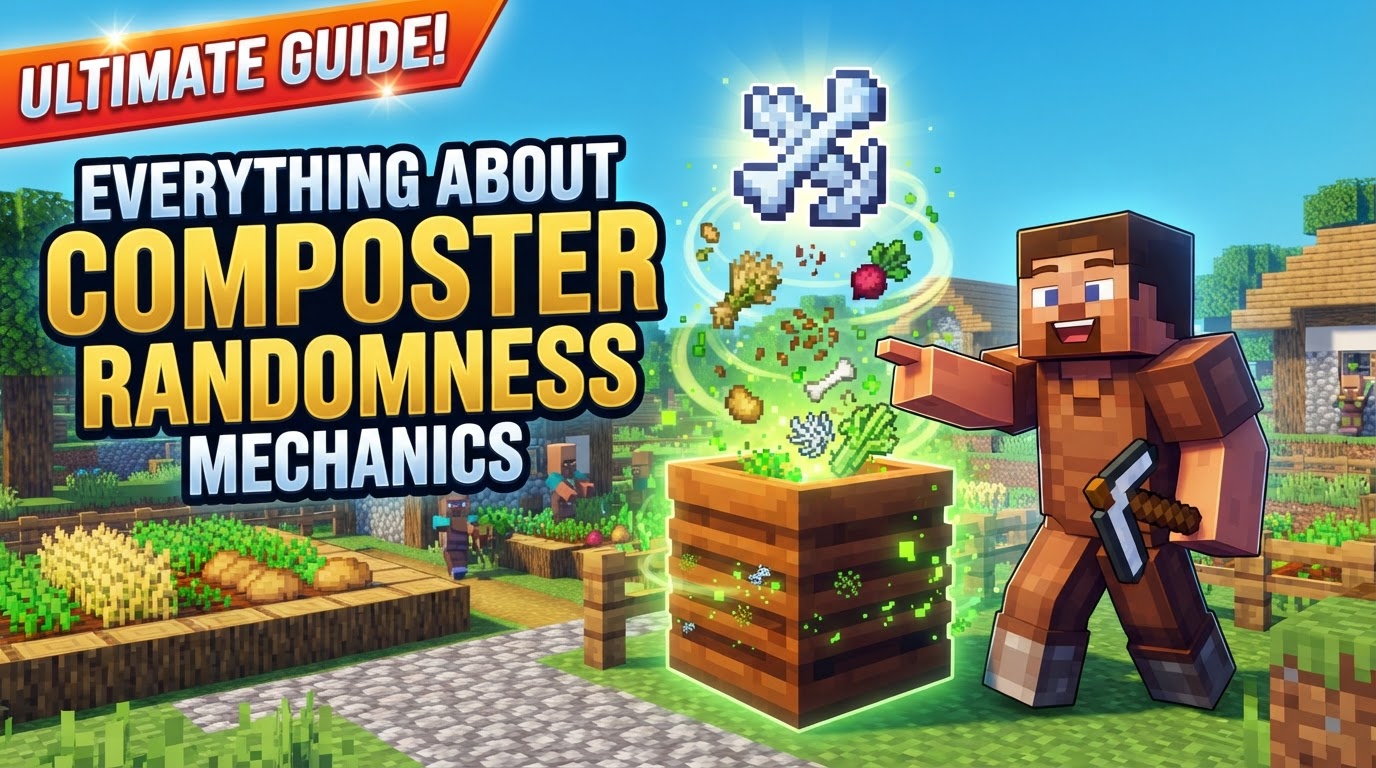
The Composter’s Core Purpose and Probabilistic Heart
At its core, the composter serves two primary functions: converting most plant-based and food items into bone meal, a crucial fertilizer for accelerating crop growth, and acting as a job site block for farmer villagers. However, the efficiency and speed of this conversion are entirely governed by its probabilistic internal system.
The composter operates on a system of seven internal layers of compost. When an item is successfully added, the compost level increases by one layer. Once the seventh layer is reached, the composter becomes full, and bone meal is ready for collection. This progression isn’t guaranteed with every item. Instead, each compostable item possesses a specific percentage chance of successfully increasing the compost level. This inherent randomness is what defines the composter’s behavior, making item selection and automation crucial considerations.
Guaranteed Success: Leveraging Certainty in a Random System
While randomness dictates much of the composter’s operation, there are specific instances of guaranteed success that savvy players can leverage:
- In Bedrock Edition, the very first item added to an entirely empty composter (going from level 0 to 1) always has a 100% chance of success. This provides a reliable initial boost.
- Certain high-value food items, such as cake and pumpkin pie, universally boast a 100% chance to increase the compost level in both Java and Bedrock Editions. These items are the most efficient for rapid bone meal production due to their absolute reliability.
These guaranteed increases stand out against the backdrop of varying probabilities for other items, offering predictable progress within an otherwise chance-based system.
Visualizing Progress and Automating Output
Monitoring the composter’s progress is both visual and technical. As its compost level increases, the composter’s appearance changes, visually indicating its fullness. This immediate feedback helps players track their bone meal production by simply observing the block.
Beyond visual cues, the composter is also a valuable component for Redstone automation. It can act as a power source for a Redstone comparator, emitting a signal strength that directly correlates with its fullness. An empty composter (level 0) emits a signal strength of 0, while a full composter ready to dispense bone meal (level 7) emits a signal strength of 8. This proportional signal allows for sophisticated automation, enabling systems to detect when bone meal is ready or when more items need to be fed into the composter.
The flow of items into and out of the composter is also critical for automation. Items can only be added to or removed from the top of the composter. This means that hoppers placed directly above can push compostable items into it. Once bone meal is produced, a hopper placed directly underneath the composter can automatically pull out the generated bone meal, resetting the composter to empty and ready for further processing.
The Composting Cycle: A Step-by-Step Guide
Engaging with the composter, whether manually or through automation, follows a clear sequence:
- Placement: Begin by placing the composter block in your chosen location. Its position can impact automation setups, especially concerning hopper access.
- Adding Items: To initiate the composting process, hold a compostable item in your hand and use it on the composter. If the item successfully increases the compost level based on its probability, green particles will emanate from the composter, providing a clear visual confirmation of success.
- Level Progression: Continue adding items. Each successful addition visibly progresses the composter through its seven layers. The changing texture of the block serves as a constant indicator of its current fullness.
- Bone Meal Production: Once the composter reaches its seventh and final layer, its appearance will clearly indicate that bone meal is ready. At this point, using an empty hand on the full composter will yield one bone meal item. Crucially, this action also resets the composter to an empty state (level 0), allowing the cycle to begin anew.
Maximizing Output: Strategic Composting Tips
To overcome the inherent randomness and achieve efficient bone meal production, strategic planning is essential:
- Prioritize High-Efficiency Items: Focus on items with the highest composting chances. Items like hay bales, baked potatoes, bread, cookies, flowering azalea, pumpkin pie, and cake offer significantly better returns on investment in terms of time and resources. Using these items fills the composter much faster, leading to quicker bone meal yields.
- Compost Abundant Low-Value Items: While less efficient per item, readily available items like seeds (with a 30% chance) can still be incredibly useful. In large quantities, especially when automated from extensive crop farms, these low-value items can provide a steady, albeit slower, stream of bone meal without requiring significant player intervention or valuable resources.
- Automate with Hoppers and Comparators: The true power of the composter is unlocked through automation. Set up hoppers to continuously feed compostable items into the top of the composter. Simultaneously, place a hopper underneath to automatically collect the produced bone meal. Integrating Redstone comparators allows you to detect the composter’s fullness, enabling advanced systems that can, for example, pause item input once full or trigger an alert for bone meal collection.
- Integrate into Farms: The most efficient composting systems are those integrated directly into existing crop farms. By feeding excess crops and seeds directly into composters, you create a self-sustaining cycle where farm byproducts are converted into fertilizer for the same farm, significantly boosting overall productivity and resource management.
- Consider Cactus Farms: Cactus, with a respectable 50% chance of increasing compost levels, is an excellent candidate for dedicated bone meal farms. Cactus farms are relatively easy to build and automate, providing a consistent and scalable source of compostable material that can be automatically harvested and fed into composters.
Avoiding Common Composter Pitfalls
Even with a clear understanding of its mechanics, players can fall into common traps that hinder efficiency:
- Using Low-Efficiency Items Exclusively: Relying solely on items with a low chance of increasing compost levels, especially for manual composting, will result in slow production and wasted effort. It’s crucial to balance resource availability with composting efficiency.
- Ignoring Automation: Manually adding items and collecting bone meal is tedious and inefficient for large-scale operations. Not utilizing hoppers and comparators means missing out on significant potential for hands-free, continuous bone meal production.
- Forgetting to Collect Bone Meal: A composter that is full and ready to dispense bone meal will not process any further items. Forgetting to collect the bone meal will halt production, leading to wasted compostable materials and a bottleneck in your farming system.
- Not Integrating into Farming Systems: Treating the composter as a standalone unit rather than an integral part of your crop production misses a prime opportunity for renewable fertilizer and efficient resource management.
- Trying to Compost Non-Compostable Items: Not all organic-looking items can be composted. Meat, fish, poisonous potatoes, dead bushes, and bamboo, for instance, cannot be processed. Attempting to compost these items is futile and wastes resources. Always check an item’s compostability.
By understanding the probabilistic nature of the composter, leveraging its automation capabilities, and avoiding common mistakes, players can transform this simple block into a powerful engine for sustainable resource generation in their Minecraft worlds.
Tags:
YOU MAY ALSO LIKE...