How to breed horses for better stats
Understanding Horse Breeding Mechanics
In the world of Minecraft, horses are invaluable companions, offering swift transportation and enhanced mobility. However, not all horses are created equal. Each horse possesses three hidden statistics: health, movement speed, and jump strength. These stats are permanently fixed at the moment a horse is born or spawned into the world and cannot be altered through training or items once set. Understanding these core mechanics is the first step toward breeding superior equine companions.
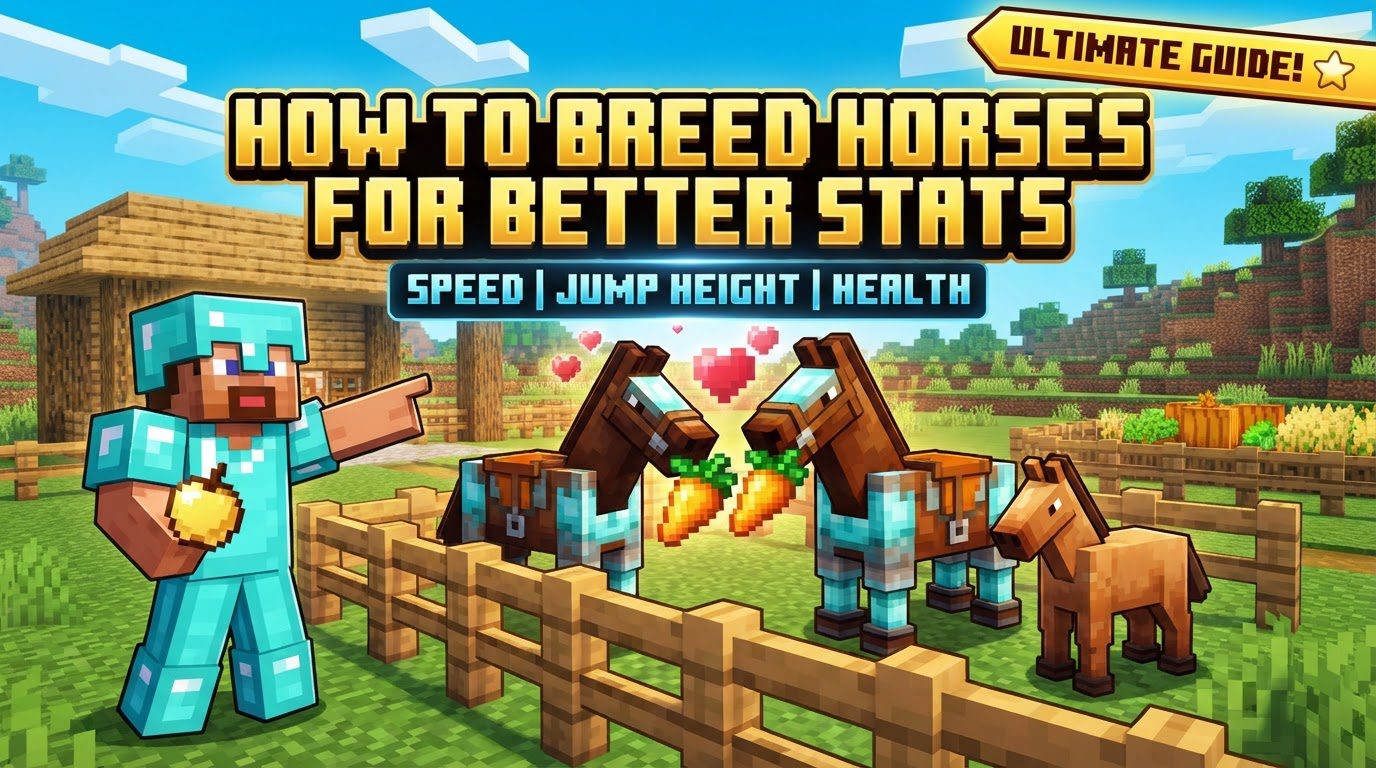
- Health: This stat ranges from a minimum of 15 hit points (HP) to a maximum of 30 HP. A higher health pool means your horse can withstand more damage from falls, hostile mobs, or environmental hazards.
- Movement Speed: Measured in blocks per second, a horse’s speed can vary significantly, from approximately 4.86 blocks per second for slower individuals up to an impressive 14.57 blocks per second for the fastest. Speed is crucial for efficient travel across vast distances in your Minecraft world.
- Jump Strength: This determines how high your horse can jump, expressed in blocks. The range is from a modest 0.4 blocks to a substantial 1.0 blocks. Greater jump strength allows you to clear obstacles more easily, navigate challenging terrain, and avoid falling into ravines or other dangers.
When two horses are bred, the resulting foal’s stats are not simply a direct copy of its parents. Instead, the foal’s stats are initially determined by taking the average of both parents’ corresponding stats. To this average, a random variation is then applied. This element of randomness is sometimes referred to as the influence of a “third invisible parent,” meaning that even with two high-stat parents, there’s always a chance for the foal’s stats to be slightly better or worse than the direct average.
It’s important to note a significant change in breeding mechanics in Minecraft versions post 1.19. In these newer versions, the breeding process is no longer inherently biased towards the average. This means that with persistent effort and selective breeding, it is theoretically possible to breed a “perfect” horse with maximum stats in all three categories, given enough generations and a bit of luck with the random variations. This change makes dedicated breeding programs more rewarding and effective than ever before.
Step-by-Step Guide to Breeding Horses
Breeding horses for improved stats involves a systematic approach, starting from taming wild horses and culminating in raising their offspring.
- 1. Tame Two Horses: Your breeding journey begins by finding at least two wild horses. These majestic creatures are commonly found roaming in the Plains and Savanna biomes. To tame a wild horse, you must repeatedly attempt to ride it. Each time you mount the horse, there’s a chance it will buck you off. Continue mounting it until hearts appear above its head, signifying that it has been successfully tamed. Taming is a prerequisite, as untamed horses cannot enter “Love Mode” and thus cannot breed.
-
2. Obtain Breeding Food: Once you have two tamed horses, you’ll need special food to encourage them to breed. The only items that work are Golden Apples or Golden Carrots.
- Golden Apples: Crafted using 1 apple surrounded by 8 gold ingots. Gold ingots are relatively rare.
- Golden Carrots: Crafted using 1 carrot surrounded by 8 gold nuggets. Gold nuggets are more common and easier to acquire, making Golden Carrots generally a more cost-effective choice for large-scale breeding operations.
You will need one of these items for each horse you intend to breed.
- 3. Prepare for Breeding: Before initiating the breeding process, ensure both of your tamed horses are healthy and in close proximity to each other. It is highly recommended to confine them within an enclosed area, such as a pen or stable. This prevents them from wandering off and ensures they remain close enough to interact and produce a foal once in “Love Mode.”
- 4. Initiate Love Mode: With your horses prepared and your breeding food in hand, feed one Golden Apple or Golden Carrot to each horse. Upon consumption, hearts will appear above their heads, indicating that they have successfully entered “Love Mode.” This is the signal that they are ready to breed.
- 5. Produce Foal: Once both parents are in “Love Mode” and are close enough to each other, they will engage in the breeding animation. Shortly after, a baby horse, known as a foal, will spontaneously appear beside them. This foal will inherit its stats based on the mechanics described earlier.
-
6. Raise Foal: A newly born foal takes approximately 20 minutes of real-world time to grow into an adult horse. This maturation period can be significantly accelerated by feeding the foal various items.
- Acceleration Foods: Sugar, wheat, apples, or hay bales can all be fed to a foal to speed up its growth. Each item reduces the remaining growth time by a certain amount.
- Most Efficient Growth Food: Among the options, Golden Carrots are the most efficient food item for reducing a foal’s growth time, allowing you to quickly mature your offspring and evaluate their stats for the next generation of breeding.
Important Tips for Optimal Horse Breeding
To truly excel at breeding high-stat horses, consider these strategic tips:
- Prioritize Desired Stats: While all three stats are important, for general gameplay and utility, it is often most beneficial to focus on movement speed and jump strength. These two stats typically have a more immediate and noticeable impact on your travel efficiency and ability to navigate terrain than a slightly higher health pool. A fast, high-jumping horse can easily outmaneuver threats and cross difficult landscapes.
- Start with a Large Pool: When beginning your breeding program, don’t settle for just two horses. Tame a significant number of wild horses, for example, ten or more. This increases your chances of finding individuals with naturally high base stats among your initial stock. A larger starting pool provides a better foundation for selective breeding, as you can pick the best two to begin with.
-
Evaluate Parent Stats: Before committing to breeding, it is crucial to assess the precise stats of your potential parent horses. In the Java Edition of Minecraft, you can use a specific command to reveal these hidden values. While looking directly at a horse, open the chat and enter:
/data get entity @e[type=horse,limit=1,sort=nearest]. This command will output detailed information about the horse, including its health, movement speed (as a generic.movement_speed attribute), and jump strength (as a generic.jump_strength attribute). Use this information to select your top contenders. - Optimal Generational Breeding Strategy: Implement a systematic generational breeding program. Begin by breeding your two horses with the best overall stats. Once the foal matures, evaluate its stats. If the foal possesses better stats than one of its parents (specifically, the weaker of the two original parents), replace that weaker parent with the new, improved foal for the next round of breeding. This continuous cycle of selective breeding and replacement will, over time, lead to an increasingly strong lineage of horses.
- Speed Up Foal Growth: As mentioned, Golden Carrots are the most efficient food item for reducing a foal’s growth time. Stocking up on these can significantly accelerate your breeding program, allowing you to evaluate new generations more quickly.
- Potion Breeding (Bedrock Specific Trick): For players on Bedrock Edition, there’s a unique trick that can potentially enhance your breeding efforts. Applying speed or jump boost potions to the parent horses before they breed can sometimes result in the foals inheriting enhanced attributes in those specific categories. This method can help in creating faster and higher-jumping horses over successive generations, providing an additional layer of optimization for Bedrock players.
Common Mistakes to Avoid
Even experienced players can make mistakes when breeding horses. Being aware of these pitfalls can save you time and resources.
- Untamed Horses: A frequent oversight is attempting to breed untamed horses. Remember, only horses that have been successfully tamed (indicated by hearts appearing above their heads when ridden) will respond to breeding food and enter “Love Mode.” Wild horses will simply eat the food without initiating breeding.
- Incorrect Food: It’s easy to confuse breeding food with other horse-related items. Only Golden Apples or Golden Carrots will trigger “Love Mode” in horses. Regular carrots, apples, wheat, or other food items, while useful for feeding or taming, will not cause horses to breed. Ensure you have the correct golden-tier food.
- Impatience: Breeding a horse with truly elite stats is rarely a quick process. It often requires multiple generations of selective breeding, careful evaluation, and a degree of luck with the random statistical variations. Impatience can lead to abandoning a breeding program too early or making hasty decisions that hinder progress. Persistence is key.
- Ignoring Stats: Breeding horses without first assessing their individual stats is akin to gambling. While you might get lucky, it will primarily lead to random outcomes rather than a targeted improvement in your horse’s abilities. Always use the available methods (like the Java Edition command) to evaluate parent stats and make informed breeding choices to ensure consistent progress towards your goals.
Tags:
YOU MAY ALSO LIKE...