Calculating Nether Portal Coordinate Alignment (Step by Step)
Understanding Nether Portal Mechanics
Mastering Nether portal alignment is a fundamental skill for efficient travel and base management in Minecraft. The core principle revolves around a unique coordinate scaling system between the Overworld and the Nether, coupled with specific portal search behaviors. Understanding these mechanics is crucial for creating reliable, two-way portal links.
Coordinate Scaling and Y-Axis Behavior
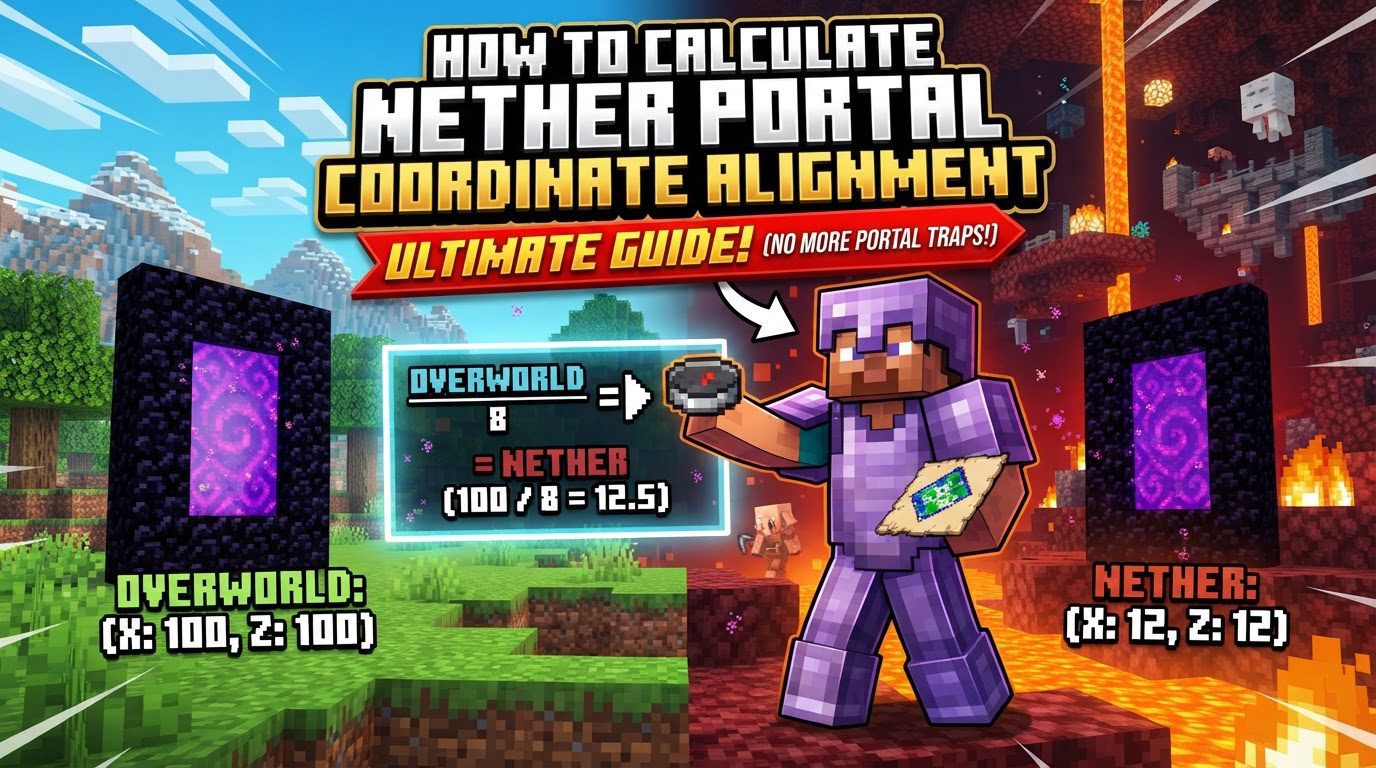
- Coordinate Ratio: The most critical piece of information is the scaling factor for horizontal movement. For every one block traveled in the Nether, you effectively traverse eight blocks in the Overworld. This 1:8 ratio applies specifically to the X and Z coordinates, which govern your position on the horizontal plane. This significant difference is what makes Nether travel so efficient for covering long distances in the Overworld.
- Y-Coordinate (Height): Unlike the horizontal coordinates, the Y-coordinate, which dictates your vertical position or height, does not scale between dimensions. When calculating portal links, the Y-coordinate remains the same. While it doesn’t scale, its importance should not be overlooked, as it plays a role in avoiding hazards and ensuring portals link to desired locations, particularly when considering vertical proximity to other portals or safe terrain.
Portal Search and Generation
When a player enters a Nether portal, the game doesn’t instantly teleport them to a predefined location. Instead, it calculates an “ideal” destination point in the other dimension based on the portal’s coordinates and the scaling ratio. Following this, it initiates a search for existing portals around this ideal point.
- Overworld to Nether Search: When traveling from the Overworld into the Nether, the game searches for existing portals within a 3×3 chunk area around the calculated ideal Nether coordinates. This translates to a 48×48 block radius in the Nether.
- Nether to Overworld Search: Traveling from the Nether back to the Overworld involves a much larger search radius. The game looks for portals within a 17×17 chunk area around the ideal Overworld coordinates. This expansive search covers a 272×272 block area. It’s important to note a specific distinction for Bedrock Edition: the search range in both dimensions is a fixed 128 blocks from the ideal point. When converting this back to Overworld terms from a Nether portal, this means a potential search across 1024 Overworld blocks. This larger search area in Bedrock can make precise linking more challenging if not carefully managed.
- Nearest Portal Priority: Should the game find multiple existing portals within its designated search radius, it will always send the player to the closest one. This “closest” determination is based on a straight-line distance calculation from the ideal destination point. This mechanism is why proper alignment is crucial; even a slightly off-center portal can become the “closest” and lead to an unintended link.
- New Portal Generation: If, after its search, the game fails to find any existing portals within the specified radius, it will automatically generate a new portal. This new portal is created at the nearest suitable location to the ideal coordinates, typically avoiding hazards like lava or open air. While convenient for initial exploration, auto-generated portals are often not ideally placed and can lead to mislinking if not managed.
Step-by-Step Guide to Portal Alignment
Achieving a perfect one-to-one link between your Overworld and Nether portals requires a systematic approach. Follow these steps to ensure reliable travel.
- 1. Build Your Overworld Portal: Begin by constructing your first Nether portal in your desired Overworld location. This will typically be near your base or a significant landmark you wish to connect.
- 2. Record Overworld Coordinates: Before lighting the portal, stand inside its frame. Open your debug screen (F3 on Java Edition) or ensure “Show Coordinates” is enabled (Bedrock Edition) and carefully note down the X, Y, and Z coordinates of your position. While X and Z are paramount for the scaling calculation, recording the Y-coordinate is also important. It serves as a reference for the Nether portal’s height, helping you avoid dangerous areas and maintain vertical consistency.
-
3. Calculate Ideal Nether Coordinates: This is the core of the alignment process. Take the Overworld X and Z coordinates you recorded and divide each by 8. The Y-coordinate, as established, remains unchanged.
-
Example: If your Overworld portal is located at X=800, Y=64, Z=400, your ideal Nether coordinates would be calculated as:
- X: 800 / 8 = 100
- Y: 64 (remains the same)
- Z: 400 / 8 = 50
Thus, your target Nether location is approximately (100, Y, 50).
-
Example: If your Overworld portal is located at X=800, Y=64, Z=400, your ideal Nether coordinates would be calculated as:
- 4. Travel to the Nether: Light your Overworld portal and step through it. The game will either create a new portal for you in the Nether or send you to the closest existing one if it’s within the search radius.
- 5. Navigate to Calculated Nether Coordinates: Once in the Nether, use your recorded coordinates to navigate to your calculated ideal X and Z location. You can use your debug screen or map to guide you.
- 6. Build Your Nether Portal: At (or as close as possible to) your calculated X, Y, Z coordinates, construct a new Nether portal. It’s often recommended to place this portal at a Y-level that matches your Overworld portal’s height, if the terrain allows and it’s a safe location. If the exact Y-level is unsafe (e.g., in a lava lake or high in the air), choose a nearby safe Y-level, keeping in mind the Y-coordinate’s role in vertical proximity to other portals.
- 7. Test the Link: Step through your newly constructed Nether portal to return to the Overworld. If all calculations and placements were done correctly, you should arrive precisely back at your original Overworld portal, establishing a perfect two-way link.
Important Tips for Seamless Portal Travel
Beyond the basic steps, several best practices can enhance your portal network and prevent common issues.
- Manual Placement is Key: Always prioritize building both portals manually at their calculated coordinates. Relying on auto-generated portals often leads to imprecise placement and can complicate linking.
- Precision in Coordinates: Strive for the most precise X and Z coordinate alignment possible. When dealing with decimal results from division, it’s generally recommended to round down to the nearest whole block coordinate for placement.
- Mind the Y-Level: Although the Y-coordinate doesn’t scale, aligning the Y-level of your portals as closely as possible can significantly help. It reduces the chance of mislinking to other portals that might be vertically closer to the ideal destination, and it helps ensure your portal generates in a safe and accessible area.
- Destroy Auto-Generated Portals: If the game generates an unwanted portal when you first enter a dimension, break it immediately. Leaving these unlinked or improperly linked portals can cause confusion and misdirection in your network.
- Utilize Nether Hubs: Leverage the 1:8 travel ratio by creating central Nether hubs. By building a main portal in the Nether and then branching off with other portals at calculated coordinates, you can easily access multiple distant Overworld locations, drastically cutting down travel time.
- Overworld Portals First: To ensure a precise one-to-one link, always build your Overworld portal first. Then, use its coordinates to manually construct the corresponding Nether portal at the exact calculated location. This method offers the most reliable way to establish specific connections.
Common Mistakes to Avoid
Even experienced players can fall prey to common errors. Being aware of these pitfalls can save you time and frustration.
- Not Calculating Coordinates: The most frequent mistake is simply building a second portal in the other dimension without performing the coordinate calculations. This almost invariably leads to mislinked portals, new unwanted portals appearing, or players being sent to unexpected locations.
- Ignoring Y-Axis for Placement: While the Y-axis doesn’t scale, neglecting its importance in placement can cause problems. Building portals at vastly different Y-levels can result in mislinks if another portal happens to be vertically closer to the ideal destination, or it can lead to new portals generating in highly unsafe areas like lava oceans or high up in the air.
- Portals Too Close to Each Other: Having multiple portals in either the Overworld or the Nether that are too close to one another is a recipe for mislinking. The game’s search radius will often encompass several portals, and it will always pick the closest one to the ideal destination, which might not be the one you intended. Maintain adequate separation between your portal pairs.
- Bedrock Edition Search Range Misconceptions: Players on Bedrock Edition must be especially mindful of the significantly larger portal search range. The 128-block radius in both dimensions means a Nether portal can link to an Overworld portal up to 1024 Overworld blocks away. This increased range makes precise alignment even more critical to prevent unintended connections to distant or unrelated portals.
- Rounding Errors: Incorrect rounding of coordinates is a subtle but impactful mistake. For instance, rounding up when you should round down, or mismanaging decimal places, can lead to slight misalignments. These small errors can be enough for the game to consider another nearby portal as the “closest” or to generate a new portal slightly off your intended mark. Always aim for precise integer coordinates by rounding down when placing blocks.
Tags:
YOU MAY ALSO LIKE...