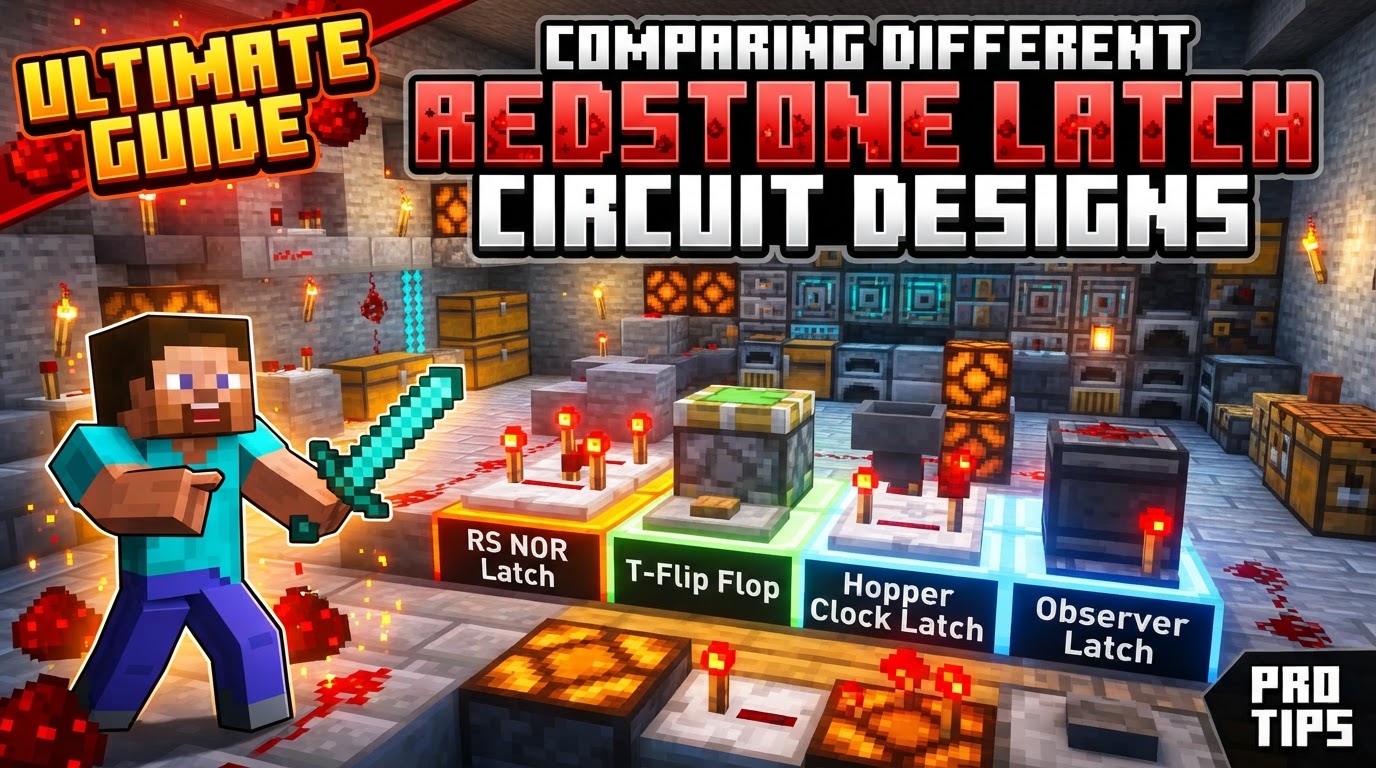
Comparing Different Redstone Latch Circuit Designs
The most common oversight in complex Redstone contraptions isn’t a lack of power, but a misunderstanding of how to store a state. In the intricate world of Minecraft Redstone, the ability to remember whether something is ON or OFF is paramount. This fundamental concept is managed by Redstone latches, often referred to as flip-flops. These ingenious circuits are the very bedrock of memory within your blocky contraptions, transforming fleeting button presses into sustained actions and enabling sophisticated automation. They are designed to hold a binary state – either ON or OFF – and maintain it indefinitely until explicitly instructed to change, making them indispensable for everything from simple door mechanisms to advanced computing.
The Dual-Control Memory: RS NOR Latch
The RS NOR latch is arguably one of the most foundational memory elements in Redstone engineering, providing distinct control over setting and resetting its output. It functions much like having two separate buttons: one to turn something ON and another to turn it OFF.
- Key Mechanics: An RS NOR latch features two primary inputs, Set (S) and Reset (R), and typically provides two complementary outputs, Q and not-Q. This means if Q is ON, not-Q is OFF, and vice-versa – they are never simultaneously ON or OFF. A momentary pulse applied to the Set input will switch the Q output to ON, and it will remain ON even after the input signal vanishes. Conversely, a pulse to the Reset input will turn the Q output OFF, and it will stay OFF. This inherent memory function makes it ideal for situations requiring persistent states controlled by separate activation and deactivation triggers.
- Conceptual Construction: At its core, an RS NOR latch is built from two NOR gates. The output of the first NOR gate feeds into an input of the second, and the output of the second feeds back into an input of the first. This creates a self-sustaining feedback loop. One remaining input on each NOR gate is then designated as the Set and Reset input respectively. In Minecraft, NOR gates can be constructed using Redstone torches and blocks.
- Practical Applications and Tips: This latch excels in scenarios where you need dedicated controls for activating and deactivating a mechanism. Think of a door that opens with one button and closes with another, or a game mechanic that needs to be toggled ON and OFF by different events. RS NOR latches can be constructed in remarkably compact forms, including ultra-efficient one-wide designs, making them versatile for integration into tight spaces.
- Common Pitfalls: The most critical error with an RS NOR latch is activating both the Set and Reset inputs simultaneously. While some Minecraft implementations might resolve this by prioritizing one input over the other, it generally leads to an undefined or unstable state, where the output might flicker or become unpredictable. Always ensure your design prevents simultaneous activation to maintain reliable operation.
Single-Button Simplicity: The T Flip-Flop
For operations where a single input needs to toggle a state, the T (Toggle) Flip-Flop is the circuit of choice. It transforms a momentary button press into a persistent ON or OFF state, acting as a convenient single-button switch.
- Key Mechanics: A T Flip-Flop operates with a single input, typically labelled T. Each time this input receives a pulse, the output state flips: if it was ON, it turns OFF; if it was OFF, it turns ON. This makes it perfect for controlling lights, doors, or any device that needs to be switched with one uniform action. Many common designs leverage the unique latching behavior of Redstone repeaters, which can temporarily hold a state.
- Conceptual Construction: One popular and easy-to-understand T Flip-Flop design involves two Redstone repeaters. These repeaters are often set to their maximum delay, creating a short timing window. When an input pulse arrives, this timing allows the circuit to briefly unlock, change its internal state, and then re-latch into the new state. Beyond repeater-based designs, more advanced versions can utilize pistons moving Redstone blocks, droppers and hoppers interacting, observer blocks detecting changes, or even Redstone comparators for more compact or specific behaviors.
- Practical Applications and Tips: T Flip-Flops are indispensable for user-friendly interfaces, such as a single button controlling a basement light or a hidden entrance. It’s crucial to understand that many T Flip-Flop designs are sensitive to the length of the input pulse. A longer pulse, like that from a wooden button, might require additional repeaters within the circuit to extend the internal timing delay, ensuring the circuit has enough time to fully toggle. For large-scale builds, piston-less designs are often preferred as they generate less lag, contributing to smoother game performance.
- Common Pitfalls: Incorrect repeater settings, particularly their delay, are a frequent source of failure. If the delay is too short or too long for the specific design, the circuit may fail to latch correctly or might not toggle at all. Similarly, an input pulse that is either too brief or too extended for the circuit’s design can cause misfires or prevent the desired state change. Careful calibration of repeater delays and understanding input pulse characteristics are vital.
Data Storage and Timing: D Latches and D Flip-Flops
When it comes to storing specific pieces of information or synchronizing data within a larger system, D (Data) Latches and D Flip-Flops are the advanced memory components of choice. They are fundamental for sequential logic and more complex digital systems in Minecraft.
- Key Mechanics: Both D latches and D flip-flops feature two primary inputs: a Data line (D) and a Clock input (C). Their core function is to capture the state of the Data input and store it as their output (Q) when triggered by the Clock. The distinction lies in how they are triggered:
- A Gated D Latch is level-triggered. Its output (Q) actively mirrors the state of the Data input (D) for as long as the Clock input is in its active state (e.g., ON). When the Clock input changes to its inactive state (e.g., OFF), the latch “closes” and holds the last state of the Data input it saw.
- A D Flip-Flop is edge-triggered. It only samples the Data input and updates its output at a specific transition of the Clock input – either when the clock goes from OFF to ON (a rising edge) or from ON to OFF (a falling edge). This precise timing prevents data corruption and ensures synchronized data flow.
- Conceptual Construction: Simple D latches can be constructed using the latching feature of Redstone repeaters, where one repeater holds the data and another acts as the gate. To create a D flip-flop, which requires edge-triggering, builders often combine two gated D latches in a master-slave configuration. One latch might be high-triggered (active when clock is ON) and the other low-triggered (active when clock is OFF), working in sequence to capture the data only at the moment of the clock edge.
- Practical Applications and Tips: D latches and flip-flops are absolutely crucial for building sequential logic circuits, which are systems where the output depends not only on the current inputs but also on the sequence of past inputs. They are the building blocks for counters, registers, and more complex memory arrays found in advanced Redstone computers. They excel at storing a single bit of information at precisely the right moment, dictated by a clock pulse, making them essential for synchronized data processing.
- Common Pitfalls: A common mistake is confusing the behavior of a level-triggered D latch with an edge-triggered D flip-flop. Using a latch where a flip-flop is needed can lead to unintended data changes if the data input changes while the clock is active. Conversely, using a flip-flop where a latch would suffice might overcomplicate a simpler design. Incorrect configurations of comparators or repeaters, especially when trying to achieve specific clocking behaviors or data storage, can prevent these circuits from functioning as intended.
Choosing the Right Latch for Your Contraption
Understanding the nuances of RS NOR latches, T Flip-Flops, and D Latches/Flip-Flops empowers you to build more sophisticated and reliable Redstone contraptions. The RS NOR is your go-to for separate ON/OFF controls, the T Flip-Flop simplifies single-button toggles, and D-type latches provide precise data storage and synchronization for complex digital systems. By mastering these fundamental memory circuits, you unlock a new realm of possibilities in your Minecraft engineering endeavors, transforming simple mechanisms into intelligent, state-aware machines.
Tags:
YOU MAY ALSO LIKE...