How to Build Bases Invisible to Administration
A common misconception among Minecraft players is the belief that one can construct a base truly invisible to server administration. The reality, however, is far more complex and often disappointing for those hoping to operate entirely off the grid. It is generally not possible to build a base in Minecraft that is genuinely “invisible” to server administrators through legitimate gameplay mechanics. Server administrators are equipped with a vast array of sophisticated tools and plugins designed specifically to monitor player activity and server data, ensuring fair play and server integrity. Any attempt to circumvent these tools through exploits or unauthorized third-party software typically results in severe penalties, including permanent bans from the server.
The Inescapable Gaze of Administration
The notion of an admin-invisible base often stems from a misunderstanding of the extensive capabilities available to server operators. Unlike hiding from other players, which is entirely achievable, hiding from an administrator’s monitoring systems is fundamentally different. These systems operate at a server level, recording actions and data regardless of in-game visibility or location.
Comprehensive Server Logging and Monitoring
Server administrators employ powerful plugins and server-side tools that track nearly every facet of player interaction. These are not merely for curiosity but are essential for maintaining a stable, fair, and secure environment. Some of the most prevalent tools include:
- PlayerActivityLogger, Player Logger, Activity Logger: These plugins are designed to record a wide range of player actions. This includes every block placed, every block broken, every chat message sent, every command executed, and every item interaction. Crucially, they also log precise player locations (coordinates) at various intervals or when specific actions occur.
- CoreProtect: A highly popular and robust logging plugin, CoreProtect allows administrators to query historical data with extreme precision. It provides detailed records of block changes, player interactions, and even item movements, often through user-friendly web interfaces or in-game commands. An administrator can, for instance, instantly see who placed a specific block, when it was placed, and where.
- Server Panels and Activity Logs: Beyond specific plugins, most server hosting panels offer their own suite of activity logs. These logs track modifications to server settings, file access, and player management actions. They help administrators identify unusual activity, potential security risks, or unauthorized changes to the server environment itself.
- Real-time Statistics and Historical Data: Advanced monitoring tools track real-time player statistics, historical online data, and critical server performance metrics like CPU and memory usage. While not directly revealing base locations, these tools can flag suspicious patterns of activity that might lead an admin to investigate a player more closely.
These systems create an undeniable digital footprint for every player. From the moment a block is placed, its existence and the identity of its placer are recorded. No amount of in-game camouflage or remote building can erase these server-side logs.
Anti-Griefing and Anti-Cheat Mechanisms
Beyond general logging, administrators also utilize plugins specifically designed to prevent malicious behavior and ensure fair gameplay. These tools, while often player-facing, still grant administrators oversight:
- GriefPrevention: While plugins like GriefPrevention allow players to claim land to protect their builds from other players, administrators retain full visibility and control over these claimed areas. They can see the boundaries of claims, the players who own them, and the structures within them. These systems do not hide a base from staff; they merely protect it from unauthorized player modification.
- Anti-Cheat Plugins (e.g., Vulcan, Matrix): These sophisticated plugins are engineered to detect various forms of illicit client-side modifications or “hacks.” This includes flight, speed hacks, reach modifications, and inventory manipulation. They are constantly scanning player behavior for anomalies. If a player is using hacks to reach a remote base, the anti-cheat system will likely detect it, alerting staff and potentially revealing the player’s location and intentions.
Direct Administrative Powers
In addition to automated systems, administrators possess direct, in-game capabilities that bypass all player-level concealment:
- Teleportation: Administrators can instantly teleport to any player’s location, regardless of how remote or hidden it is. They can also teleport to specific coordinates, allowing them to investigate any part of the map with ease.
- Inventory Inspection: Admins can view a player’s inventory, including any hidden stashes or items.
- Spectator Mode and Noclip: Many server platforms allow administrators to enter a spectator mode, enabling them to fly through blocks and observe the world without being seen. This means they can instantly “noclip” through mountains, ground, or ocean floors to find any hidden structure.
- In-Game Invisibility: While players can use invisibility potions, this effect only makes them visually undetectable by some entities and other players. It does not prevent server-side logging of their movements, interactions, or coordinates. Furthermore, other players can sometimes detect invisible entities through debug screens (F3+B) or client-side modifications, let alone administrators with their specialized tools.
Debunking Common Misconceptions
Several tactics commonly believed to grant invisibility from administrators are, in practice, entirely ineffective:
- Hiding in Obscure Locations: Building a base deep underground, far from spawn, or in a difficult-to-reach area might deter other players, but it offers no challenge to an administrator. Their monitoring tools record the construction and presence, and their teleportation abilities nullify any geographical advantage.
- Using Invisibility Potions: As mentioned, in-game invisibility is a visual effect. It does not stop server logs from recording your every move, block interaction, or command. An admin can still see your logged coordinates and actions, even if your in-game avatar is transparent.
- Assuming Obscurity Equals Undetectability: This is perhaps the most significant misconception. No matter how cleverly a base is hidden from the casual observer or even a determined player, the server’s backend systems will have a record of its construction, the player’s presence there, and all associated activities.
The True Goal: Making Bases Harder for *Other Players* to Find
While true invisibility from administration is a myth, the techniques often considered for that purpose are highly effective if your goal is to make a base difficult for *other players* to discover. If your primary concern is player-to-player concealment, these legitimate strategies can significantly enhance your base’s security:
Strategic Location Choices
- Remote Locations: Constructing your base incredibly far from spawn points, popular landmarks, or common player paths drastically reduces the chance of accidental discovery by other players. The sheer time investment required to travel to such areas acts as a natural deterrent.
- Underground or Underwater Bases: Building deep beneath the surface or at the bottom of the ocean makes a base much less visible to casual exploration. Players typically explore at surface level or in easily accessible caves.
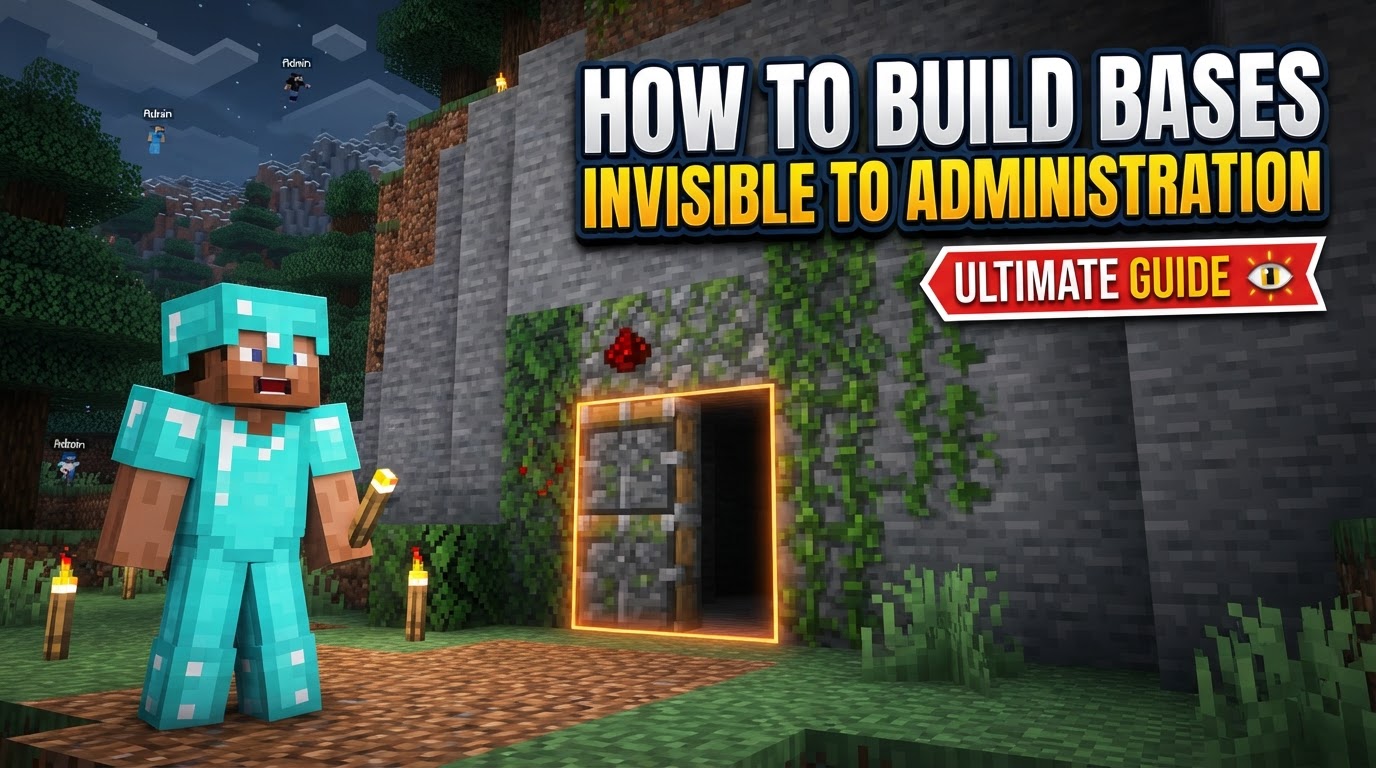
- Building into Natural Terrain: Integrating your base directly into a mountain, a large cave system, or a cliff face, using blocks that seamlessly blend with the natural surroundings, can make it incredibly difficult for passersby to spot.
Camouflage and Concealment
- Matching Blocks: Use blocks that perfectly match the surrounding environment. If building in a desert, use sandstone; in a forest, use dirt and stone. The goal is to make your base appear as a natural part of the landscape.
- Disguised Structures: Make your base entrance or even the entire base appear as something innocuous. This could be a small, unassuming hut, a natural block formation, or even part of a larger, seemingly abandoned structure that draws no suspicion.
Redstone Secrecy
- Hidden Entrances: Redstone mechanisms are invaluable for creating secret entrances. Piston doors that blend into walls, hidden pathways activated by specific block placements or levers, or even complex systems that require specific item inputs can create highly secure and visually undetectable entry points.
- Lava or Water Pathways: Entrances that require navigating through a pool of lava (with fire resistance) or a deep body of water can deter most players who aren’t specifically looking for a secret passage.
In conclusion, while the dream of a truly invisible base from server administration remains firmly in the realm of fantasy, the techniques players use to hide from each other are both practical and effective. Understanding the comprehensive monitoring capabilities of administrators is crucial for any player. Attempting to bypass these systems is not only futile but also risks severe repercussions. Instead, focus your efforts on clever architectural design and strategic placement to outwit fellow players, always operating within the established rules of the server.
Tags:
YOU MAY ALSO LIKE...