Identifying a Nether Fortress From a Distance (Step by Step)
Navigating the perilous depths of the Nether in Minecraft often leads players on a crucial quest: the search for a Nether Fortress. These formidable structures are not just challenging to explore but are vital for progression, offering unique resources and encounters necessary for advancing in the game. Identifying a Nether Fortress from a distance requires a keen understanding of its generation mechanics and a strategic approach to exploration. This comprehensive guide will equip you with the knowledge to efficiently locate these elusive strongholds.
Understanding Nether Fortress Generation Mechanics
To effectively spot a Nether Fortress, it’s essential to first grasp how these structures are generated within the game world. This knowledge forms the bedrock of any successful search.
- Structure and Composition: Nether Fortresses are distinctive for their large scale, constructed primarily from dark nether bricks. They are characterized by a complex network of bridges, enclosed corridors, and towering sections, creating a unique and easily recognizable silhouette against the Nether’s landscape.
- Generation Location: These structures are not confined to a single biome; they possess the ability to generate in all Nether biomes. Furthermore, their vertical placement is highly variable, as they can appear at any Y-level. While they can span across vast vertical distances, it’s not uncommon for portions of a fortress to be partially or even fully buried within Netherrack, making them harder to spot from certain vantage points.
- Regional Spawning Rules: The Nether world is internally divided into specific regions for structure generation. In Java Edition, these regions measure 432×432 blocks, while in Bedrock Edition, they are slightly larger at 480×480 blocks. Within each of these defined regions, the game is programmed to spawn either a Nether Fortress or a Bastion Remnant, but never both. This means that if you discover one type of structure, you know not to expect the other within that same region.
- Fortress Generation Chances: The likelihood of a fortress generating within a region varies between game editions. In Java Edition, there is a 2/5 (or 40%) chance for a fortress to spawn over a bastion. Bedrock Edition presents a slightly lower probability, with a 1/3 (approximately 33.3%) chance.
- Significance for Progression: Beyond their architectural presence, Nether Fortresses are critical for game progression. They are the primary source of blaze spawners, which yield Blaze Rods necessary for crafting Eyes of Ender and brewing. They also host Wither Skeletons, whose skulls are required to summon the Wither boss, and contain Nether Wart, an indispensable ingredient for potion brewing.
Step-by-Step Process for Identification
A systematic approach significantly increases your chances of spotting a Nether Fortress from a distance.
Maximize Visibility
- Monitor and In-Game Brightness: Begin by optimizing your visual settings. Maximize your physical monitor’s brightness. Within Minecraft, navigate to your video settings and increase the in-game brightness to its highest possible setting, often labeled “Bright” or “Moody”. This will help distinguish dark structures against the often dim and varied lighting of the Nether.
- Increase Render Distance: This is perhaps the most critical setting. Set your render distance to its highest possible value that your system can comfortably handle. A greater render distance allows the game to load and display chunks further away, making it possible to see distant structures that would otherwise remain hidden.
Strategic Travel
- Travel Along an Axis: Instead of aimlessly wandering, choose a specific cardinal direction. Travel consistently along either the X or Z axis (e.g., continually moving in the positive X, negative X, positive Z, or negative Z direction). Fortresses have a tendency to generate in “strips” or elongated patterns along one of these axes, making linear travel more efficient than circular exploration.
- Maintain Altitude: While fortresses can generate at any Y-level, it’s advisable to maintain a consistent intermediate altitude. Avoid flying too high near the ceiling of the Nether or descending too low towards the lava level. Although the main structure might be at a higher elevation, its “support” pillars often extend downwards to the lava level. Traveling at a middle height increases the likelihood of spotting either the main body of the fortress or its supporting foundations.
Utilize External Tools (Optional)
- Online Fortress Finder: For players seeking a guaranteed location without extensive in-game searching, online tools like Chunkbase’s Nether Fortress finder are invaluable. By inputting your world’s seed and your current coordinates, these tools can precisely map out the locations of fortresses in your world.
Using the F3 Debug Screen (Java Edition)
- Coordinates and Direction: Pressing F3 in Java Edition brings up the debug screen, which displays your current coordinates (X, Y, Z) and the direction you are facing. This is crucial for maintaining your axial travel path and for noting down locations.
- Identifying Spawners via Pie Chart: The F3 debug screen also offers an advanced feature for potential fortress detection. By pressing Shift + F3, you can access the in-game pie chart. Navigate through the options (typically `tick.level.blockEntities` or `tick.blockEntities` depending on your game version) to look for entries related to spawners. An active spawner in the vicinity, especially a blaze spawner, is a strong indicator of a nearby fortress, even if the structure itself isn’t immediately visible.
Important Tips for Exploration
Beyond the technical steps, several practical tips can aid your search and ensure your survival in the Nether.
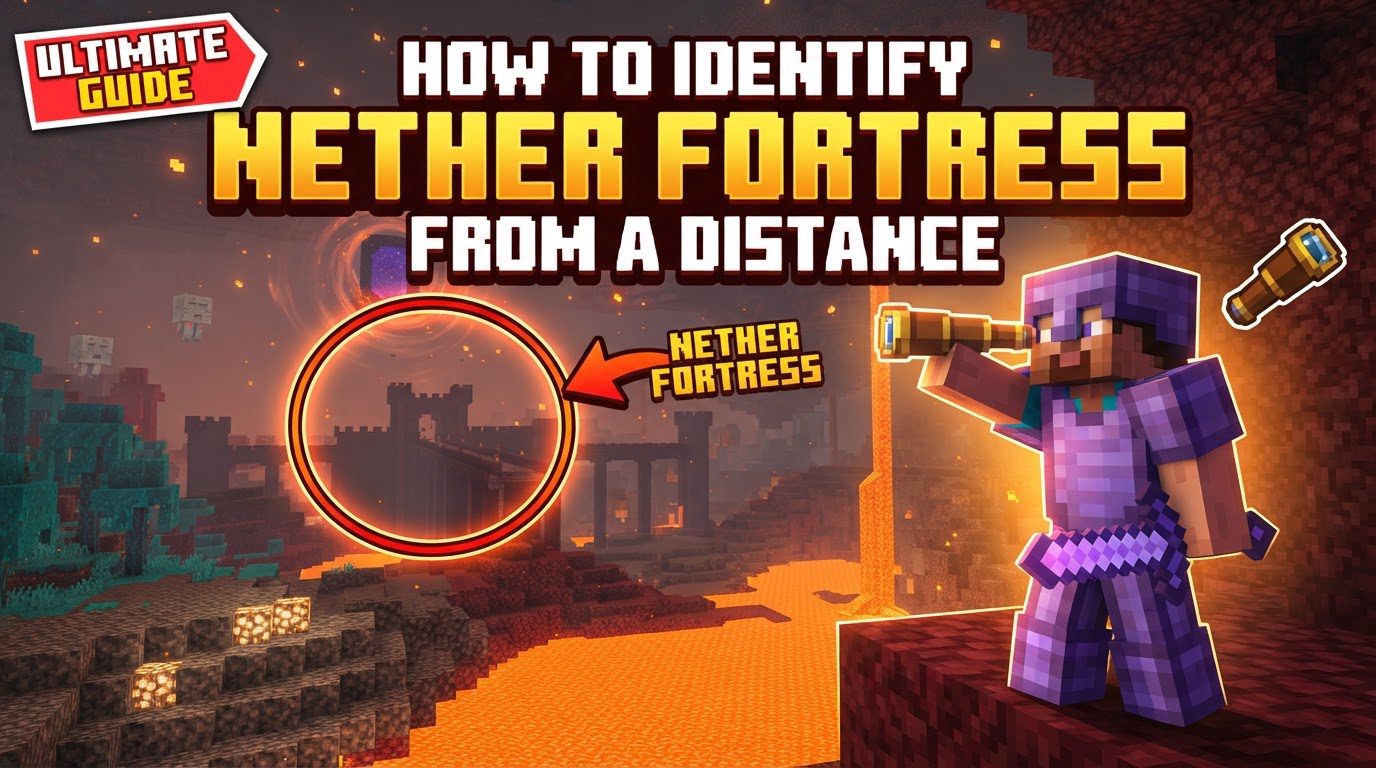
- Look for Distinct Dark Shapes: The primary visual cue for a Nether Fortress is its dark nether brick construction. These dark blocks stand out significantly against the predominantly reddish and orange hues of the Netherrack, basalt, and crimson/warped forests. Actively scan the horizon for large, angular, and architecturally distinct shapes that break the natural terrain. Keep an eye out for tell-tale elements like long bridges, elevated walkways, and substantial block structures.
- Carry Fire Resistance Potions: The Nether is a hostile environment, filled with pools of lava and fire-breathing ghasts. Carrying several Fire Resistance Potions is absolutely essential for navigating safely and surviving accidental falls into lava or attacks from fire-based mobs.
- Bring Plenty of Building Blocks: Always pack a generous supply of non-flammable building blocks (such as cobblestone or netherrack). These are invaluable for bridging across dangerous gaps, creating safe pathways over treacherous lava lakes, and building temporary shelters or observation posts.
- Use a Strider for Lava Traversal: If your search route involves crossing expansive lava lakes, consider using a Strider. By equipping a saddle and holding a Warped Fungus on a Stick, you can ride a Strider across lava. This method is far more efficient and considerably safer than painstakingly bridging across vast liquid infernos.
- Mark Your Path: The Nether’s often monotonous terrain can make it easy to get lost. Place distinct markers, such as torches, glowstone, or specific colored blocks, at regular intervals or at points of interest. This will help you retrace your steps, avoid revisiting already searched areas, and find your way back if you need to retreat.
Common Mistakes to Avoid
Being aware of common pitfalls can save you time, resources, and frustration during your fortress hunt.
- Wandering Aimlessly: One of the most inefficient ways to search for a fortress is to explore without a clear direction. Random, uncoordinated travel can lead to moving in circles, revisiting areas, and ultimately wasting valuable time and resources. Stick to your chosen axis and maintain a consistent direction.
- Running Along a “Dead Zone”: If you stumble upon a Bastion Remnant, understand that you are in a region where a Nether Fortress will not generate. Due to the regional spawning mechanics, a fortress simply cannot coexist with a bastion in the same 432×432 (Java) or 480×480 (Bedrock) block area. If you find a bastion, you must travel a significant distance – generally at least 400 blocks in a new direction – to enter a new structure-generating quadrant where a fortress might spawn.
- Not Increasing Render Distance/Brightness: As mentioned, these settings are paramount. Failing to maximize your render distance and in-game brightness severely limits your ability to spot distant structures. A fortress that would be visible from afar with optimal settings might remain completely hidden if your visibility is restricted.
- Ignoring Y-level: While fortresses can spawn at any height, traveling indiscriminately at very high or very low Y-levels can obscure them. A fortress partially buried in the ceiling might be missed if you’re flying too low, and a fortress with long support structures extending from a high elevation might be overlooked if you’re only scanning the lava level. Maintaining a middle altitude offers the best chance of spotting any part of the structure.
- Confusing Structure Types: It’s crucial not to mistake a Bastion Remnant for a Nether Fortress. While both are large, dark structures in the Nether, Bastion Remnants are distinctly different. They do not contain blaze spawners or Nether Wart, and their primary purpose and loot are different from those of fortresses. Always ensure the structure you’ve found is indeed a fortress before committing to extensive exploration.
Tags:
YOU MAY ALSO LIKE...